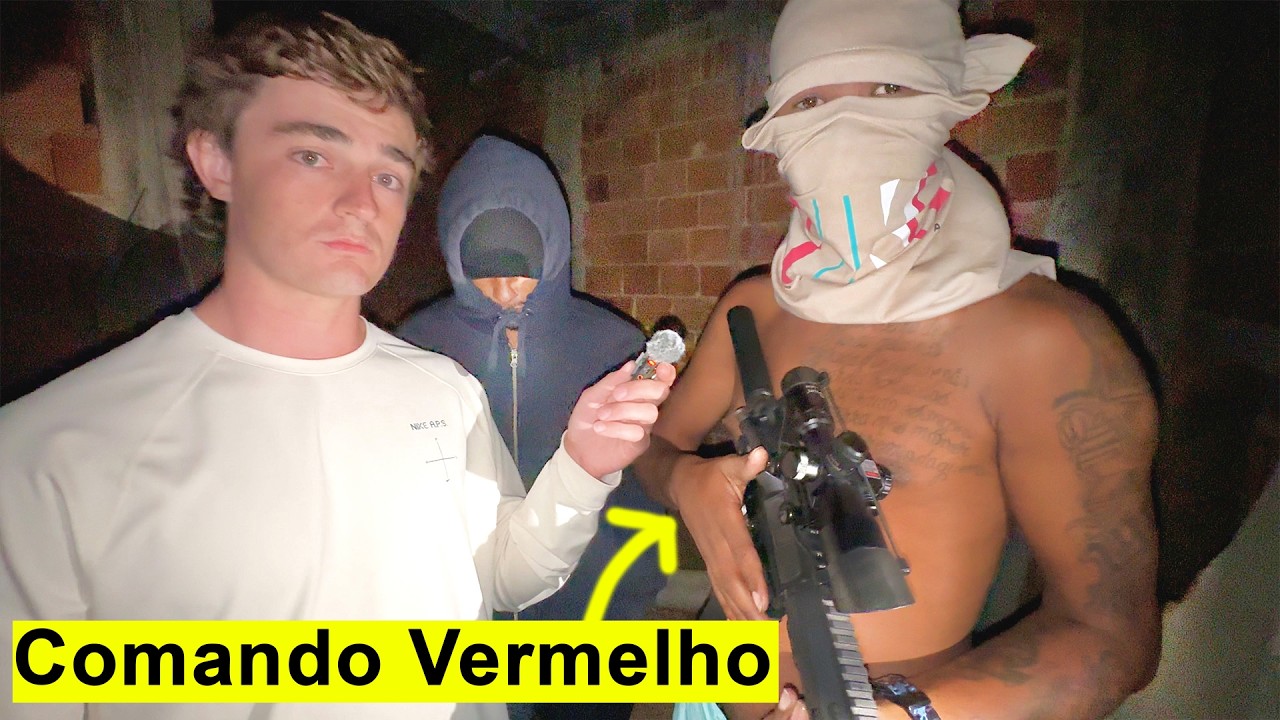
Life inside a Brazilian favela is nothing like what you see in Hollywood films — and it's far more complex than the news lets on. In Rocinha, Rio de Janeiro's largest favela with an estimated 200,000 residents, there are soccer courts between cramped alleyways, thriving local businesses, funk music studios, and communities full of people who laugh, eat, and raise families. But running underneath all of it — controlling every corner, every transaction, and every camera lens — is one of Brazil's most powerful criminal organizations: Commando Vermelho. After two days inside, including a face-to-face interview with a most-wanted gangster who has killed over 30 people, here's what life in a favela really looks like.
What Is Life Really Like Inside a Brazilian Favela?
The first thing that surprises most visitors to Rocinha is how normal so much of it feels. There are moto taxis ferrying people up the steep hillside, kids playing football on concrete courts, shops selling Doritos and chocolate bars, and neighbors chatting in narrow alleyways barely wide enough for two people to pass. The community started in the 1960s when migrants from northern Brazil — where farming work was scarce — flooded Rio looking for opportunity. They built homes on the hillsides the wealthy didn't want, and those communities grew into the sprawling favelas of today.
But the infrastructure tells a different story. Higher up the hill, roads disappear entirely. Only staircases connect the uppermost homes. Hundreds of electrical wires snake chaotically overhead. Entire families live in single rooms stacked on top of each other, with some alleyways housing over 300 to 500 people in just a few dozen meters. Life here exists largely outside the Brazilian government's reach — residents don't pay taxes to the state. They pay taxes to the gangs.
How Do Gangs Actually Control Rio's Favelas?
The level of control Commando Vermelho and other gangs exert over favelas like Rocinha is total. It's not just that they sell drugs in dark alleyways — they function as a parallel government with their own taxation system, rules of conduct, and enforcement mechanisms.
Every business inside the favela pays a cut to the gang. Tour guides pay a fee simply to bring visitors in. Want to fly a drone for filming? You'd need to pay a gang-approved operator. Want to film in certain alleyways? That's off-limits entirely — not because it's physically blocked, but because the gangs forbid it to protect their operations. Drug tables operate openly in the middle of covered walkways, staffed by armed soldiers who keep watch around the clock.
Perhaps most strikingly, Brazilian news broadcasts don't just report weather forecasts — they report which gangs control which neighborhoods on any given day, as territorial battles shift the map in real time. The gang's influence even extends to culture: funk music from the favela is deliberately used to glamorize gang life and recruit the next generation.
Is It Safe to Visit a Favela in Rio de Janeiro?
This is the question every traveler asks — and the honest answer is: it depends entirely on who you go with and what you do. Rocinha does have an active tourism economy, and tour guides operate with the gang's permission. Locals inside the favela generally don't rob each other because the gang enforces strict internal rules: no robbery, no domestic abuse, no harming children. In that narrow sense, residents describe it as feeling safer than parts of the city outside.
However, the risks for outsiders — especially those with cameras — are real and serious. Filming gang members without permission, wandering into the wrong alleyway, or drawing attention to operations can escalate quickly. Our guide was explicit: entering certain corridors with a camera would mean being taken to the top of the favela by gang members. The danger isn't random violence — it's the specific, structured threat of crossing the gang's rules. Go with a trusted guide, follow instructions without question, and understand that you are a guest operating under someone else's authority the entire time.
What Is Commando Vermelho and How Powerful Are They?
Commando Vermelho — translated as the Red Command — is one of Brazil's oldest and most powerful criminal organizations, with roots going back to the 1970s in Rio's prison system. Today they control significant portions of Rio's favelas, running drug distribution networks, extortion operations, and armed militias that rival the capacity of police forces.
Inside Rocinha, their presence is everywhere and nowhere at the same time. You don't see uniformed soldiers marching through the streets. Instead, you see young men stationed at corners, tables stocked with marijuana and cocaine positioned inside covered alleyways, and an invisible web of observers who know exactly who enters and exits at all times. The gang member interviewed during this visit — one of the most wanted men in the favela — carries military-grade weapons, has killed over 30 people by his own account, and cannot leave Rocinha because Rio's facial recognition camera network would flag him for immediate arrest. The favela is simultaneously his kingdom and his prison.
How Are Kids in Favelas Recruited Into Gang Life?
No one knocks on doors with a recruitment pitch. The process is far more insidious than that. Growing up in Rocinha means growing up surrounded by armed men who have money, status, and influence. You see guns before you see career counselors. You hear funk music glorifying the narco lifestyle before you hear much about university scholarships.
The gang's cultural reach through music is deliberate. Funk — Brazil's enormously popular homegrown genre — is used as a recruitment tool, wrapping the gang lifestyle in beats and bravado that appeal to teenagers with few visible alternatives. When a kid doesn't have strong parental support, when the streets are their main social world, and when the men with the most apparent power and resources are all gang-affiliated, the path of least resistance becomes gang membership. As one local put it simply: "The only way to get money is becoming a gangster." Ask a kid in Rocinha whether he'd rather be a rapper or a footballer, and increasingly the answer is neither — he wants to be in the game.
Do Police Actually Enter Brazilian Favelas?
Technically, yes. In practice, the relationship is far more complicated. Large-scale police operations — some of them militarized and deadly — do periodically sweep through Rio's favelas, often with tragic civilian casualties and limited long-term impact on gang operations. But on a day-to-day basis, police presence inside favelas like Rocinha is minimal to nonexistent.
The reason, according to locals, is corruption. Gang payments to officers mean that routine law enforcement simply doesn't happen in most of these communities. The government has essentially ceded control of these territories to criminal organizations, collecting no taxes from residents and providing little in return beyond occasional violent incursions that tend to harm civilians as much as gang members.
How Did Brazil's Favelas Start and Why Do They Exist?
Rocinha's story begins in 1960, but the broader favela phenomenon is rooted in Brazil's deep economic inequality and internal migration patterns. Waves of workers from Brazil's poorer northern states — where agricultural work, primarily coffee farming, was drying up — flooded south toward Rio de Janeiro seeking jobs and a better life. With no affordable housing in the formal city, they built informal settlements on the steep hillsides that wealthier residents didn't want.
There's a telling irony in how that geography plays out. In most wealthy cities, the hillside views command premium prices. In Rio, the hills became the favelas — communities built by people with nothing, now home to hundreds of thousands living entirely outside the formal economy. Over six decades, those temporary shelters became permanent neighborhoods with their own culture, music, economy, and unfortunately, their own violent power structures. Today an estimated 200,000 people call Rocinha alone their home, making it not just a favela but one of the largest urban communities in South America.
The Interview That Changed Everything
The visit ended somewhere most journalists and travelers never reach: in an abandoned, partially constructed building near the top of Rocinha, sitting across from two armed members of Commando Vermelho. The man across the table has killed over 30 people. He held his weapon casually, answered questions about remorse — or the lack of it — and spoke about a future he knows will likely end violently or behind bars. He was once a kid in this same favela with different dreams.
What stays with you isn't the guns or the danger. It's the recognition that the systems producing this — poverty, inequality, corruption, neglect — are the real story. The gangsters are a symptom. The favela itself, with its resilient community, its music, its football courts, and its two hundred thousand lives, is the thing worth understanding.