Georges St-Pierre is widely regarded as the greatest mixed martial artist of all time — and a training session with him reveals exactly why. In a hands-on session breaking down striking, takedowns, and ground control, GSP articulates the underlying logic of his fighting system with unusual clarity: every movement is about balance, deception, and economy of effort. Here is what he teaches.
Distance Control Starts with the Feet
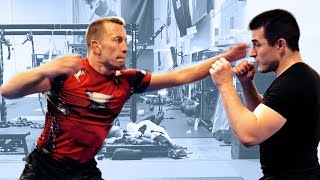
GSP's first and most foundational principle is distance management, and he traces it entirely to footwork. The core mistake most fighters make, he explains, is crossing their legs or moving without a stable base — leaving them unable to explode or defend when it matters.
His rule is simple: push off the opposite foot in the direction you want to move. Step left, push off the right. Step right, push off the left. Move backward, push off the lead foot. Move forward, push off the back foot. This keeps the fighter in constant balance and ready to generate force in any direction.
Equally important is not reaching for contact before closing distance with the feet. Extending the arms to bridge a gap telegraphs intention and gives the opponent an easy handle. Instead, GSP instructs moving the feet first to establish proper range, then making contact.
 02:10
GSP demonstrating footwork patterns and the push-off principle with a training partner
Watch at 02:10 →
02:10
GSP demonstrating footwork patterns and the push-off principle with a training partner
Watch at 02:10 →
The Jab as a Decoy for Takedowns
GSP identifies two broad styles in MMA: proactive fighters who create their own openings, and reactive chain wrestlers like Khabib Nurmagomedov who use defensive pressure to set up their offense. GSP places himself firmly in the first category — dynamic, explosive, and deception-driven.
His preferred setup for both single and double-leg takedowns is the jab. The logic is psychological as much as mechanical. Because the jab originates outside the opponent's primary field of vision and draws the eye, it plants a short-term memory in the opponent's mind. Once tagged once or twice, the fighter instinctively reacts to the hand — and that split-second of redirected attention is the window GSP exploits.
He describes it like a cobra: the hand moves visibly, capturing attention, while the body launches low and fast into the legs. The opponent has a false sense of security because they believe they are outside striking range — but GSP's legs, longer than his arms, have already closed the gap.
05:30
GSP demonstrating the jab-to-takedown sequence, showing how the hand distracts while the legs shoot
Watch at 05:30 →
The Elbow-Deep Double Leg and Turning the Corner
Once the shot is committed, GSP emphasizes going elbow-deep rather than relying solely on the legs. The reason is leverage: if the opponent is bigger or stronger and attempts to sprawl, a shallow grip on the legs can be broken. But with the elbow driven deep past the hips, the opponent's ability to sprawl is mechanically compromised.
The finish involves looking and stepping across the opponent's body to drive them to the mat. Against a very strong opponent who successfully defends the straight drive, GSP teaches turning the corner — instead of forcing the direction, the wrestler pivots around the opponent's resistance, exploiting the space that opens on the other side.
08:45
Live drilling of the elbow-deep double leg, including the turn-the-corner variation against a sprawling defense
Watch at 08:45 →
Guard Position: Protection, Control, and Distance
On the ground in the guard, GSP's framework shifts to protecting the head while creating and denying space. From the bottom, he keeps his head off the ground, abdomen contracted, and maintains a gap to see the opponent. Arms kept close to the body — not flat on the mat — make it harder for the top fighter to control the wrists and create punching lanes.
His preferred tool from guard is the clamp: controlling the opponent's head and arm simultaneously. This restricts elevation and forces a binary situation — the opponent is either too close to generate power, or too far to land at all. He also uses his legs and feet actively, capable of pushing the opponent away or kicking upward to the head, ensuring the top fighter must always account for both possibilities.
Dominant Positions and Three Rules for Passing Guard
GSP ranks top positions clearly. Back control with the opponent face-down is the highest value position — the fighter on the bottom cannot strike effectively, while chokes and strikes are both available. Mount is second. Guard is the least desirable top position, though GSP notes it is less dangerous in MMA than in pure jiu-jitsu because gravity assists control.
When working from inside an opponent's guard, he follows three non-negotiable rules:
- Never put hands on the floor. Posting opens the arms to submissions and allows the bottom fighter to close the distance and attack the neck.
- Never let the opponent's head rise higher than yours. A high head creates guillotine opportunities that are extremely difficult to defend.
- Never allow the opponent to take an angle. Sweeps, armbars, and leg attacks all require the bottom fighter to create an angle. Constantly resetting hips and position eliminates the reference point those attacks need.
The goal from guard is never to settle — it is always to pass to a more dominant position. Respecting these three rules makes damage possible even from an inferior position while the work of improving position continues.
Skill Above All Else
Beyond the technical detail, GSP closes with a straightforward assessment that frames everything else: skill is the dominant variable in a fight. Strength, toughness, and heart matter — but they are secondary. Two years of training experience is a significant advantage. The techniques he teaches are not shortcuts; they are a system built over a career of mastery, offered here in compressed form to anyone willing to do the work to internalize them.