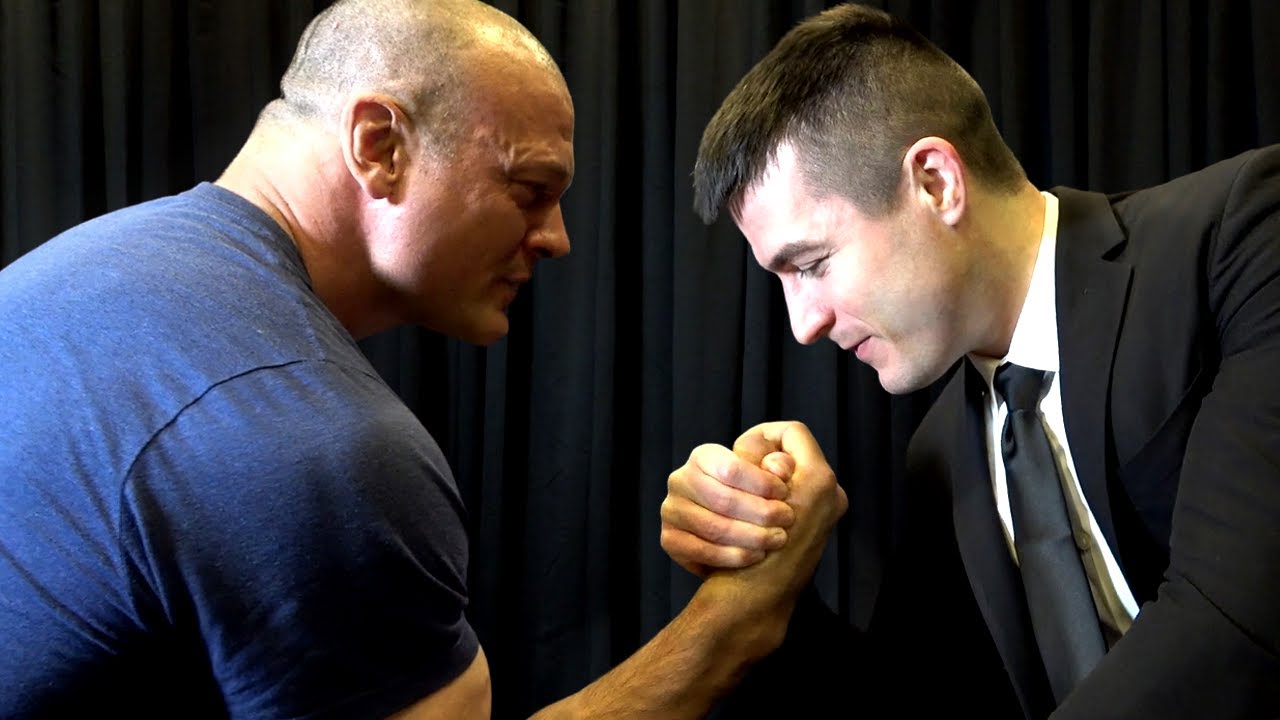
Arm wrestling looks simple — two people, one table, one winner. But according to professional arm wrestler Devin Larratt, the match is decided long before the first strain of muscle. Positioning, angle, and technique separate world-class competitors from everyone else, and understanding even the basics reveals a surprisingly deep sport.
It Starts Before You Even Lock Up
The first principle Larratt teaches is positional: always make your opponent come to you. By forcing the other person to reach toward you rather than the reverse, you immediately shift the muscle balance in your favor — more of your muscles working against fewer of theirs.
Hand placement matters just as much. The higher the ridge of the hand sits in the grip, the more pressure transfers into the opponent's fingertips rather than your own. Targeting the fingers is a recurring theme across every technique in the sport — it's the fundamental weakness being exploited.
The Post: A Simple Opening That Unlocks Everything
The first move Larratt introduces is called the post. On its own, it isn't a finishing move — it's modest in raw power. But it functions as an essential setup that opens up nearly every other technique.
The post is an upward drive of the knuckles combined with a climbing motion of the hand. The goal is constant positional improvement: getting deeper into the grip, climbing up and over the opponent's hand, and advancing that position continuously. As Larratt puts it, always be climbing — always generating better angles, never static.
 02:10
Demonstration of the post move — upward knuckle drive and hand climbing motion
Watch at 02:10 →
02:10
Demonstration of the post move — upward knuckle drive and hand climbing motion
Watch at 02:10 →
Outside Moves: The Top Roll
Arm wrestling techniques divide broadly into outside and inside categories. Outside moves are characterized by pulling motions that attack the opponent's fingers.
The top roll is the premier outside move and, by Larratt's account, the most widely used technique among world champions. The sequence works like this: pressure is applied upward into the opponent's fingers while the wrist begins to bend. As the opponent attempts to counter by bending their own wrist, the arm wrestler blocks that counter through pronation — a rotational turning of the forearm — and carries through the fingers all the way to the pin.
What makes the top roll particularly effective is the asymmetry it creates. The opponent feels their leverage and weight advantage slipping away as the angle shifts. A skilled top roller can control opponents far stronger than themselves simply by maintaining that finger pressure and superior positioning.
04:30
Top roll technique demonstrated — wrist bend, pronation, and carry through the fingers
Watch at 04:30 →
Inside Moves: The Hook
The hook operates differently. Where the top roll attacks through the fingers and pronation, the hook is driven by the wrist flexors and targets the opponent's pronation directly. Rather than an asymmetric pulling motion, the hook is more of a press — shoulders driving forward, loading the inside of the wrist.
The practical difference in feel is significant. The hook tends to keep both competitors more squarely engaged in the match; it's less likely to immediately strip away your position. However, Larratt notes that elite arm wrestlers don't simply allow an opponent to settle into a comfortable hook and press. At the world-class level, a pure pressing match is rare — competitors are constantly disrupting and countering.
The King's Move: Controversial and Here to Stay
Perhaps the most debated technique in modern arm wrestling is the king's move. It is, at its core, a defensive maneuver — but one that has reshaped high-level competition.
The goal of the king's move is to attack the opponent's arm angle through dragging while simultaneously targeting their fingers through pronation. Critically, the athlete using it will deliberately concede other positional advantages to maintain these two anchors. The execution involves a sharp turn and often a dipping motion, pulling the opponent toward you while protecting your own structural position.
The king's move is typically deployed against very strong opponents — situations where conventional technique would be overpowered. Its rise has caused controversy because it represents a significant strategic departure from traditional arm wrestling, but Larratt is clear: it works, and it isn't going away.
07:45
King's move demonstration — turn, dip, and drag against a strong opponent
Watch at 07:45 →
Where the Injuries Happen
The most serious injury in arm wrestling isn't a bicep tear — it's a humeral break. The humerus, the long bone of the upper arm, can fracture under the torque generated during a match, particularly when forces are applied at extreme angles.
Bicep tears do occur, but the spiral fracture of the humerus is the injury that arm wrestlers fear most. When it happens, there's no mistaking it. The forces involved are a direct consequence of how specialized and powerful these athletes become — Larratt himself notes he is a highly specialized athlete, and the strength on display even in a casual demonstration is striking.
Understanding arm wrestling as a technical discipline rather than a pure test of strength reframes what you're watching. Every grip, every angle, every climbing motion is a calculated move in a contest that rewards knowledge as much as power.