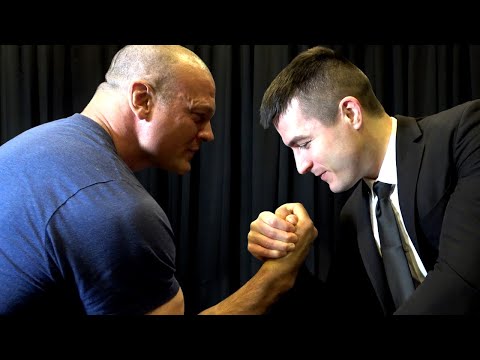
In professional arm wrestling, the open weight division is the ultimate proving ground — no weight classes, no handicaps, just whoever is strongest at the table. For Devon Larratt, a decorated champion in the lighter weight categories, one man stands between him and that title: Leavonne Sagilly, a 420-pound Georgian who hasn't lost since 2017 and represents what Larratt calls "the pinnacle of the sport."
Who Is Leavonne Sagilly?
Leavonne Sagilly is, by any measure, an anomaly. He competes at around 420 pounds, grew up grinding through the world championship circuit rather than arriving as a crossover athlete, and has systematically dismantled every opponent he has faced for nearly a decade. He trains with brutal simplicity: heavy pull-ups and extremely heavy curls — reportedly wrist-curling loads Larratt says he will never match.
 01:15
Photos of Leavonne Sagilly showing his massive physique, including a comparison with a younger photo
Watch at 01:15 →
01:15
Photos of Leavonne Sagilly showing his massive physique, including a comparison with a younger photo
Watch at 01:15 →
"He's a sledgehammer," Larratt says. "He's doing a 180-kilo curl. I'm never going to get there. I need to catch him through something smaller — like a pit bull, somehow nip onto his fingertip and not let go."
Precision vs. Raw Power: Two Different Philosophies
The contrast in training philosophies couldn't be starker. Leavonne's approach is built on raw strength — massive base movements, extraordinary loads, and the kind of muscle mass that simply overpowers opponents. Larratt's approach, developed over 32 years of competitive arm wrestling, is surgical by comparison.
Larratt focuses on fine angles through the wrist, heavy pronation, hand control, and extensive table time — what he calls "skill-based training." He's candid that this is partly by necessity. Multiple elbow surgeries have limited his ability to train the way he once did, particularly in the "hook" style that dominated his early career, where wrist flexion and forward shoulder drive are primary weapons.
"Arrogantly, I'm going to say my training is more precise than his," Larratt admits. "I'm working on very fine angles. Typically the reason you win or lose a match is very small things in the hand and the wrist. That's the failure point. So I put everything into the most valuable pieces."
When asked whether he should simply adopt Leavonne's training methods, Larratt is direct: he's been down too many roads over three decades to chase someone else's formula. What wins most matches, he argues, isn't a bigger row or stronger legs — it's hand and wrist control at the critical moment.
The Matches: Torn Biceps, Fouls, and Near-Misses
Larratt and Sagilly have met multiple times, and each encounter has left its mark — literally. In their first match, Sagilly tore Larratt's bicep. Larratt now has a tattoo commemorating it: a cat with "415" and the words "Leavonne was here."
09:45
Larratt showing his bicep tattoo commemorating his injury from the first Sagilly match
Watch at 09:45 →
Their most recent meeting, in 2024, came closest to a different result. Larratt stopped Sagilly in the opening round — meaning neither competitor could move the other — and in the strap phase, Larratt managed to get into Sagilly's wrist in a way that stunned even himself.
11:20
Video footage of the 2024 Larratt vs. Sagilly match, showing the strap phase and the near-winning position
Watch at 11:20 →
"I was in shock," he says. "I think I had the opportunity to seize the initiative, but I couldn't believe I had him in that position." The moment passed. Larratt received a foul for his shoulder dropping below the table — a violation called a "decline humerus" — and, already on his second foul of the match, the round was forfeited. Sagilly then ran through the remaining rounds. The match is best of seven; Sagilly won comfortably from that point.
The physical toll was severe. Larratt says he couldn't walk properly for four months after the 2024 match.
The Weight Gap and the Weight Cutting Strategy
Currently competing at around 265 pounds, Larratt gives up roughly 155 pounds to Sagilly on the scale. His strategy heading into their next meeting is to arrive as heavy as possible — ideally 310 to 320 pounds. Notably, his method for getting there is not additional weightlifting. It's eating.
"Stay in my basement and eat," he says. His training focus remains the same regardless of bodyweight: precise arm wrestling technique, protecting his damaged elbow, and refining the hand and wrist mechanics that he believes are the true determinants of a match's outcome.
Larratt is clear-eyed about the purpose Sagilly serves in his career. Without this one unbeatable opponent, he says, he'd be content as a weight-class champion. "If it wasn't for him, I wouldn't do all this. When you're not the champ, you're not happy, and you're going to do everything you can."
The Legend Before Sagilly: John Brzenk and the Roots of Arm Wrestling Technique
To understand where arm wrestling is today, Larratt points to John Brzenk — widely considered the greatest of all time. Brzenk won the real-life tournament that inspired the Sylvester Stallone film Over the Top and went essentially undefeated for roughly 25 years, competing at around 210 pounds against the entire world.
16:30
Archival footage of John Brzenk arm wrestling, including a match against a Russian or Georgian champion
Watch at 16:30 →
What made Brzenk revolutionary wasn't his size — he competed well under 230 pounds for most of his career. It was his training philosophy. At a time when most athletes assumed arm wrestling was just a byproduct of general strength, Brzenk treated it as a standalone discipline. He didn't lift weights. He arm wrestled, went to tournaments, and refined his technique until it was, in Larratt's words, "way above everybody's."
Brzenk, now in his early sixties, is still embedded in the sport and expected to appear at upcoming tournaments. Whether he returns to competition seems, to Larratt, almost inevitable.
The arc from Brzenk's technique-first philosophy to Sagilly's overwhelming physical dominance captures the tension at the heart of elite arm wrestling: does precision or power ultimately win? For Larratt, the answer is still being written — one strap match at a time.