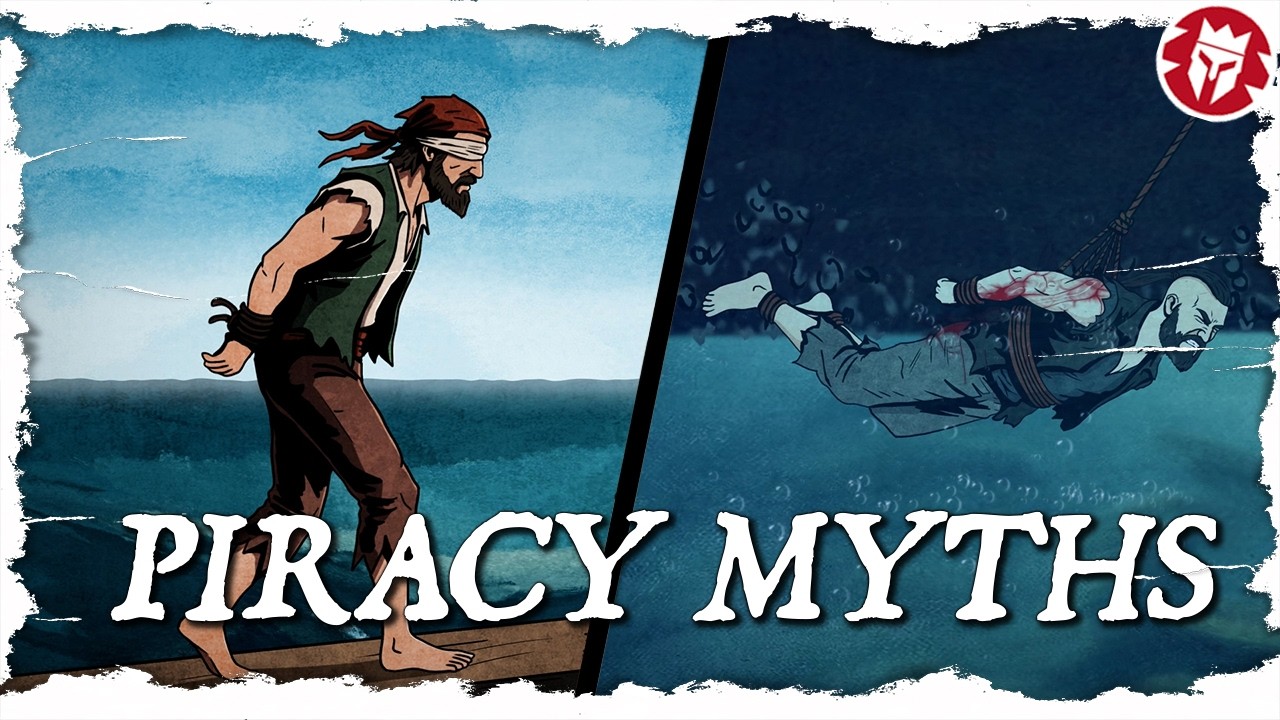

Almost everything you think you know about pirates is wrong. The most common myths about pirates — buried treasure, walking the plank, peg legs, talking parrots, and that iconic 'Arr' — were largely invented by novelists, playwrights, and Hollywood filmmakers. The real pirates of the Golden Age of Piracy were sailors, criminals, and opportunists living brutal, short lives driven by desperation and profit, not adventure. Here's what the legends get wrong, and what the historical record actually shows.
What Are the Biggest Myths About Pirates?
The pirate myths we carry today come from a surprisingly small number of sources. Robert Louis Stevenson's Treasure Island, J.M. Barrie's Peter Pan, and a handful of Hollywood productions are responsible for the vast majority of pirate stereotypes. Real pirates of the early eighteenth century — men like Blackbeard, Bartholomew Roberts, and Henry Every — lived in a world of disease, violence, uncertainty, and very little romance. The gap between legend and reality is enormous, and closing that gap reveals a history that is, if anything, more gripping than the fiction.
 01:45
How Treasure Island and fictional pirates shaped our understanding of real pirate history
Watch at 01:45 →
01:45
How Treasure Island and fictional pirates shaped our understanding of real pirate history
Watch at 01:45 →
Did Pirates Really Bury Treasure on Islands?
The buried treasure myth is by far the most famous pirate trope — the captain, the remote tropical island, the dotted-line map with a giant red X. It is also almost entirely false. Real pirates had little reason to bury their loot. They did not expect to live long lives, so they spent their wealth quickly, typically on alcohol, women, and supplies for the next voyage. Hoarding gold in a sandy hole on a deserted island simply made no practical sense.
If a pirate struck it genuinely rich — like Henry Every, who captured the Grand Mughal Fleet in 1695 — the logical move was to disappear and live quietly off that fortune, not keep risking his life guarding a buried cache. The myth was popularised by Edgar Allan Poe's The Gold-Bug, which drew on real rumours about Captain William Kidd's supposed hidden wealth, but it was Stevenson's Treasure Island that truly embedded the idea into global culture. That one novel is almost solely responsible for the treasure-map fantasy we all grew up with.
What Did Pirates Actually Steal on the High Seas?
Closely tied to the treasure myth is the idea that pirates hunted chests overflowing with gold doubloons, diamonds, and rubies. While some pirates and privateers did target treasure fleets — Sir Francis Drake famously raided Spanish fleets carrying gold and silver from South America, and Henry Every seized an enormously valuable Mughal convoy — this was the exception, not the rule.
05:10
What pirates actually plundered: tobacco, sugar, rum, silk, and tools rather than gold chests
Watch at 05:10 →
For most pirates, day-to-day plunder was far more mundane. The typical haul from a captured merchant vessel included tobacco, sugar, rum, silk, cotton, tools, and sometimes enslaved people. A pirate ship functioned less like a floating vault and more like a floating warehouse. Pirates would seize merchant cargo and then sail to friendlier ports to sell the goods — a grimly practical enterprise that bears little resemblance to the treasure-hunt fantasy.
Did Pirates Really Make People Walk the Plank?
Walking the plank is one of the most theatrical images in pirate lore — and one of the least historically supported. The slow, ritualised punishment captured perfectly by Treasure Island and Peter Pan was extremely rare in practice. Real pirates, when they chose to kill, did so quickly: hanging, hacking down, or simply throwing victims overboard.
Keelhauling — dragging a bound sailor under the ship's barnacle-encrusted hull — is another punishment far more common in movies than in history. It was primarily associated with the Dutch navy, and even there it was an unusual event. The punishment that was genuinely common among Golden Age pirates was marooning: abandoning a condemned sailor on a tiny, uninhabited island, often little more than a sandbar. Despite the romanticised image later cultivated by novels like Robinson Crusoe, marooning was a slow death sentence by thirst and starvation. Blackbeard used it with particular cynicism — after a successful raid on Charleston, he marooned seventeen of his own crewmen simply to keep their share of the loot for himself.
08:30
Blackbeard marooning his own crew after the Charleston raid to keep the loot for himself
Watch at 08:30 →
Did Pirates Actually Have Parrots and Peg Legs?
Close your eyes and picture a pirate. There's probably an eye patch, a peg leg or a hook, and a parrot on the shoulder. That composite image blends two fictional characters — Long John Silver from Treasure Island and Captain Hook from Peter Pan — and has almost nothing to do with historical reality.
Prosthetic limbs were not impossible in the early eighteenth century. Pirates and sailors did face cannon fire, musket wounds, falls, and accidents that could cost a limb. But a peg leg on a slippery ship deck was a serious liability. Those who survived amputation and kept sailing would more likely have been assigned to the galley. More often, losing a limb meant early retirement. Pirate articles — the contracts crews signed before voyages — frequently included injury compensation. Sailors under Bartholomew Roberts, for example, received 800 pieces of eight from the common fund for a lost limb.
Eye patches are slightly more plausible. Eye injuries did happen, and covering a lost eye with cloth was practical. One popular theory holds that pirates wore patches over a healthy eye to keep it adapted to darkness below deck — a physiologically sound idea, but one without solid historical evidence behind it. As for the parrot: pirates did capture exotic birds and animals to sell in European markets, where they fetched good prices. An eccentric captain keeping a caged parrot is not impossible. But the iconic shoulder-perched, 'pieces of eight'-squawking sidekick? That is pure Stevenson.
12:15
Actor Robert Newton as Long John Silver — the man who accidentally invented the pirate accent
Watch at 12:15 →
Why Do Pirates Say Arr? The Surprising Truth
The pirate accent — 'Arr me mateys,' 'Shiver me timbers,' 'Yo-ho-ho' — is one of the most recognisable sound signatures in popular culture. It is also a modern invention. Historical pirates spoke like any other person of their era. The theatrical phrases were literary creations, and 'Yo-ho-ho' comes directly from Treasure Island.
The famous 'Arr' has a surprisingly specific origin: actor Robert Newton, who played Long John Silver in Disney's 1950 adaptation of Stevenson's novel. Newton's heavy south-western English accent produced a distinctive rolling 'Arr' that audiences loved, and it was imitated across film and television until it became the default sound of pirates everywhere. In reality, pirate crews were ethnically and linguistically diverse. Operating in a broadly English-dominated maritime world, they nonetheless incorporated Dutch and French nautical terms and African loanwords. Their jargon was the specialised language of professional sailors — technical, efficient, and largely incomprehensible to landlubbers, but nothing like 'Cannons be ready, Captain.'
Were Pirates Really Noble Robin Hood Rebels?
Popular culture — from classic novels to anime like One Piece — often frames pirates as noble rebels fighting imperial oppression. There is a kernel of truth here. The Golden Age of Piracy was partly fuelled by thousands of sailors and privateers left unemployed after major conflicts like the War of the Spanish Succession ended. Some pirate ships did elect their officers and divide plunder more equally than naval or merchant vessels offered.
16:40
The real variety of pirate flags during the Golden Age — far beyond the standard Jolly Roger
Watch at 16:40 →
But equal shares do not make a Robin Hood. Pirate attacks were opportunistic and predatory, targeting the weakest available ships using the threat of extreme violence. The strategy was deliberately calculated: build a fearsome enough reputation that merchant ships surrender without a fight. That reputation was earned through real atrocities — killing and torturing victims to signal credibility. Blackbeard famously wove slow-burning fuses into his beard, wreathing himself in smoke to look demonic. The goal was terror, not liberation.
What Was the Jolly Roger Flag Actually Used For?
The skull-and-crossbones Jolly Roger is the universal symbol of piracy, and unlike many other myths, it was real — but far more varied and tactical than most people realise. The skull-and-bones motif appeared on many pirate flags, but it was never a universal standard. Pirate flags featured cutlasses, hourglasses, skeletons, hearts, and the devil. Even the black background was not universal; earlier buccaneers flew national flags or red flags.
More importantly, a pirate ship never flew its own colours while approaching a target. It would fly friendly or neutral colours to get within range, then raise the Jolly Roger — usually accompanied by a warning shot — as a psychological weapon demanding immediate surrender. The black flag was a tool of intimidation, not identity. It was psychological warfare, designed to collapse resistance before a single broadside was fired. Even the most iconic symbol of Golden Age piracy turns out, on inspection, to be more complicated and more interesting than the legend suggests.
The Real Pirates Were More Fascinating Than the Myths
Strip away the buried treasure, the peg legs, the parrots, and the theatrical 'Arr,' and what remains is a genuinely compelling history. The pirates of the Golden Age were real people navigating a brutal world — driven by economic desperation, professional solidarity, and the calculated use of fear. Their true story, with its democratic ship contracts, its mundane cargoes of tobacco and rum, its ruthless psychological warfare, and its grimly practical violence, is more surprising and more human than anything Hollywood invented. The legends endure because they are entertaining. But the history endures because it is true.