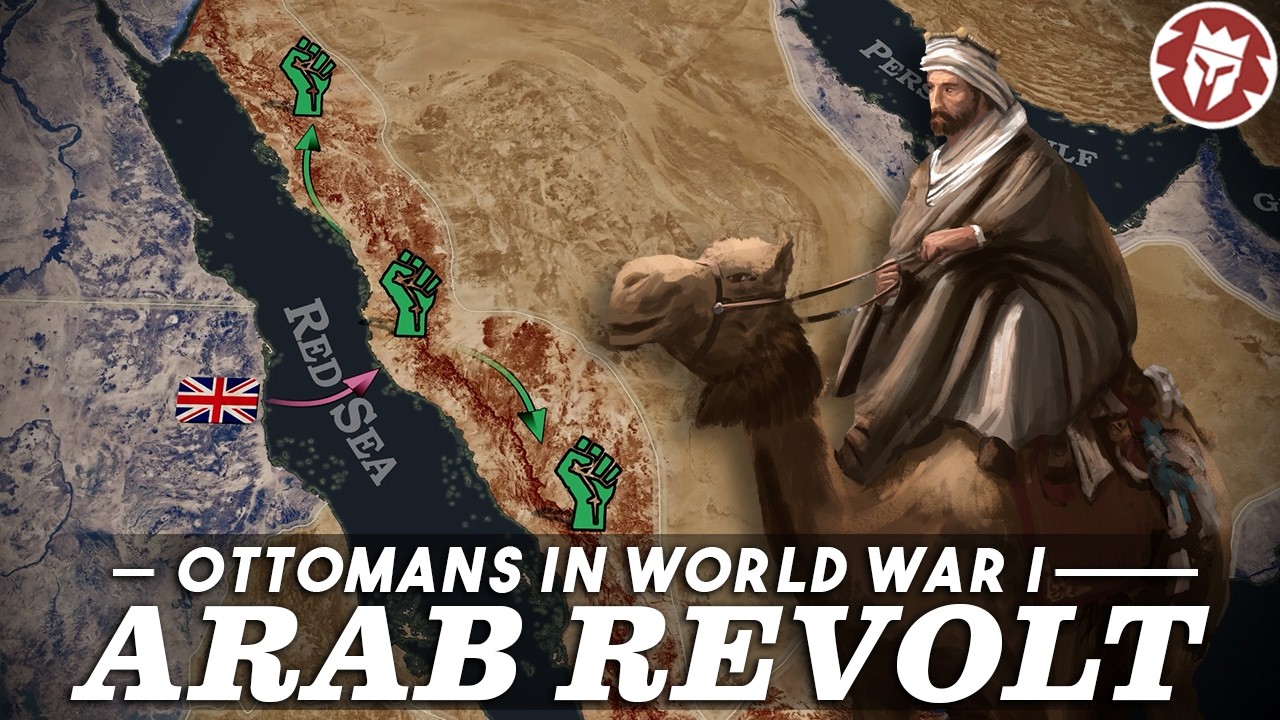

The Arab Revolt of 1916 was one of the most dramatic and consequential events of the First World War in the Middle East. Launched by Sharif Hussein bin Ali of Mecca on June 10, 1916, the revolt was the result of careful British diplomacy, Ottoman overreach, and Hussein's own ambition to forge an independent Arab kingdom. Within months, it would draw in a young British intelligence officer named T.E. Lawrence and fundamentally challenge Ottoman authority across the Hejaz — all while Britain was simultaneously fighting for control of the Sinai and Russia was battering the Ottomans across the Caucasus.
What Was the Arab Revolt of 1916 and Why Did It Start?
Following the Ottoman entry into the war, both the Entente and the Central Powers competed for the allegiance of Sharif Hussein bin Ali, the guardian of Mecca and one of the most symbolically powerful figures in the Muslim world. The Ottomans pressed him to endorse a holy war, or jihad, against the Allies. The British, meanwhile, wanted something far more destabilizing to the Ottoman Empire: an outright Arab uprising.
 02:15
Map showing the Caucasus front and Russian advances from Erzurum to Trabzon in early 1916
Watch at 02:15 →
02:15
Map showing the Caucasus front and Russian advances from Erzurum to Trabzon in early 1916
Watch at 02:15 →
Hussein had his own agenda. Wary of Ottoman centralization in the Hejaz and fearing the consequences of remaining loyal to a weakening empire, he dispatched his son Abdullah to Cairo to negotiate with the British. The result was the famous Hussein-McMahon Correspondence — ten letters exchanged between July 1915 and March 1916 — in which Britain pledged recognition of Arab self-determination in exchange for Hussein's promise of 100,000 fighters. In reality, the Sharifian Army numbered around 50,000 men, but possessed only about 10,000 rifles.
On June 10, 1916, Sharif Hussein fired the symbolic first shot of the Arab Revolt from his palace window in Mecca. Within days, around 5,000 Arab fighters pressed Ottoman fortresses overlooking the city and the Jirwal barracks. It was the beginning of a revolt that, despite its shaky start, would permanently alter the map of the Middle East.
- Ottoman garrison in Mecca: approximately 1,400 troops
- Arab forces besieging Mecca: roughly 5,000 fighters
- One hilltop fortress held out for over four weeks, shelling the Great Mosque itself
- British artillery sent from Sudan finally breached the fort walls
- By July 4, 1916, the last Ottoman resistance in Mecca — the Jirwal barracks — surrendered
Simultaneously, 4,000 Bedouin horsemen of the Harb tribe attacked Jeddah, and Abdullah Hussein led 7,000 fighters against Taif. With Royal Navy warships and aircraft supporting the coastal assault at Jeddah, the Ottomans surrendered by June 16. Taif, however, held out until September 21 — eventually falling after British-supplied Egyptian artillery tipped the balance. By the end of September, Hussein's forces had captured Mecca, Taif, Jeddah, Rabigh, al-Qunfudhah, and Yanbu, taking roughly 6,000 Ottoman prisoners.
What Role Did T.E. Lawrence Play in the Arab Revolt?
Despite these early gains, the revolt was in danger of stalling. Roughly 15,000 Ottoman troops remained in the Hejaz under the formidable Lt-General Fakhri Pasha in Medina, and Bedouin volunteers — satisfied with their loot — were drifting home. Fakhri prepared a counteroffensive.
08:40
The opening shots of the Arab Revolt — Sharif Hussein fires from his palace window in Mecca, June 10, 1916
Watch at 08:40 →
On October 16, 1916, Captain T.E. Lawrence arrived in Hejaz. After meeting Hussein's sons at Rabigh, he identified Faisal as the most capable military leader and joined his staff in November. Lawrence's strategic vision was bold: rather than simply trying to drive the Ottomans out of Medina in a conventional siege, he urged attacks on the Hejaz Railway — cutting Ottoman supply lines and keeping them perpetually off-balance.
Lawrence also pressed Britain to send gold, weapons, ammunition, and technical specialists, empowering the Arabs to fight a guerrilla war on their own terms. When Fakhri sent three brigades from Medina toward Yanbu on December 1, Lawrence secured Royal Navy support. Warships bombarded Ottoman positions and aircraft harassed their flanks. By December 11, the Ottomans reached Yanbu's outskirts but were exhausted, ill, and malnourished. Fakhri redirected his attack toward Rabigh, but ongoing guerrilla pressure and aerial harassment forced a retreat to Medina by January 18, 1917. The revolt had survived its first great crisis.
What Happened at the Battle of Romani in 1916?
While the Arab Revolt flickered to life in the Hejaz, Britain faced a direct military threat to its most vital strategic asset: the Suez Canal. In early 1916, Ottoman forces under Colonel Kress von Kressenstein raided British positions at Katia, Dueidar, and Oghratina, setting the stage for a major push toward Romani — where heavy artillery could bombard canal shipping.
By July 1916, the German-Austrian-Ottoman force in Sinai totalled about 16,000 men with 56 machine guns and heavy artillery. General Sir Archibald Murray's Egyptian Expeditionary Force at Romani numbered 14,000 troops, predominantly the Anzac Mounted Division and the 52nd Lowland Division, backed by monitors offshore, an armored train, and air support.
14:55
Battle of Romani — Anzac light horse counterattack drives back the Ottoman columns on August 5, 1916
Watch at 14:55 →
At 1:00 AM on August 4, three invading columns — roughly 8,000 strong — struck the Romani outpost line. The fighting was brutal and close. By 2:30 AM attackers had bayoneted Mount Meredith. By mid-morning, three Ottoman columns were halted by concentrated Royal Horse Artillery fire and withering machine-gun fire from the light horse brigades. Reinforcements, including New Zealand Mounted Rifles and elements of the 42nd Division, arrived and launched a counterattack at 14:00.
By August 5, a general Anzac Mounted Division advance shattered the invading front line. Wellington Ridge was cleared, and over 1,619 prisoners were taken by 6:30 AM. The rearguard at Katia fell in the afternoon. When the dust settled, the two-day Battle of Romani had inflicted approximately 9,000 casualties on the invading force, including 4,000 prisoners, at a cost of about 1,202 British casualties. The Ottoman campaign against the Suez Canal was finished.
How Did the Ottomans Try to Capture the Suez Canal?
The Ottoman strategy in Sinai was methodical. Von Kressenstein planned a multi-axis assault: heavy artillery would shell Romani while light infantry engaged the defensive redoubts, and the main force would envelop Romani from the right and rear, cutting off the British garrison. The plan was well-conceived, but it underestimated how quickly the British could concentrate forces — within 24 hours of the initial attack, Murray had assembled 50,000 men in the Romani area, overwhelming the overstretched Ottoman force.
What Happened at the Battle of Magdhaba?
Following Romani, the British built a railway and water pipeline across the Sinai at an impressive pace of roughly 15 miles per month. By December 21, the Anzac Mounted Division entered El Arish, which the Ottomans had already abandoned. The next objective was Magdhaba, garrisoned by around 1,400 Ottoman troops manning six redoubts.
On December 22, 7,000 men — three brigades of the Anzac Mounted Division, the Imperial Camel Brigade, and the Royal Flying Corps' 5th Wing — assaulted Magdhaba. Aircraft opened the battle at 06:30, revealing enemy positions. By 16:00, the 1st Light Horse Brigade had captured the key Redoubt No. 2, and Ottoman resistance crumbled. The British suffered 146 casualties; 1,282 Ottoman troops were captured. The road into Palestine was opening.
How Did the Caucasus Campaign Unfold in 1916?
While Britain fought for the Sinai and nurtured the Arab Revolt, Russia was prosecuting its most successful campaign of the entire war. General Nikolai Yudenich's Caucasus Army had captured Erzurum in February 1916, cracking the Ottoman 3rd Army wide open. Through a combination of amphibious assaults along the Black Sea coast and relentless land pressure, Russian forces captured Trabzon on April 18 without a fight.
The Ottomans responded by reinforcing the region with two additional corps and deploying the 2nd Army — but the Baghdad Railway's limited capacity delayed its arrival by 2.5 months. When the Ottoman 3rd Army launched its offensive in June toward Of, initial successes were reversed after ten days of heavy casualties. Russian counterstrokes from July 2 onward captured Mamakhatun, Bayburt, and ultimately Erzincan by July 23–25. Ottoman losses reached 17,000 casualties with a comparable number taken prisoner; Russian losses were around 12,000.
Who Was Mustafa Kemal and What Did He Do in WWI?
Following the cascade of Ottoman defeats in the Caucasus, Lt-General Mustafa Kemal — the hero of Gallipoli — was appointed commander of the 16th Corps of the Ottoman 2nd Army on March 15, 1916. Composed of battle-hardened Gallipoli veterans, this corps became a key instrument in the Ottoman counteroffensive on the Muş–Bitlis front in August 1916.
The Ottomans temporarily recaptured Bitlis on August 5 and Muş on August 6, threatening the route back to Erzurum. However, Yudenich launched a rapid counteroffensive. The 7th Turkish Division of Kemal's 16th Corps was dispersed at Muş, with approximately 2,200 troops captured. By August 10, the Russians had retaken Muş, and by August 14 they held the Euphrates line. Kemal's corps — and the wider Ottoman 2nd Army — had failed to reverse the tide. The late-1916 offensives cost the Russians around 20,000 casualties and the Ottomans up to 60,000.
What Did the 1916 Middle East Campaigns Mean for the War?
By the close of 1916, the strategic picture in the Middle East had shifted significantly. Russia continued to dominate the Caucasus front, threatening deep into Anatolia — a threat that only an internal Russian crisis could ultimately neutralize. Britain, scarred by Gallipoli and Kut, had found renewed momentum through the defense of Romani and the ignition of the Arab Revolt. The construction of the Sinai railway and pipeline promised to sustain a push into Palestine, while Lawrence and Faisal were beginning to forge the guerrilla campaign that would haunt the Ottomans for years to come. The stage was set for the fall of Baghdad and the armistice of Erzincan.