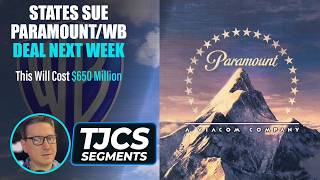
The question everyone in Hollywood is asking right now — will the Paramount-Warner Bros merger be blocked? — is suddenly a lot more urgent. According to new reports from Reuters, a coalition of US state attorneys general is preparing to file a lawsuit as early as next week to stop the deal from going through. After nearly a year of drama, negotiations, and back-channel maneuvering, the legal walls may finally be closing in on one of the biggest media mergers in history.
Here's the full breakdown of what's happening, what's at stake, and how this is most likely going to play out.
 00:45
Host explains the coalition of state AGs preparing to file suit against the Paramount-Warner Bros merger
Watch at 00:45 →
00:45
Host explains the coalition of state AGs preparing to file suit against the Paramount-Warner Bros merger
Watch at 00:45 →
Will the Paramount-Warner Bros Merger Actually Be Blocked?
The short answer: probably not permanently — but it's going to get messy. The coalition of state attorneys general, led initially by California and New York and now joined by several others, has the legal standing to sue and potentially delay the merger significantly. That delay alone could cost Paramount hundreds of millions of dollars.
Most analysts following this story closely believe the deal will ultimately go through, but not without Paramount making major concessions. Think of it less like a hard block and more like a tollbooth — the states are going to make Paramount pay, either financially or structurally, before they let this thing roll across the finish line.
The merger has already been navigating choppy waters in Europe, where Paramount has been forced to give up certain assets it was set to acquire from Warner Bros just to satisfy EU and UK regulators. That same playbook is likely to be used here in the US — give something up, make the attorneys general feel like they won, and move on.
Why Are State AGs Suing to Stop the Merger?
The concerns driving the state-level lawsuits break down into two major categories: monopolization of media and potential corruption in the federal approval process.
03:10
Oregon AG's separate injunction and DOJ corruption allegations explained
Watch at 03:10 →
On the monopolization front, the attorneys general are worried about what it means for American consumers — and for the broader media landscape — when two of the biggest theatrical studios in the world merge into one massive entity. Fewer studios means fewer competing voices, less diversity in content, and historically, worse outcomes for workers, creators, and audiences alike.
But there's a second, more explosive angle here. The Oregon Attorney General has gone a step further than the other states, filing for a separate injunction to temporarily halt the merger while they investigate whether the Department of Justice's approval of the deal was legitimate. Oregon is essentially alleging that the DOJ didn't greenlight this merger based on a proper review of the facts and the law — they're claiming it was greenlit as a favor. Subpoenas have reportedly been issued for communications between Paramount executives and government officials, particularly those connected to the White House. If those allegations have merit, this stops being a business story and becomes a full-blown political scandal.
What Is Oregon's AG Doing Separately to Block the Deal?
Oregon is pursuing its own legal track distinct from the multi-state coalition. The Oregon AG is seeking an injunction — a court order to pause the merger — while an investigation into alleged corruption at the DOJ plays out. The argument is straightforward: if the federal body that approved this merger did so because of political favors rather than legitimate antitrust analysis, then that approval is tainted and the merger should not proceed on the basis of it.
05:22
The $650 million penalty deadline breakdown and what it means for Paramount's debt load
Watch at 05:22 →
Subpoenas are going out to capture all communications between Paramount's key players and government officials. Whether or not those subpoenas turn up a smoking gun, the investigation itself creates serious legal risk and further delays for the deal.
What Happens If the Merger Misses the October Deadline?
This is where the financial stakes become almost absurd. If the Paramount-Warner Bros merger is not completed by October, Paramount is contractually obligated to pay Warner Bros shareholders a penalty of $650 million. That's on top of the roughly $80 billion in debt the company is already expected to carry as a result of this acquisition.
And it doesn't stop there. Every three months the deal remains unclosed after that October deadline, another $650 million penalty gets added to the tab. That's a quarter-billion-dollar-a-month incentive for Paramount to find a way to make this work — and fast. This financial pressure is almost certainly going to push Paramount toward offering concessions rather than fighting the lawsuits all the way through the courts.
Will Paramount Sell CNN or HBO Max to Save the Deal?
This is the most fascinating part of the story, and honestly, it's where the deal gets truly wild. The prediction here — and it's an educated one — is that Paramount will approach the state attorneys general and essentially ask: what do we need to give up for you to let this happen?
The two assets most likely to be put on the table are CNN and HBO Max. CNN is almost certainly going to be a central demand from the AGs because media monopolization — particularly in news — is going to be one of their biggest concerns. Allowing a single company to control that much of America's news infrastructure is a genuinely alarming prospect, and the attorneys general know it's their strongest argument.
HBO Max is a wilder card, but the logic holds. Paramount could theoretically acquire Warner Bros, immediately divest itself of HBO Max and CNN, and then complete the merger in a slimmed-down form that satisfies regulators. It's not a perfect outcome for anyone, but it's a path forward. Whether those assets get sold off to independent buyers or to another streaming giant remains to be seen.
Is This Merger Actually Bad for Hollywood?
Honestly? Most people in the industry think so — even those who believe it will ultimately happen. The concern isn't just about monopoly in the abstract. It's about what consolidation actually does to the creative ecosystem over time.
What made Hollywood great for decades was competition. Multiple studios with different creative cultures, different risk tolerances, different ideas about what stories were worth telling. When you compress that into fewer and fewer entities, you get fewer bets placed, more homogenized content, and more pressure to produce safe, bankable franchises rather than original work.
There's also the very real issue of debt. Paramount is already going to be carrying an enormous financial burden from this acquisition. Promising to produce 15 movies a year at Warner Bros and another 15 at Paramount sounds bold on paper — but where is that money coming from? How many $200 million tentpole productions can a debt-laden company greenlight without the whole thing eventually buckling? The math is precarious at best.
Add to that the job losses, the strain on theater owners who will now have to absorb a flood of releases from one mega-studio, and the general chilling effect consolidation has on opportunity for new voices — and it's hard to see this as a win for the industry, even if the merger technically succeeds.
Why Did Some Prefer Netflix Buying Warner Bros Over Paramount?
It might seem counterintuitive to prefer a tech giant like Netflix buying a storied studio over another traditional studio doing it — but the reasoning actually makes sense. If Netflix had acquired Warner Bros, it would have been bringing a major new player into the theatrical business. Netflix is not a theatrical studio. That acquisition would have added competition to the marketplace, not subtracted it.
The Paramount deal does the opposite. Two major theatrical studios become one. That's a net loss of a competitive voice in the industry, plain and simple. Neither outcome is ideal — the preference would be for Warner Bros to remain Warner Bros, independent and competitive — but between the two options, the Netflix deal represented addition, while the Paramount deal represents subtraction.
What Happens Next?
All eyes are now on next week. If the multi-state lawsuit gets filed as expected, we'll enter a new phase of this saga where the real negotiating begins. Paramount knows the clock is ticking toward that October deadline. The attorneys general know Paramount knows. That gives the states enormous leverage — and Paramount will almost certainly blink first.
The question is just what they'll have to give up. CNN? HBO Max? Both? Something else entirely? Whatever the answer, it's going to reshape the media landscape in ways we probably can't fully anticipate yet. Stay tuned — this one is far from over.