Most lifters cycle through the same handful of exercises indefinitely. That consistency is valuable — but it can also mean missing out on movements that address real gaps in your training. The seven exercises below are not gimmicks. They have biomechanical logic behind them, some have direct scientific support, and they range from moderately familiar to genuinely obscure. They are ordered roughly from common to rare, so by the end you are almost certainly encountering something new.
1. Dead Hang
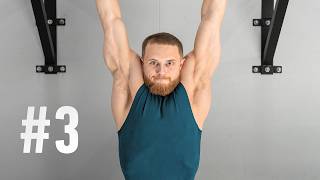
The dead hang is simultaneously one of the simplest and most underused exercises in the gym. Hanging from a pull-up bar for time improves grip and forearm strength, builds shoulder health by decompressing the rotator cuff tendons, develops core endurance, and can relieve spinal compression — particularly useful after heavy squat or deadlift sessions.
To test your baseline, simply hang until you drop. Beginner times sit around 15–30 seconds; advanced lifters typically reach 90 seconds or more; elite hangers exceed three minutes.
 02:10
Chart showing beginner, intermediate, advanced, elite, and world-record dead hang times
Watch at 02:10 →
02:10
Chart showing beginner, intermediate, advanced, elite, and world-record dead hang times
Watch at 02:10 →
Technique cues: Use chalk. Grip just outside shoulder width. Start with a looser grip to delay forearm fatigue, then tighten progressively as you begin to slip — the same way you pace yourself in a race. Keep your legs straight, feet together, toes pointed down to minimize swing. Breathe steadily; do not hold your breath. If bodyweight is too difficult, loop a resistance band around the bar and step into it, or use an assisted pull-up machine.
2. Zapman Hammer Curl
Named after nineteenth-century strongman George Zottman — with a slight mechanical modification — this curl exploits a fundamental asymmetry in human strength: you are roughly 40–50% stronger on the eccentric (lowering) phase than on the concentric (lifting) phase. A standard dumbbell curl never fully challenges that stronger eccentric, leaving muscle-building stimulus on the table.
The fix uses grip rotation to shift which muscles bear the load at each phase of the movement. Curl the weight up with a hammer (neutral) grip, allowing the brachialis and brachioradialis to assist. At the top, rotate to a supinated (palms-up) grip and lower slowly, forcing the biceps to handle the eccentric alone — a heavier effective load than they would face in a standard curl.
Technique cues: Grip the dumbbell in the center of the handle, not against the head. Curl to just below vertical, rotate palms up, then sweep the weight down in a wide arc. At the bottom, rotate back to hammer grip and repeat. Eight to ten reps per set is a reasonable target. If you prefer traditional curls, simply slow the negative to a three-to-four-second count to achieve a similar effect.
3. Incline Dumbbell Y-Raise
The standard dumbbell lateral raise has a well-known problem: because gravity pulls straight down, there is zero tension on the side delt at the bottom of the movement, and peak tension only arrives at the very top. The incline Y-raise redistributes that tension across a far longer portion of the range of motion.
Set an adjustable bench to a 20–30° incline — leaning noticeably far back. Brace your upper back against the pad, chest lifted. Starting with dumbbells at your sides, raise them upward and outward in a Y shape, squeezing the side delt fibers together on the way up and feeling them stretch apart on the way down. Stop at the sides — do not let the dumbbells swing back to a vertical hang, which would eliminate tension at the bottom.
10:45
Demonstration of incline dumbbell Y-raise setup and movement path
Watch at 10:45 →
The Y angle also targets the fibers between the front and side delt heads, adding visible width from the front. As a bonus, lifting in the scapular plane (roughly 30° forward of straight out to the side) tends to feel more comfortable on the shoulder joint for many people.
4. Sideways-Facing Single-Arm Rear Delt Fly on the Pec Deck
Most lifters use the reverse pec deck facing forward, which limits the range of motion almost entirely to the shortened position. The rear delts receive no meaningful stretch — the equivalent of doing bicep curls only in the top half of the movement. Turning sideways on the machine solves this by allowing the arm to sweep across the body, fully lengthening the rear delt before each rep.
Technique cue: Think of a large pile of money on the floor — the wider the arc your arm covers, the more you keep. This mental image encourages sweeping with the rear delt rather than yanking with the biceps and upper back. No pec deck available? A cable set low to the ground achieves the same stretch as long as you reach across your body at the bottom. With dumbbells, lie on a bench and let the weight hang across your torso before each rep.
5. Dragon Flag
Bruce Lee's signature core exercise remains one of the most effective ab movements available — and one of the most avoided, because it is genuinely hard. Dragon flags load the entire rectus abdominis isometrically to keep the spine extended while the lower abs work to lift the legs. The obliques stabilize, the serratus anchors the scapulae, and the lats assist throughout. Expect significant delayed-onset soreness, including in the upper abs, after your first session.
Progression: Begin with lying leg raises (flat on back, legs straight, core braced). Once you can complete eight to ten controlled reps, move to bent-knee dragon flags on a bench — bending the knees shortens the lever arm considerably. From there, work toward full straight-leg dragon flags, aiming for four to eight reps. The advantage over hanging leg raises is that the bench stabilizes your torso, allowing you to direct tension into the abs rather than fighting unwanted swing.
22:30
Progression from lying leg raises to bent-knee dragon flags to full dragon flags
Watch at 22:30 →
6. Kelso Shrug
The Kelso shrug is arguably the most underrated back-thickness exercise that exists. It isolates the mid-trapezius and rhomboids by removing the biceps from the equation entirely — something no standard row accomplishes. During a row, the biceps frequently reach failure before the mid-back is fully stimulated. The Kelso shrug addresses this directly: elbows stay locked throughout, so the only thing moving the weight is scapular retraction.
After reaching failure on a heavy row set, most people can still perform four or five Kelso shrugs. That gap represents mid-back stimulus that the row left uncaptured.
Setup: Use a chest-supported T-bar row machine with a wide grip — approximately 1.5 times shoulder width. With arms completely straight, squeeze the shoulder blades together as hard as possible, pause for one second at peak contraction, then let them peel apart on the negative. The weight will only travel four to five inches. That is correct. If the range of motion looks like a normal row, the arms are bending too much. No T-bar machine? Brace against an incline bench and perform the same movement with dumbbells.
7. Seated Cable Deadlift
The least familiar exercise on this list looks unusual, but the logic is sound. Conventional deadlifts and Romanian deadlifts are exceptional — but they carry a significant fatigue cost to the lower back, core, and quads. The seated cable deadlift fixes the hips against a bench, which eliminates most of that systemic fatigue and allows near-complete focus on the glutes and hamstrings. The absence of plates also means you can lower the bar further than a floor pull, increasing the range of motion.
Technique: Sit on a low bench facing the cable stack. Take a grip just outside shoulder width and plant your feet on the platform with toes turned slightly out. Squat the weight up to establish your starting position, then initiate each rep by unlocking the hips and knees, lowering the bar as close to the body as comfortable. Lower until your lower back begins to round — for most people this is around ankle height. Drive through the glutes to extend the hips and lock out. Think deadlift, not row: the arms are cables, not drivers. A deliberate glute squeeze at the top of each rep reinforces the correct muscle recruitment pattern.
Single-leg variations are also highly effective here because the bench provides balance support that free-weight single-leg work cannot. This makes it straightforward to identify and correct left-to-right strength imbalances: start with the weaker side, go to near-failure, then match reps on the stronger side.
32:15
Seated cable deadlift setup and full rep demonstration including single-leg variation
Watch at 32:15 →
None of these exercises replaces consistent, hard training with the basics. But each one fills a specific gap — whether that is rear delt range of motion, mid-back isolation, or glute stimulus without systemic fatigue. Rotate one or two into your current program and assess how they feel over several weeks before drawing conclusions.