After following the same leg workout for 365 consecutive days — no skipping — the results were visible enough to warrant a full breakdown. This isn't a generic routine. Every exercise was chosen for a specific physiological reason, every technique cue was refined over a full year, and the order of movements was deliberate. Here is the complete program, with the science behind each decision.
Step 1: Lying Leg Curls — Why Hamstrings Come First
Starting a leg session with hamstring curls might seem counterintuitive, but it solves a problem many lifters ignore: cranky knees during squats. By warming up the posterior chain before any heavy loading, the glutes fire more effectively, soft tissues around the knee get primed, and squat strength actually improves.
The choice of lying leg curls over seated is worth explaining. Research does show that seated leg curls produce roughly 1.6 times more hamstring growth over 12 weeks — and seated curls are included on the second leg day of the week for exactly that reason. But lying leg curls have a unique advantage: they place greater stretch on the sartorius, a long diagonal muscle that becomes highly visible on lean legs during quad poses. Because the sartorius is more elongated in a prone position, the lying variation provides a superior stimulus for that specific muscle.
The key technique addition was lengthened partials at the end of the final set. Once full reps are no longer possible, the bottom half of the range still has significant strength available. Continuing with partial reps in that range takes advantage of the hamstrings' strength curve near failure. The critical cue: drive your hips into the pad throughout. Letting the hips pop up recruits the glutes and lower back, bleeding tension away from the target muscle.
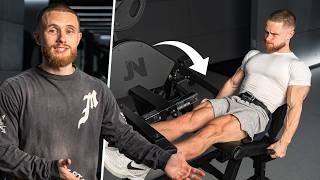 03:20
Demonstration of lying leg curl with hips pressed into pad and partial reps at end of set
Watch at 03:20 →
03:20
Demonstration of lying leg curl with hips pressed into pad and partial reps at end of set
Watch at 03:20 →
Step 2: Pendulum Squat — The Primary Quad Builder
Three sets of six to eight reps on the pendulum squat served as the cornerstone of quad development throughout the year. Like any squat pattern, it also heavily loads the glutes and adductors — but its specific mechanics make it superior for quad emphasis.
The pendulum squat's arcing movement path creates maximum tension at the bottom of the range, where quad torque is highest. This is where most lifters shortchange themselves: cutting depth early means missing the most productive portion of the lift. Recording yourself from the side often reveals you're not as deep as you think. For those without access to a pendulum machine, a hack squat with feet positioned back and a deep knee angle is the closest substitute. Barbell squats with a high bar position and upright torso, or Smith machine squats with feet back, also work well.
Set management matters here. The first two sets should leave one or two reps in reserve — the stimulus is large enough that grinding to failure every set will hurt performance on subsequent sets. The final set is all-out effort. One important note on the pendulum: the sticking point near the bottom feels almost impossible, but if you push through it, the rep usually completes. Many extra reps are left on the table by lifters who stop at that sticking point rather than grinding through it.
Every few months, a deload week is necessary — strip the weight back and recover. Progressive overload applied consistently to failure sets week over week demands it.
07:10
Pendulum squat at full depth showing the arcing movement path and bottom-range sticking point
Watch at 07:10 →
Step 3: Romanian Deadlift — The Hamstring and Glute Anchor
The Romanian deadlift remained the single most impactful exercise for hamstring and glute development over the year. Its value comes from hip extension under load — the function of the hamstrings that the leg curl, a knee flexion exercise, cannot train. Together, they cover both primary roles of the hamstring muscle group.
Progressive overload is the mechanism. Starting with two plates per side for six hard reps and finishing the program at three plates for six reps means the muscle had to grow to meet the demand. That logic is simple but non-negotiable.
The central technique cue is pushing the glutes straight back — not down. This preserves the hip hinge pattern and prevents the movement from collapsing into a squat. A slight knee bend is maintained throughout, but the knees do not drift forward. The bar should travel in a vertical line over the middle of the foot, not arc outward.
The most common error is chasing extra range of motion by rounding the lower back or letting the bar drift forward. The RDL does not need to go below the knee to deliver a full hamstring stretch — it just needs to maintain a neutral spine and keep tension on the muscle. Filming from the side reveals bar path clearly and is worth doing at least once.
Step 4: Leg Extension — Targeting the Rectus Femoris
No squat variation effectively stimulates the rectus femoris — the large superficial head of the quadriceps that crosses both the hip and knee joints. Because both joints move simultaneously during a squat, the rectus femoris changes little in length and receives minimal stimulus. A 2021 study confirmed this: Smith machine squats produced no measurable rectus femoris growth over five weeks, while leg extensions did.
One or two hard sets are sufficient here. Volume can be low because the isolation is complete — no glutes or lower back can compensate, and the mind-muscle connection is direct.
The most impactful technique change was setting the seat as far back as possible. A 2024 study found this position produced approximately 170% more quad growth than a standard upright seat. Strapping in — using the handles or even an inexpensive airline seat belt extender — keeps the hips planted and prevents them from rising off the seat, which would redistribute tension away from the quads. A 3-second slow eccentric can be used to reduce knee strain while maintaining stimulus, particularly useful during injury recovery.
14:45
Leg extension with seat fully reclined and hip strap in place, showing controlled eccentric phase
Watch at 14:45 →
Step 5: Hip Abduction and Calf Raises — The Finishers That Matter
Hip Abduction Machine
The glutes — particularly the glute medius — are among the most visible indicators of training status on any physique. After the pendulum squat and RDL have heavily loaded the glute max, hip abduction provides targeted stimulus to the upper glute fibers.
Technique here recently shifted based on input from Dr. Bret Contreras: performing the movement with hips extended (bridged position) rather than leaning forward aligns better with the fiber direction of the glute medius. Leaning forward biases the glute max; bridging biases the glute medius. Since the glute max was already worked extensively, the bridged position fills the gap.
The biggest mistake is going too light. This exercise is often treated as low-effort accessory work, but intermediate and advanced lifters should be maxing out most hip abduction machines and adding load with a pin. If you can stand up immediately after your last rep without pausing to recover, the set wasn't hard enough.
Straight-Leg Calf Raises
Skipping calves at the end of a long leg session is the primary reason most people's calves don't grow. Eight to ten reps with a strong emphasis on the deep stretched position is the protocol. Short, bouncy reps up onto the toes do not provide adequate stimulus. The growing body of evidence on stretch-mediated hypertrophy strongly supports prioritizing the bottom range.
At the end of the final set, sink into the bottom stretch and hold for 30 seconds. The discomfort is significant but the stimulus is disproportionately effective for calf hypertrophy. If calves are a weak point, move them to the beginning of the workout to ensure they're never skipped.