Can you look like you're on steroids without ever taking them? To find out, eight self-proclaimed natural athletes were shown to random strangers who were asked a simple question: who's on steroids and who isn't? The results were revealing — not just about public perception, but about which specific physical traits trigger steroid suspicion in the first place. By understanding exactly what people look for, you can prioritize those features and maximize your natural, enhanced appearance.
The Experiment: Natural Athletes, Skeptical Strangers
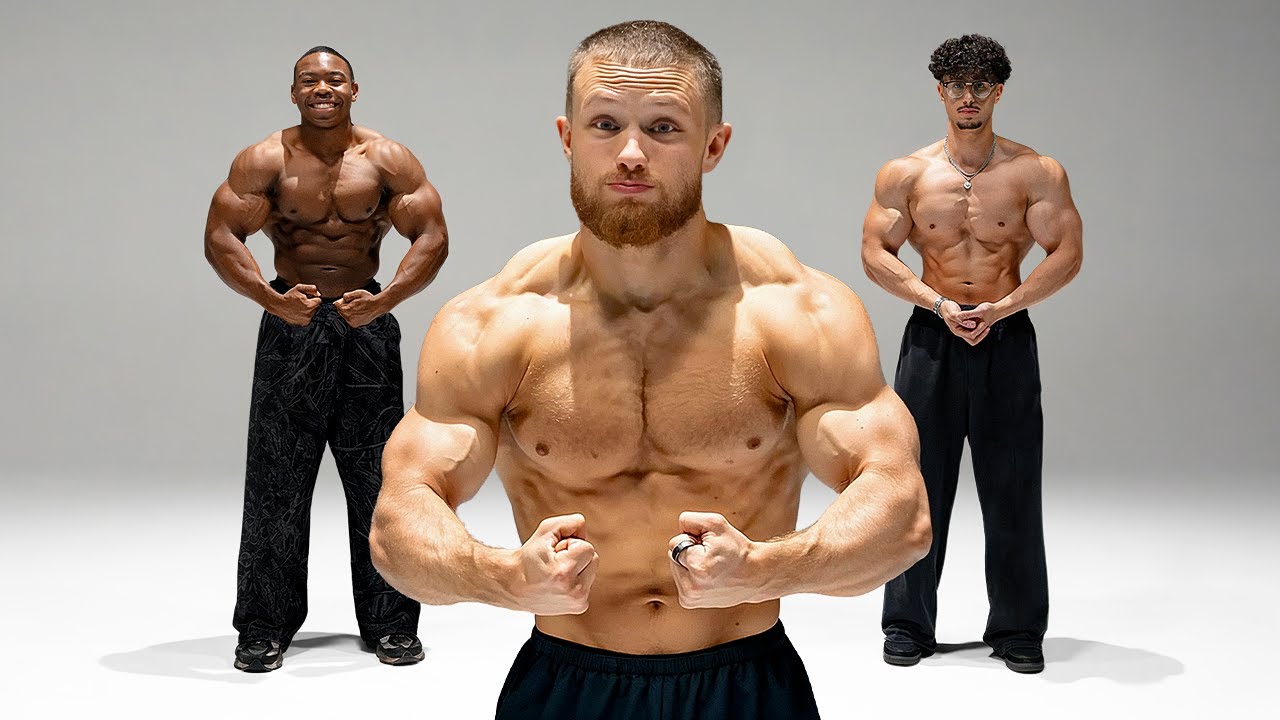
Eight lifters who all claim to be natural were lined up and shown to members of the public. Strangers were asked to identify who they thought was enhanced. Several subjects landed in what became the "questionable zone" — most observers believed they were probably taking something, even after being told otherwise.
 01:10
Side-by-side lineup showing 'definitely natty zone' on the right and 'questionable zone' on the left
Watch at 01:10 →
01:10
Side-by-side lineup showing 'definitely natty zone' on the right and 'questionable zone' on the left
Watch at 01:10 →
A medical doctor was also brought in to blood test every subject, adding a scientific layer to the visual experiment. The combination of public perception data and actual testosterone results produced some genuinely surprising findings.
The Five Features People Associate With Steroid Use
1. 3D Deltoids
Shoulders were the most commonly cited indicator of enhancement. Specifically, people look for a round, three-dimensional quality to the deltoids — particularly the side delts. Training lateral raises at least twice per week is a solid baseline, but for those struggling to develop this area, increasing frequency to three to five sessions per week can accelerate growth. The side delts respond well to volume and frequency, and prioritizing them early in a training career pays long-term dividends.
2. Peaked Biceps
Almost every observer pointed to the biceps on the subjects in the questionable zone. Big, peaked biceps — even more than overall arm size — register as a red flag for steroid suspicion among everyday people. One subject, a former competitive gymnast, attributed his 18-inch arms partly to his athletic background and a specific technique: preacher curls with forced reps, using the opposite hand to assist the concentric phase, then lowering the full weight slowly on the negative. Another effective approach is the Bayesian curl — performed with the arm pulled behind the body to maximize the stretch and emphasize the long head of the bicep.
09:45
Demonstration of Bayesian curl technique emphasizing the stretch position
Watch at 09:45 →
3. Developed Upper Chest
A full, sculpted upper chest was flagged as an enhanced feature on one subject — a competitive powerlifter who holds the all-time Canadian drug-tested bench press record for his weight class. The bench press remains one of the best mass builders for the chest, and the data backs this up anecdotally: nearly every lifter with a big bench has a correspondingly impressive chest. For upper pec development specifically, incline pressing or incline flyes produce slightly better results than flat work alone, so including both in a program gives the most complete chest development.
4. Massive Traps
Every subject in the questionable zone had noticeably larger traps than those in the definitely-natural zone. This one actually has a physiological basis: the upper traps have a higher androgen receptor density than most other muscle groups, meaning they respond more dramatically to elevated testosterone. This is why steroid users often develop disproportionately large traps. To build them naturally, standard shrugs remain effective — but using a slightly wider grip and focusing on shrugging up and in (rather than straight up) better aligns with the actual fiber orientation of the upper traps, which run more horizontally than most people realize. Overhead lateral raises and direct neck training are also underrated contributors.
5. Being Lean
Above all other factors, leanness is the single most controllable variable for looking enhanced. A side-by-side comparison of the same person at 20% body fat versus 10% body fat — despite being 30 pounds lighter at the leaner weight — showed dramatically more steroid accusations at the lower body fat level. The physique looks simultaneously smaller in absolute terms and far more impressive visually. Vascularity, often assumed to be steroid-related, is similarly tied more to low body fat and genetics than to drug use.
19:30
Comparison photos showing same person at ~20% body fat vs ~10% body fat
Watch at 19:30 →
The Power of Lighting and Posing
Lighting may be the most underappreciated factor in the enhanced versus natural debate. During filming, the same group of athletes was shot under two different lighting conditions: standard diffuse lighting and direct spotlighting. Under diffuse light, everyone looked natural. Under spotlighting, every single person looked enhanced — an immediate transformation with no change to their physiques whatsoever.
21:00
Same athletes under diffuse lighting vs. direct spotlighting — dramatic difference in appearance
Watch at 21:00 →
The same principle applies to posing and camera equipment. A casual shot under kitchen lighting on a smartphone versus a posed most-muscular under a spotlight on a professional camera can look like two completely different people — taken less than a minute apart. Understanding this doesn't diminish anyone's work; it just adds important context to what you see online.
What the Blood Tests Actually Showed
All eight subjects had their testosterone, luteinizing hormone (LH), and follicle-stimulating hormone (FSH) levels measured by a medical doctor. Most healthy young men fall between 200 and 850 ng/dL for testosterone. Levels above 1,000 are suspicious; above 1,500 is essentially impossible without exogenous use.
Seven of the eight subjects came in between 415 and 689 ng/dL. One subject registered at 928 ng/dL — above the typical range, but not beyond the realm of natural variation for an active young male. Crucially, his LH and FSH levels were completely normal, which rules out steroid suppression. LH and FSH drop sharply with exogenous testosterone use, so normal levels on both hormones alongside elevated total testosterone points toward natural high-end production rather than drug use.
Perhaps the most interesting finding: within the natural range, higher testosterone did not correlate with more muscle mass. Research supports this — testosterone only produces dramatic size increases at super-physiological levels achieved through injection. Within the normal healthy range, training and nutrition matter far more than where your testosterone happens to fall.
Genetics, Hard Work, and Realistic Expectations
One subject — a 19-year-old with a physique that drew near-universal disbelief — illustrated an important point. Historical photographs show comparably muscular individuals from 1912 and 1949, decades before injectable testosterone was available. Some people are simply genetic outliers, just as some people are seven feet tall. When elite genetics combine with serious, consistent training, the results can look impossible to those unfamiliar with the full range of human potential.
That said, for most people, the practical takeaway is straightforward: prioritize the side delts, build your biceps with techniques that emphasize the stretch, include incline pressing for the upper chest, train your traps with proper fiber-orientation awareness, and — above all — get lean. Those five variables, combined with smart lighting and posing, will get you as close to the naturally enhanced look as your genetics will allow.