Sticking to a workout routine long-term is genuinely hard — and if you've struggled with it, you're not alone. After years of being an active person who still couldn't stay consistent, a breakthrough finally came in 2020: the result was 30 pounds of mostly lean mass gained, a 300-pound bench press, a 350-pound squat, a 440-pound deadlift, and improved cardio — all over two years. The secret wasn't willpower. It was identifying and solving four specific sub-problems that cause most people to quit. Here's exactly what they are and how to fix them.
Why Is It So Hard to Stick to a Workout Routine?
The reason sticking to a workout routine feels so hard isn't a character flaw — it's a systems problem. There are four distinct obstacles that derail most people before they ever see meaningful progress:
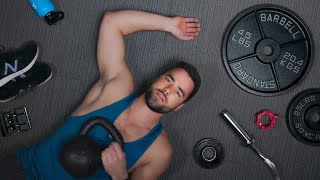 01:45
The four sub-problems that make sticking to a workout routine so difficult for most people
Watch at 01:45 →
01:45
The four sub-problems that make sticking to a workout routine so difficult for most people
Watch at 01:45 →
- You don't know what to do or where to start.
- You aren't seeing any results when you do show up.
- There's too much friction between you and your workout.
- It's too easy to fail with zero consequences.
Most fitness advice treats these as one big motivational problem and tells you to just want it more. That's not helpful. Each of these is a separate issue that requires a separate solution. Let's go through them one by one.
How Do You Start a Workout Routine as a Beginner?
The internet has more fitness advice than there are grains of sand on a beach, and that abundance is its own problem. Every routine you consider seems to have someone — usually an authority figure with a YouTube channel — telling you it's wrong, dangerous, or suboptimal. It's paralyzing.
Here's the honest truth: if you're a beginner or intermediate lifter, you don't need a hyper-specialized program. A basic strength training routine combined with some added cardio will improve nearly everything you're chasing — muscle mass, strength, endurance, and even fat loss (which is mostly diet anyway). The complexity you see online is designed for advanced athletes, and if you were at that level, you'd already know it.
What actually works for most people starting out? Two foundational setups:
05:10
Example workout log showing progressive overload in action on the squat
Watch at 05:10 →
- A home-friendly routine built around a single kettlebell and a $20–30 doorframe pull-up bar — no gym required.
- A gym-based strength routine using a power rack and a bench, following a structured program with defined sets, reps, and progressive targets.
The key is picking something concrete, written down, and programmed by someone who knows what they're doing — not improvised week to week. Having a coach or a well-designed program removes the guesswork entirely and lets you just show up and execute.
Why Aren't You Seeing Results from Working Out?
If you've been putting in the time at the gym but not seeing results, there's a very good chance you already know the answer — you're just not tracking your progress. This single habit separates people who improve from people who plateau forever.
What Is Progressive Overload and Why Does It Matter?
Progressive overload is the foundational principle behind all strength and fitness gains. It simply means pushing yourself slightly beyond your current limit so your body is forced to adapt and grow stronger. It's not complicated in theory — but in practice, most people skip it entirely.
08:22
How running in place for 3 minutes a day became a 23-minute daily habit after 45 days
Watch at 08:22 →
Why? Because they either show up and decide on the fly what to do, or they follow the same sets and reps week after week with no increase. Without tracking, you can't push intelligently. You're just going through the motions.
Start recording every workout: sets, reps, weight lifted, and time or distance for cardio. It doesn't need to be a fancy app — a notebook works perfectly. Then use that data to add a small amount of weight or reps every session. For example: three sets of five reps at 275 pounds on the squat this week becomes 280 pounds next week, then 285 the week after.
There's an unexpected bonus to this habit: tracking makes the gym exciting. Changes in body composition are slow and hard to notice in the mirror, but improvements in your numbers show up fast. Watching those numbers climb gives you a reason to look forward to each session.
10:55
Apple Watch activity sharing as a lightweight accountability and encouragement tool
Watch at 10:55 →
How Do You Make It Easier to Actually Work Out?
You already know what it feels like to have every intention of working out and then just... not. Life gets in the way. You're tired. It takes too long to get ready and drive to the gym. Before you know it, you've skipped three days in a row and the habit has dissolved.
This is a friction problem, not a motivation problem. The solution is to reduce the number of steps between you and your workout as much as possible.
A home gym eliminates commute time entirely — that alone removes one of the most common excuses. But you don't need to build a garage gym to see the benefit. Smaller changes work too:
- Lay out your gym clothes and pack your bag the night before.
- Schedule your workout at the same time every day so there's no decision to make.
- Start with a shorter, easier routine if the current one feels overwhelming.
That last point matters more than people realize. The goal at the beginning isn't to have the perfect workout — it's to build the habit of showing up. One real example: a friend started by running in place in his apartment for just three minutes a day, watching virtual running videos to make it tolerable. Three minutes. That's it. After 45 days of doing it consistently, he was running 23 minutes at a stretch with noticeably better endurance. The habit came first, and the results followed.
Doing something small is always better than doing nothing at all while waiting for the perfect conditions.
How Do You Stay Accountable to Your Fitness Goals?
This is arguably the single most important factor in long-term consistency, and it's the one most people skip entirely. Ask yourself: what actually happens if you skip your workout today? For most people, the honest answer is nothing. No consequence, no check-in, no one who notices. That makes it very easy to rationalize skipping — and then to skip again.
To stay consistent, you need to make failing slightly harder by introducing accountability.
What Does Effective Fitness Accountability Look Like?
Working with a remote lifting coach is one of the most effective forms of accountability available. The setup works like this: after each workout, you log your sets and reps and film your final set of each exercise. The next morning, you receive a form critique and updated programming. More importantly, your coach is expecting that log. Knowing someone is waiting on your results makes skipping feel like letting someone down — which is a far stronger motivator than abstract self-discipline.
But coaching isn't the only path. Other effective accountability methods include:
- Workout partners — someone who shows up with you and notices when you don't.
- Activity sharing apps — features like Apple Watch's activity sharing let you and your friends see each other's exercise data and send encouragement when workouts are completed.
- Habit-tracking apps with social features — tools like Habitica let you team up with others and track habits collectively.
One thing worth noting: accountability isn't just about pressure and consequences. Positive encouragement from people who care about you matters just as much. When a friend sends you a supportive message after a tough workout, it reinforces the behavior just as effectively as being called out for skipping. The best accountability systems have both elements — someone who holds you to the standard, and someone who cheers when you meet it.
The Bottom Line: What Actually Makes a Routine Stick?
Sticking to a workout routine long-term comes down to solving four concrete problems: knowing what to do, tracking your progress so you can see results, eliminating friction so showing up is easy, and building accountability so failure has a cost. Fix all four, and consistency stops being a willpower battle and starts being a system that works for you — even on the days you don't feel like it.
Start simple. Track everything. Reduce the barriers. And find people who will hold you to it. That combination — not motivation, not the perfect program — is what actually builds a lasting routine.