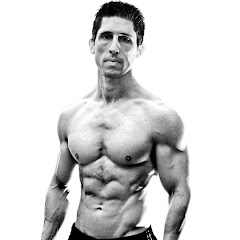
Most people chasing wider shoulders fixate on lateral raises and call it a day. But truly round, wide-looking delts depend on developing all three heads — front, middle, and rear — and smartly distributing that volume across your entire training week, not just one shoulder session. Here is a complete dumbbell-only approach to make it happen.
Why Roundness, Not Just Width, Is the Real Goal
When you look at the shoulder from the front, what reads as "width" is actually the combined fullness of all three delt heads. Flatten out the front or rear and the middle delt loses its three-dimensional appearance no matter how developed it is. The goal, then, is to build a truly round shoulder that looks impressive from every angle — front, side, and back.
 00:30
Diagram showing how removing front and rear delt size flattens the appearance of the middle delt
Watch at 00:30 →
00:30
Diagram showing how removing front and rear delt size flattens the appearance of the middle delt
Watch at 00:30 →
Use Your Pull Day to Sneak in Extra Delt Volume
One of the most underused strategies for shoulder development is treating back day as a second opportunity to hit the most underdeveloped heads — the middle and rear delts. Your push day already gives the front delt considerable indirect work through pressing movements like bench press, push-ups, and dips. The rear and middle delts don't get the same free ride, so you have to be deliberate about finding extra volume for them.
Four exercises worth incorporating on pull day include:
- Chest-supported row with flared elbows — angling the elbows out to the sides shifts stimulus from the lats toward the upper back and rear delts, loading them heavily under a movement that doesn't feel like a shoulder exercise.
- High pull — one of the safest ways to overload the middle delts with meaningful weight, disguised as a general pulling movement.
- Seated cable row — a classic pull exercise with significant rear delt recruitment when performed with proper retraction and controlled tempo.
- Face pulls — non-negotiable for rear delt development. Even fitting these in on leg day is worth considering to accumulate the volume this head needs.
The Dedicated Shoulder Day Workout
Even with all that pull-day volume, a focused shoulder session is where the real structural gains are built. Each head of the delt deserves direct attention within a single workout. Here is the full sequence.
1. Dumbbell Standing Overhead Press — 2 to 3 sets, 8 to 10 reps
Start with a compound movement to prime the entire shoulder girdle. The standing variation is preferred over a seated bench press because it does not interrupt natural shoulder biomechanics at the bottom of the range. Use a weight that brings you to failure in the 8 to 10 rep range. If you already hit overhead pressing on push day and your shoulders are not a separate session, you can skip this and move straight to isolation work.
2. Dumbbell Iso Alternating Front Raise — 1 to 2 hard sets, 10 to 12 reps
The key technique point here is initiating each rep by deliberately engaging the front delt before powering the dumbbell upward. This pre-activation ensures the front delt is actually doing the work rather than the traps or momentum taking over. Only one to two quality sets are needed here since the front delt already receives significant indirect volume from chest work.
3. Upper Limit Lateral Raise — 3 sets, 12 to 15 reps
Sit on the floor with a lighter pair of dumbbells than you would normally use for lateral raises. Begin with the dumbbells just one inch off the ground and raise them out to the sides, maintaining constant tension by never allowing the weights to touch the floor at the bottom. At the top of the rep, squeeze for a moment before lowering under control. This movement is designed to teach you how to isolate and feel the middle delt — an essential prerequisite for growing it.
07:20
Demonstration of the upper limit lateral raise performed seated on the floor with light dumbbells
Watch at 07:20 →
4. Dumbbell Cheat Lateral Raise — 3 sets, 6 to 8 reps per arm
This exercise pairs with the upper limit lateral as its heavy counterpart. Grab a significantly heavier dumbbell and use a controlled cheat to get the weight moving, then focus all effort on resisting the weight on the way down — the eccentric portion. The heavier load and overloaded eccentric provide a different growth stimulus that complements the strict, lighter version performed earlier. Work each arm to failure in the 6 to 8 rep range.
5. Rear Delt Row — 2 to 3 sets, 10 to 12 reps per arm
This dumbbell variation prioritizes shoulder extension rather than elbow flexion, which shifts the stimulus firmly onto the rear delt rather than the biceps or upper back. Think about driving the elbow back and slightly behind the body rather than pulling the weight up toward the hip. Two to three sets per arm in the 10 to 12 rep range is sufficient here.
6. Dumbbell Hip Hugger — 2 to 3 sets, 12 to 15 reps
This finishing exercise is unusual but highly effective because it combines the abduction pattern that targets the middle delt with the extension pattern that hits the rear delt — addressing both underserved areas simultaneously. Elbows drift slightly back and out to the sides in a motion that mimics hugging someone around the hips. When performed correctly, the contraction in both the middle and rear delts is intense. Use a weight that brings failure in the 12 to 15 rep range.
12:10
Demonstration of the dumbbell hip hugger exercise showing elbow path and contraction point
Watch at 12:10 →
Optional Finisher: Iron Cross Isometric Hold Alternation
For those who want to push past the formal workout, finish with alternating isometric holds — one hold in the front raise position, then one in the lateral raise position, using a lighter pair of dumbbells. Because isometric strength exceeds concentric strength, even a fatigued muscle can sustain these holds. Continue until you can no longer control the position in either direction.
The Takeaway
Wider shoulders are not just a middle delt problem. They are the result of consistently developing all three heads across multiple sessions per week — taking advantage of both push day overlap for the front delt and deliberate pull day programming for the middle and rear. Layer that foundation with a focused shoulder session that addresses each head directly, and the roundness will follow.
14:50
Full workout summary screenshot showing all exercises, sets, and rep ranges
Watch at 14:50 →