
So just how successful is Shanghai Disneyland? According to Bob Iger, who has been involved with the project since its inception in the late 1990s, the answer is: remarkably, undeniably successful. More than 100 million visitors passed through its gates before the park even hit its 10-year anniversary — a milestone that silenced every skeptic who once claimed the Chinese consumer would never embrace Disney at that price point. Sitting down to celebrate a decade of the park, a visibly proud Iger called it "pitch perfect" — and it's hard to argue with him.
How Successful Is Shanghai Disneyland After 10 Years?
When Disney first announced plans to build a theme park on mainland China, the critics were loud. Competitors argued it was too expensive. Industry observers questioned whether Chinese audiences would connect with Disney's distinctly Western storytelling. Iger never bought into that narrative.
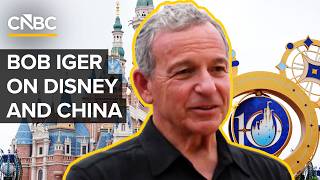 00:45
Iger describing the vision of building a park that was 'authentically Disney but distinctly Chinese'
Watch at 00:45 →
00:45
Iger describing the vision of building a park that was 'authentically Disney but distinctly Chinese'
Watch at 00:45 →
"I knew the quality of what was going to be delivered to people would more than offset the cost of it," he said. And the numbers bear that out. Over 100 million visitors in under a decade is not a fluke — it's a validation of a very deliberate strategy.
The park was designed from the ground up to be, in Iger's now-famous phrase, "authentically Disney but distinctly Chinese." That wasn't just marketing language. It was a philosophical commitment to making the Chinese people feel a sense of ownership over the park — that this place was theirs, not simply an American export dropped onto their soil.
From an investor's perspective, Iger was equally bullish. The economic success has been strong, and with the sheer size of the available property and Disney's deep intellectual property library, he sees the potential for growth as essentially limitless.
02:10
Iger explaining how Chinese guests now arrive in costume and become part of the show
Watch at 02:10 →
How Has the Chinese Consumer Changed at Theme Parks?
One of the most fascinating threads in Iger's reflection was how Chinese guests have evolved over the past decade. When the park first opened, most visitors had never set foot in a Disney theme park anywhere in the world. There was excitement, yes — but also a kind of uncertainty about what the experience was supposed to feel like.
That has changed dramatically. Today, guests arrive dressed in costume. They lean into the magic. They become, in Iger's words, "part of the show" — not because they're paid to, but because they want to. That organic participation, he noted, is one of the clearest signs that the park has genuinely been adopted as a cultural touchstone in China, not merely tolerated as a tourist attraction.
"That says a lot, actually," Iger observed. And he's right. When guests voluntarily perform the rituals of a place — the costumes, the character interactions, the immersive engagement — it signals something deeper than satisfaction. It signals belonging.
04:30
Iger confirming active construction of Spider-Man Land and two new hotels at Shanghai Disney
Watch at 04:30 →
What Is Disney's Investment Plan in China Right Now?
Despite ongoing geopolitical friction between the US and China, Disney is not pulling back from Shanghai — it's doubling down. Iger confirmed that, as of the interview, the company is actively:
- Building Spider-Man Land, a major new themed area
- Constructing two new hotels on the resort property
- Expanding Soarin', one of the park's most popular attractions
When asked directly whether he foresaw another theme park being built in China, Iger sidestepped slightly but made his optimism clear: "I just foresee continued expansion." Given the land available and the intellectual property Disney holds — from Marvel to Star Wars to Pixar — the pipeline for new experiences is essentially inexhaustible.
How Did Iger Handle US-China Geopolitical Tensions?
Here's where Iger's answer was particularly revealing about how he thinks as a CEO. He said he tries to be neither an optimist nor a pessimist about US-China relations — he tries to be a realist.
"There are going to be ups and downs, highs and lows, times of strain and times of great detente," he said. He doesn't dismiss that volatility, but he also doesn't let it paralyze decision-making. His approach has been to keep Disney focused on what it does best: entertaining people. By staying true to that core mission and keeping politics at arm's length, Disney has navigated complex geopolitical terrain more successfully than many of its peers.
It's a pragmatic philosophy, and one that likely required significant discipline over the years. The temptation to take sides — or to react to every diplomatic flashpoint — must be enormous for a company of Disney's global profile. Iger's answer suggests he resisted that temptation consistently.
What Does Bob Iger Think About AI Risks?
Perhaps the most forward-looking portion of the conversation covered artificial intelligence. Iger's take was characteristically measured, rooted in Disney's long history of embracing technology in service of storytelling.
"Disney has a long history dating back to Walt's day of using technology to improve the quality of its storytelling," he said. His view is that AI, in the hands of a skilled creator, can produce more compelling entertainment more efficiently — and that this is fundamentally a positive development.
But what about the risks? Iger's response was almost philosophical: "The world is full of risks, and if you approach the world in a risk-averse way, you achieve very little."
He pointed to Walt Disney himself as the ultimate model for navigating a world full of uncertainty. Walt founded the company in 1923, survived the Great Depression, led it through World War II, and kept taking bold risks all the way through the mid-1960s. The lesson Iger draws from that history is clear: Disney thrives not by avoiding risk, but by taking it wisely, with courage and confidence.
What Advice Did Bob Iger Leave for Disney's Future?
As Iger prepares to hand the reins to his successor, he distilled his parting wisdom into a single, elegant idea: balance legacy with innovation.
"The world is not a place that is standing still," he said. "Disney can't stand still. It must continue to change." But that change must be anchored in Disney's core values and its fundamental mission — which Iger describes, simply and beautifully, as "making the world happy."
It's a deceptively simple mandate. But as Iger's tenure demonstrates, executing it at global scale, across cultures, political environments, and technological disruptions, is anything but simple. Getting that balance right — honoring what Disney has always been while boldly building what it could become — is the central challenge he's leaving for the next generation of leadership.
What Is Bob Iger Doing After Leaving Disney?
With his final day as CEO arriving, Iger was reflective but clearly at peace. "What's next for me is truly enjoying life after Disney," he said. After nearly two decades as CEO, he describes his time leading the company as "an extraordinary life experience" — one he will be forever grateful for.
He also expressed genuine confidence in his successor, Josh D'Amaro, and the broader leadership team. "I'm feeling really good about handing the company over to Josh," he said, adding that he believes the team will take Disney "to higher heights, well beyond where I took it."
That kind of graceful exit — celebrating what was built while genuinely rooting for what comes next — may be the final, quiet lesson of Bob Iger's remarkable run at Disney.