
US car sales are declining — and this time, it's not a temporary slump. By 2040, annual new car sales in the United States could fall to just 13.7 million units, down significantly from the record highs hit roughly a decade ago. A convergence of slowing population growth, surging vehicle prices, longer-lasting cars, and emerging autonomous technology is reshaping the auto industry in ways that can't simply be waited out. As one forecaster put it bluntly: "You're no longer a growth industry. You're a declining industry."
Here's a deep look at the forces behind this structural shift — and what it means for drivers, automakers, and the broader economy.
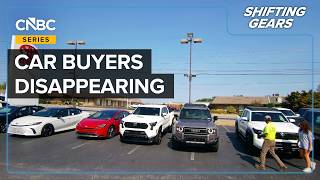 00:45
Analyst explains the structural nature of the US auto sales decline and the 13.7 million unit projection for 2040
Watch at 00:45 →
00:45
Analyst explains the structural nature of the US auto sales decline and the 13.7 million unit projection for 2040
Watch at 00:45 →
How Many Cars Will Be Sold in the US by 2040?
By 2026, US auto sales are already expected to come in roughly 1.5 million units below the industry's all-time peak. Looking further ahead, forecaster Mark Gottfredson projects annual US new car sales could fall to 13.7 million units by 2040 in a pessimistic scenario. His base case is slightly more optimistic at 15.7 million — still below current forecasts from S&P Global Mobility and Cox Automotive for 2026.
That base case assumes immigration stays near 900,000 people per year, population grows at about 0.3 to 0.4% annually, licensing rates hold steady, and vehicles per driver remain at roughly 1.2. Even under those relatively stable assumptions, the market is stagnating. The more challenging scenarios? They paint a considerably darker picture for automakers.
Autoforecast Solutions, meanwhile, expects US volumes to stagnate through at least 2033 — the furthest year for which the company currently publishes forecasts. "The market is right-sized," said Sam Fiorani of Autoforecast Solutions, "and new players are just going to make that tighter and tighter."
02:10
Sam Fiorani of Autoforecast Solutions on why affordability is locking younger buyers out of the new car market
Watch at 02:10 →
Why Are US Car Sales Declining?
The decline in US car sales isn't driven by one single factor. It's a perfect storm of several trends hitting simultaneously, each reinforcing the others. Analysts point to four major forces:
- Slowing population growth — US population expansion now depends almost entirely on immigration. Without it, the pool of potential car buyers simply doesn't grow.
- Fewer young drivers — About half of 16-year-olds are no longer getting driver's licenses, a dramatic shift from past generations.
- Vehicles lasting longer — The average car on US roads hit a record 12.8 years in 2025, meaning fewer cars need to be replaced.
- Autonomous vehicle technology — While self-driving cars have been slower to arrive than predicted, their eventual mainstream adoption could further reduce the number of vehicles per driver.
Together, these factors could account for roughly 2 million fewer new car sales annually by 2040 compared to what the market might otherwise support.
Why Are Young People Not Buying Cars Anymore?
This is one of the most striking behavioral shifts in the auto industry. Decades ago, turning 16 meant one thing: racing to the DMV to get your driver's license. That urgency has largely evaporated. Today, approximately half of 16-year-olds aren't bothering to get licensed at all.
03:30
The deregistration rate data showing how longer-lasting vehicles are suppressing replacement demand
Watch at 03:30 →
By age 25, most people do eventually get a license — but by then they're confronting a new barrier: vehicle prices that are simply too high for younger, less-wealthy buyers to afford. New cars have become loaded with collision avoidance systems, ADAS technology, and a host of other features that weren't even imagined 15 years ago. Those features make cars safer and more sophisticated, but they also make them significantly more expensive.
"We're still seeing groups of young people who enjoy driving and want a new car," said Fiorani, "but fewer and fewer can afford it. You need the younger people, the less wealthy people of us, to start buying new vehicles." When the entry-level buyer gets priced out of the market, the entire pipeline of first-time buyers shrinks — and that has compounding long-term effects on total sales volumes.
How Long Do Cars Last on Average Now?
Here's the metric that doesn't get nearly enough attention but may be the single biggest driver of declining new car sales: the rate at which old cars get taken off the road.
In 2000, about 6% of all registered vehicles were deregistered in any given year — scrapped, exported, or otherwise removed from the fleet. Those vehicles needed to be replaced, and that replacement demand fueled new car sales. By early 2026, that rate had already fallen to around 5%. By 2040, Gottfredson estimates it could drop further to just 4.4%.
Why? Because cars are simply built better and lasting longer. The average vehicle on US roads in 2025 is 12.8 years old — a record high. All that advanced technology driving up the purchase price of new vehicles is also making existing vehicles more durable and worth repairing rather than replacing. As Gottfredson put it: "We're going to see those vehicles continue to be more expensive and more and more people trying to find ways to keep their car on the road longer."
Fewer scrappage events means fewer replacement purchases. It's a simple equation with major consequences for automakers.
Will Autonomous Vehicles Actually Reduce Car Ownership?
Autonomous vehicles have been "five years away" for about 15 years now — and the industry's consistent over-promising has made many analysts skeptical. Still, the long-term direction is clear even if the timeline is fuzzy.
Gottfredson projects that if autonomous vehicle technology becomes truly mainstream, the share of the population holding driver's licenses could fall by 2 to 3% by 2040. More significantly, the number of vehicles per driver — historically around 1.2 — could drop toward 1.1 over the next decade. Robotaxi services could allow more people to get around without owning a personal vehicle at all.
That said, Gottfredson acknowledges that the self-driving timeline has repeatedly slipped. "Our perspective on autonomy and vehicle shedding has probably gone a little bit slower than we had anticipated," he said. The base case forecasts now push the most dramatic impacts out past 2030 rather than assuming near-term disruption.
One wildcard that could reverse the trend: a genuine EV technology breakthrough that makes electric vehicles dramatically more affordable or compelling. That kind of catalyst could spark a new wave of consumer demand and partially offset the structural headwinds.
How Does Immigration Affect US Auto Sales?
More than many people realize, US auto sales growth is fundamentally tied to population growth — and US population growth is fundamentally tied to immigration. With birth rates below replacement level, any net addition to the US population comes from people moving here from abroad.
If immigration policies tighten significantly, the auto market loses one of its only remaining sources of new buyer growth. Gottfredson's base case builds in roughly 900,000 immigrants per year. A more restrictive environment could push the country toward the pessimistic 13.7 million unit scenario faster than expected.
Ironically, a more open immigration policy could make the United States an increasingly attractive market for global automakers struggling with stagnation elsewhere. "If immigration continues to boost the US population," Gottfredson noted, "it will be an increasingly important market for global automakers trying to compensate for stagnation and decline in other parts of the world."
Will Chinese Automakers Enter the US Market?
One more pressure point looming on the horizon: Chinese manufacturers. While trade barriers and tariffs have kept Chinese automakers largely out of the US market so far, most forecasters expect that to change eventually. And when it does, the competitive landscape in an already-shrinking market gets dramatically more intense.
"We're going to see Chinese manufacturers coming into the US market eventually," Fiorani said. "And when that happens, it's going to put the squeeze" on domestic and established foreign automakers alike. More brands chasing fewer buyers in a structurally declining market is a recipe for brutal competition — and likely further consolidation in the auto industry over the coming decades.
The Bottom Line on US Auto Sales
The US auto industry isn't facing a temporary downturn. It's confronting a permanent structural reshaping driven by demographics that are already locked in. "We already know how many people have been born and how many people will be of vehicle driving age in 16 years," Gottfredson pointed out. "And so we can say with quite a bit of certainty that when we get to 2040, we're going to see some decline."
The only real questions are how steep that decline will be — and which automakers will be agile enough to survive it.