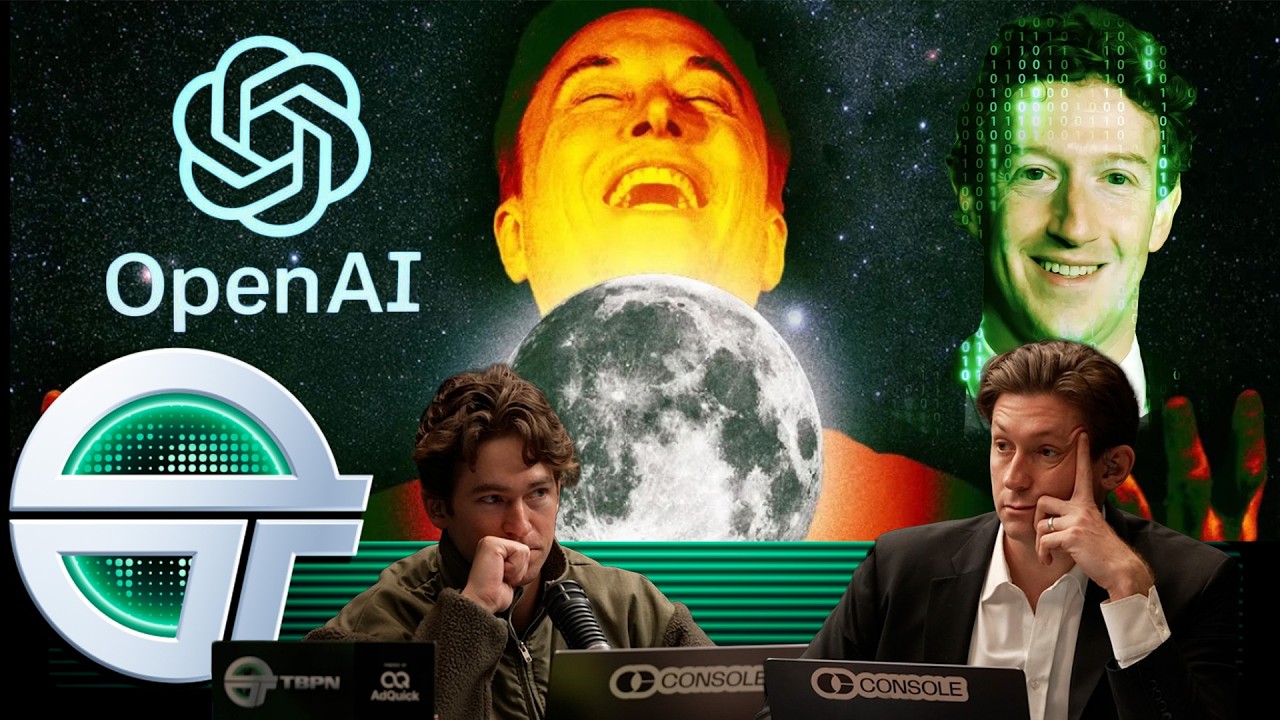
What Is Elon Musk's Terraab and Lunar Mass Driver Plan?
Elon Musk's Terraab is a sweeping long-term vision that combines Tesla, SpaceX, and xAI under one mega-project umbrella — targeting space-based data centers, next-generation chip fabrication, and ultimately a lunar mass driver: an electromagnetic launch system fixed to the moon's surface that could shoot payloads into space without rockets. Musk unveiled the concept in a high-profile keynote that was equal parts ambitious sci-fi and rough public presentation. For the first time, he visibly placed the Tesla, xAI, and SpaceX logos together, signaling what many are now calling the formation of an Elon Megacorp.
The core pitch: humanity needs roughly 1,000 times more compute than we currently have. To get there, Musk wants to build a petawatt-scale infrastructure — starting on Earth with chip fabs and space-based data centers, and eventually extending to the moon with robotic construction and electromagnetic launch capability. He closed the presentation with a render of the mass driver and the line, "I hope to see it in my lifetime." At 54, that's a deliberately vague timeline — but vintage Elon.
 02:15
Elon Musk's Terraab keynote showing Tesla, SpaceX, and xAI logos together for the first time
Watch at 02:15 →
02:15
Elon Musk's Terraab keynote showing Tesla, SpaceX, and xAI logos together for the first time
Watch at 02:15 →
How Does a Lunar Mass Driver Actually Work?
A lunar mass driver is an electromagnetic launch system built on the moon's surface. Instead of burning rocket fuel to escape the moon's gravity, it uses electromagnetic energy — generated by solar panels — to accelerate payloads to lunar escape velocity. That's approximately 5,000 miles per hour, compared to the 25,000 miles per hour needed to escape Earth's gravity well. The efficiency advantage is enormous.
Here's the basic sequence:
- Solar panels are installed on the lunar surface to generate power continuously.
- Energy is stored in batteries capable of delivering large bursts of power on demand.
- An electromagnetic track accelerates a payload — no fuel required after initial setup.
- The payload reaches escape velocity and is directed toward a useful destination: lunar orbit, Earth orbit, or a Lagrange point between the two.
Musk's vision includes manufacturing satellites directly on the moon and launching them into orbit via mass driver — dramatically cutting the cost per kilogram compared to Earth launches. The moon has no atmosphere, no weather, and much lower gravity. Once the infrastructure is in place, the economics become compelling. The challenge, of course, is getting that infrastructure there in the first place.
08:40
Diagram of the lunar mass driver concept and escape velocity comparison between Earth and Moon
Watch at 08:40 →
When Could a Mass Driver Actually Be Built on the Moon?
This is where things get genuinely contentious. The hosts broke down six prerequisite steps that need to happen before a functional mass driver is operational, and when you stack them up, the timelines stretch quickly:
- Step 1 — Reliable heavy lunar launch capacity (3–5 years minimum): Starship needs to be refueling in orbit and landing on the moon regularly, with and without crew.
- Step 2 — Power infrastructure (2+ additional years): Solar arrays and high-capacity battery storage must be deployed on the lunar surface.
- Step 3 — Robotic construction capacity: Autonomous rovers — think Optimus-style robots — need to be capable of laying electromagnetic track without constant human supervision.
- Step 4 — Build the mass driver on Earth, test it, then ship it.
- Step 5 — Solve the catching problem: Payloads launched from the moon need somewhere to go. A receiving station in orbit or at a Lagrange point must exist.
- Step 6 — Demonstrate commercial-scale operations: At least 300 metric tons launched over a 12-month period, with 95%+ mission success and 200+ launches per year.
One host put the over/under at 15–20 years. The other countered that AGI acceleration could compress everything and settled on 30 years. Neither is betting on this decade. The honest answer: it's possible within 100 years, probably not within 15, and the most aggressive credible estimate lands somewhere in the 25–40 year range — assuming AGI-driven engineering acceleration becomes real.
Is Terraab Just a Pump for a SpaceX IPO?
Critics online weren't subtle. One commentator called Terraab "a blatant pump" designed to IPO SpaceX on the back of pie-in-the-sky science fiction, merge it with Tesla, do a massive capital raise, and then buy time for five years. That's a cynical read — but not an entirely unfair one.
15:20
The six prerequisite steps breakdown for building a functional mass driver on the moon
Watch at 15:20 →
The presentation did notably bring Tesla, xAI, and SpaceX branding together for the first time publicly. The keynote lacked Musk's usual concrete timelines — no "we'll have this in five years" commitment that he's historically made (and historically missed, then eventually delivered). Instead, the vaguest of goalposts: "in my lifetime."
The counter-argument is worth taking seriously though. Never bet against Elon has been one of the most expensive lessons in tech investing over the past decade. Starlink was laughed at. It's now a multi-billion dollar business and a genuine strategic asset. The Cybertruck was mocked. It shipped. The key difference with Terraab: it's not a product. It's a civilization-scale infrastructure project. That's a different category of risk entirely — closer to the Dyson sphere thought experiment than to a new car model.
Is OpenAI's PE Deal a Smart Move or a Red Flag?
OpenAI made headlines by offering private equity firms a guaranteed minimum return of 17.5% plus early access to unreleased models. Hundreds of posts on social media screamed ponzi scheme and vendor financing. The reality is more nuanced.
Here's what's actually happening: firms like TPG, Bain Capital, Advent, and Brookfield put up $4 billion in preferred equity — not debt. A 17.5% preferred equity hurdle is not a coupon on a bond. It means those investors get priority on returns before common shareholders. That's standard preferred equity mechanics, not a Ponzi structure.
What OpenAI is actually buying is captive enterprise distribution. Private equity firms collectively did $1.8 trillion in buyouts last year. Toma Bravo alone owns 75 software companies generating $30 billion in annual revenue. A PE firm that just put $4 billion into an OpenAI joint venture isn't running a parallel RFP with Anthropic. That's the entire point. OpenAI is purchasing guaranteed access to hundreds of enterprise software companies that would otherwise take years of traditional sales cycles to reach. Anthropic is running a parallel play with Blackstone — $1 billion in common equity, no guaranteed return, more of a Palantir-style consulting venture. Both companies doing this simultaneously tells you exactly where enterprise AI distribution is heading.
What Is Zuckerberg's Secret CEO AI Agent?
Buried under the Elon news: Mark Zuckerberg is building a personalized CEO AI agent — internally being called "Zstack" in some circles — designed to give him god-mode access to Meta's internal data. The agent retrieves answers that would normally require going through multiple layers of executives and reports, surfacing KPIs, org chart data, partner performance, and budget details instantly.
More broadly, Meta is pushing AI adoption across its 78,000-person workforce. Employees are being graded on AI tool usage. Internal tools include custom agents, "My Claude," and a "Second Brain" system. Zuckerberg has been spending more time coding personally and has explicitly said the company is "elevating individual contributors and flattening teams."
The strategic logic for a CEO-specific agent is obvious: fine-tune a model on internal, private data that you'd never want to hand to a competitor's API. When you're walking into a meeting and want to know how a division is performing or what your burn rate on a specific hardware project looks like, you want that answer in seconds — not after three Slack threads and a calendar invite. If Zuck's version works well, the learnings will almost certainly inform Meta AI products built for the broader market.
How the Mall King Built a $11.6B Empire Against All Odds
A brief but worth-noting moment: the hosts paid tribute to David Simon, CEO of Simon Property Group, who passed away at 64 after a cancer diagnosis. Simon built the largest mall empire in the world — 250 properties, 206 million square feet — at a time when conventional wisdom said malls were dead. His secret wasn't denial; it was differentiation. He leaned aggressively into luxury experiences, high-end fitness centers, upscale dining, and premium retail — creating environments that e-commerce simply cannot replicate. He also snapped up struggling retailers like Forever 21, J.Crew, and Brooks Brothers, preventing vacancies and turning distressed assets into portfolio value. The lesson applies well beyond retail: in any commoditizing market, the operators who survive are the ones who build experiences worth showing up for.