
What did Brexit actually cost the UK economy? After a decade of arguments, crises, and five prime ministers, the honest answer is somewhere between 2 and 4 percent of GDP — roughly £60 to £120 billion. That is far smaller than the apocalyptic forecasts that circulated before the vote, but it is still a real, measurable hit. And when you factor in the political chaos, the broken promises on immigration, and the way Brexit rippled outward to reshape global politics, the full price tag looks considerably heavier than any single number can capture.
What Did Brexit Actually Cost the UK Economy?
Measuring the economic impact of Brexit is genuinely difficult. Since the 2016 vote, Britain has also lived through a global pandemic, a devastating energy crisis, and a string of self-inflicted policy disasters. Disentangling Brexit's specific contribution from all of that noise is the central challenge.
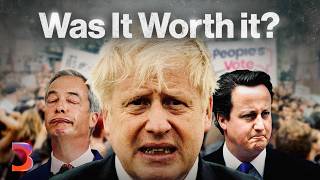 00:42
The moment the results came in — markets in freefall and a nation in shock
Watch at 00:42 →
00:42
The moment the results came in — markets in freefall and a nation in shock
Watch at 00:42 →
To get closer to an answer, economists compared the UK's actual GDP trajectory against a model built from 23 similar OECD economies — essentially asking: how would the UK have performed if it had stayed in the EU? The initial result showed a 10 percent gap, implying a £300 billion hit. But that headline figure does not survive scrutiny.
A large portion of the gap is driven by the extraordinary performance of the US and Irish economies. Ireland's GDP is heavily distorted by multinational accounting, and the United States benefited from massive fiscal stimulus and AI investment that had nothing to do with Brexit. Strip those out, and the estimated hit falls to somewhere between 2 and 4 percent of GDP — painful, but not catastrophic.
Some sectors have actually done reasonably well. Financial services, particularly derivative trading and venture capital, held up better than many expected. London remains one of the world's largest financial centres. Britain has also moved faster than the EU on areas like AI regulation, which the major US tech companies quietly appreciate. But no credible analysis produces a positive number for Brexit's overall economic impact. The direction of the effect is not really in dispute — only its magnitude.
Why Did So Many People Vote for Brexit?
Understanding the Brexit vote means understanding something that many commentators got badly wrong at the time: economics was not the primary driver for most Leave voters. Virtually every major economic institution — the IMF, the Bank of England, the Treasury — warned that leaving would be costly. People heard those warnings and voted to leave anyway. That tells you something important.
08:15
The GDP modelling comparison: UK actual performance vs. the counterfactual model
Watch at 08:15 →
At the heart of the Brexit debate was a profound disconnect between the winners and losers of globalisation. For the winners — concentrated in cities, working in finance, tech, or professional services — the European Union represented opportunity, freedom, and modernity. For the losers — communities that had watched stable manufacturing jobs disappear over decades — it represented a system that had taken something from them without ever asking permission.
There was also a deep cultural dimension. A significant portion of Leave voters felt that a cosmopolitan elite had been gradually redefining British identity without any democratic mandate. The slogan "take back control" worked precisely because it spoke to multiple grievances at once: control over borders, control over laws, control over who gets to define what Britain is.
And then there was immigration. In the decade before the referendum, net migration had climbed towards record levels, and politicians of every stripe had repeatedly promised to bring it down — and repeatedly failed. By 2016, many voters had simply stopped believing that anything would change unless something dramatic happened. Brexit was the dramatic thing available.
What Happened to UK Politics After Brexit?
If the economic damage turned out to be smaller than feared, the political damage has been larger than almost anyone predicted. Brexit did not just change a policy — it rewired the entire circuit board of British politics.
14:30
Boris Johnson's 'Independence Day' speech — the moment that revealed the true scale of Leave sentiment
Watch at 14:30 →
Five prime ministers came and went in short succession. David Cameron called the referendum and resigned when he lost it. Theresa May spent three years trying to find a Brexit deal that Parliament would accept and eventually resigned in exhaustion. Boris Johnson finally got a deal through, then resigned amid scandal. Liz Truss lasted 45 days. Rishi Sunak served out a term and was then decisively defeated at the polls.
The Conservative Party, which had governed Britain for most of the post-war period, was torn apart by Brexit along entirely new fault lines. The old left-right division was overlaid by a remain-leave division that cut across party loyalties, friendships, and families. The political fragmentation is visible in the data: the two-party share of the vote has collapsed, and the electoral map has become far more complicated than at any point in living memory.
Perhaps most significantly, Brexit has energised a politics of grievance and betrayal that shows no sign of fading. Nigel Farage, the politician most associated with making Brexit happen, has emerged as a serious contender for prime minister — running on the argument that Brexit was never properly delivered. The promise that created the movement is now fuelling its next phase.
Did Brexit Actually Reduce UK Immigration?
This is where the gap between promise and reality is most stark, and most politically explosive. One of the central expectations of many Leave voters was that Brexit would bring immigration down significantly. What actually happened was the opposite.
After 2016, net migration did not fall — it rose to record levels. The composition changed: fewer arrivals from EU countries, many more from the rest of the world. Under Boris Johnson, the government actively recruited workers from outside Europe to fill gaps in the labour market exposed by COVID. The numbers went up, not down.
This is why Brexit has become something of a self-reinforcing cycle of disappointment. The people who voted for it largely did so expecting a reduction in immigration. When that did not materialise, they felt cheated — not just by the EU, but by the politicians who had made the promises. That sense of betrayal has fed directly into the continued rise of populist politics in Britain.
22:10
The immigration data broken down by origin — EU arrivals fell, non-EU arrivals surged
Watch at 22:10 →
How Did Brexit Change the World Beyond the UK?
Brexit was not just a British story. It was, as one economist described it, an early warning light on the dashboard of globalisation — a signal that the post-Cold War consensus around open borders, free trade, and ever-closer international cooperation was fracturing.
The vote in June 2016 came just months before Donald Trump's election in the United States. Both events reflected the same underlying dynamic: large numbers of people who felt left behind by globalisation, distrustful of established institutions, and willing to take dramatic action to register their discontent. Brexit did not cause Trumpism, but the two phenomena fed each other.
More broadly, Brexit accelerated a shift toward a world organised around competing national and regional blocs rather than a single integrated global order. The EU, the US, and the major Asian economies are increasingly pulling in different directions. Britain, sitting outside the EU but not part of any other major bloc, finds itself with reduced leverage in almost every major geopolitical negotiation.
Could the UK Ever Rejoin the EU?
Recent polling suggests that 52 percent of the British public would now support rejoining the EU — the same margin, in reverse, as the original Leave vote. That symmetry is striking, but it does not translate automatically into political reality.
Full membership would require Britain to accept free movement of people — the very issue that drove the Leave vote in the first place. It would also require unanimous agreement from existing EU member states, some of whom have little incentive to make the process easy. And it would take years, during which the UK would have no influence over the EU rules it was in the process of adopting.
A more likely trajectory, according to most analysts, is some form of associate membership — closer alignment on trade, defence, and security, without full political integration. Prime Ministers Sunak and Starmer have both moved in this direction, negotiating agreements on specific areas of mutual interest. It is a pragmatic middle path, but it comes with its own tension: Britain would be accepting rules it has no say in making, which is precisely what Brexit was supposed to end.
What Are the Real Lessons of the Brexit Decade?
Ten years on, the Brexit experience has produced a few hard-won lessons that go well beyond the specific question of EU membership.
- Economics is not everything. When people feel that something important has been taken from them — security, identity, a sense of control — they will sometimes accept economic costs to get it back. Telling them the cost in advance does not necessarily change the calculation.
- Promises matter. Brexit was sold with specific, concrete promises: more money for the NHS, reduced immigration, restored sovereignty. When those promises were not delivered — or could not be delivered — the political backlash was severe and lasting.
- Leaving behind a significant minority is politically dangerous. The winners of the globalisation era consistently underestimated how much the losers had lost. Given the chance to register their displeasure, those left-behind communities took it — and the system has not yet found a way to respond adequately.
- Democratic legitimacy is remarkably durable. Despite everything — the chaos, the broken promises, the economic hit — no serious political movement in Britain has challenged the legitimacy of the referendum result or of democracy itself. That is, in its own quiet way, a significant thing.
The future, most observers agree, lies in moving past the Brexit argument and focusing on the structural problems that actually hold Britain back: low productivity, poor energy policy, an underfunded public sector, a stagnating standard of living. Brexit did not create those problems, but it consumed a decade of political energy that might otherwise have been spent addressing them. That, perhaps more than any GDP percentage point, is the true cost of the Brexit decade.