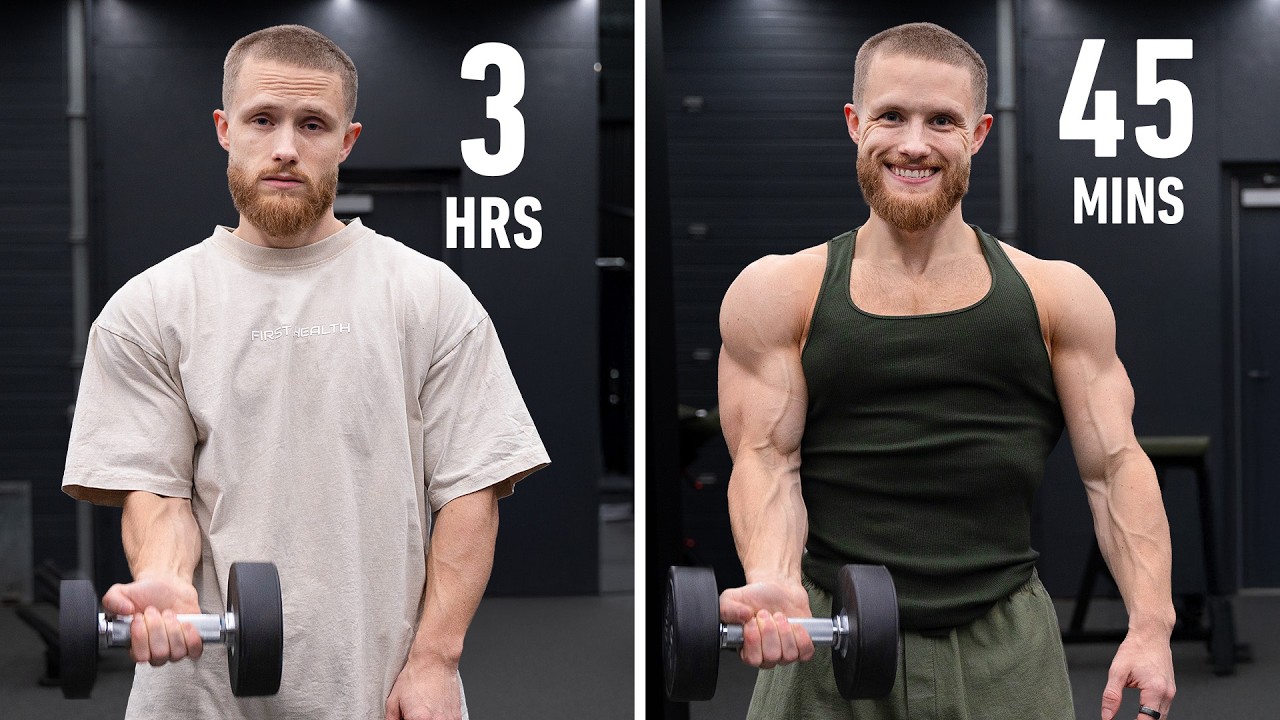

For over a decade, high volume training was gospel — 10 to 20 hard sets per muscle per week, backed by both bodybuilding tradition and a growing body of research. But after 100 days of deliberately cutting that volume in half (and sometimes by much more), the results forced a serious rethink of what actually drives muscle retention, especially when you're in a caloric deficit.
What "Volume" Actually Means
Training volume refers to the total number of hard working sets performed for a given muscle each week. If you train chest twice a week — three sets of chest press on Monday and three sets of cable flyes on Thursday — your weekly chest volume is six sets. That's it, simple math.
The standard science-based guideline that dominated the last decade landed at 10 to 20 sets per muscle per week. At the low end, that might look like 10 sets spread across two or three sessions. At the high end, you're looking at six or more exercises, multiple sessions per week, for a single muscle group — and that's before you account for every other muscle you're also training.
 03:45
Graph comparing high-end science-based volume, low-end science-based volume, and the experimental low-volume approach across all muscle groups
Watch at 03:45 →
03:45
Graph comparing high-end science-based volume, low-end science-based volume, and the experimental low-volume approach across all muscle groups
Watch at 03:45 →
During this 100-day experiment, the average volume dropped to roughly 6.5 sets per muscle per week. Most muscles received just four to six sets. Shoulders, back, glutes, and quads sat slightly higher at eight to ten sets. The split was upper, lower, rest, upper, lower, arms and delts, rest — repeated for 14 weeks, with nearly every set taken to failure.
What the Research Actually Says
The case for high volume is real. A 2010 meta-analysis by Krieger comparing one set versus two to three sets per exercise found that doing more sets produced about 40% more muscle growth. Follow-up research reinforced this, and a 2016 meta-analysis confirmed a clear dose-response: more volume, more gains.
Last year, the most comprehensive meta-analysis on the topic yet — covering 35 studies — found that same dose-response relationship holding from as few as four sets per muscle per week all the way up to 43. More volume kept winning.
But the literature has some important limitations worth understanding:
- Isolated muscle blasting: Most studies only applied high volumes to one or two muscle groups at a time. Extrapolating that to whole-body programming is a leap.
- Caloric context: Nearly all studies were conducted around maintenance calories. In a deficit, recovery capacity drops — which could change the calculus significantly.
- Short time horizons: Most interventions last 6 to 12 weeks. Whether high volume maintains its edge over a full year or two of training remains unknown.
- Diminishing returns: The marginal gains from adding more and more volume get progressively smaller. The relationship isn't linear.
The Maintenance Question and New Evidence
A key piece of research that reframes the volume debate comes from Bickel and colleagues. Subjects trained their legs at 27 sets per week for 16 weeks — a high-volume phase. Then half of them dropped to just three sets per week (one set per exercise, once weekly). After 32 more weeks at that ultra-low volume, they maintained 100% of their size and strength. Some subjects even continued gaining.
More recently, a study published in September 2024 by Herman and colleagues had 42 resistance-trained subjects follow a low-volume program: two full-body workouts per week, one set per exercise, roughly 30 minutes per session. After eight weeks, both a failure group and a near-failure group made significant gains. The failure group tended to grow more, underscoring that intensity compensates for volume when you push close to your limit.
A 2023 meta-analysis by Robinson and colleagues adds another dimension: the closer you train to failure, the more muscle you build. If any single variable deserves the title of primary growth driver, proximity to failure may have a stronger claim than sheer volume — particularly because low-volume training makes it sustainable to take nearly every set to failure without accumulating excessive fatigue.
What 100 Days of Low Volume Actually Produced
18:30
Side-by-side physique comparison photos at day 1 versus day 100
Watch at 18:30 →
The experiment ran during a cut, meaning calories were deliberately below maintenance throughout. Over 100 days, the DEXA results showed:
- Fat mass lost: 5.5 lbs
- Lean mass lost: 1.8 lbs
- Total weight lost: approximately 7 lbs
Crucially, breaking the DEXA data into two windows tells a more encouraging story. From day 30 to day 100 — 70 days of low-volume training — lean mass actually increased by half a pound while 2.3 more pounds of fat were lost. That lean mass change sits within the margin of error for DEXA, but the direction is notable.
Strength held up as well. Bench press strength was matched at day 100. Leg extension max increased by 15 lbs. In the final week of the cut — when calories were at their lowest — new personal records were hit on the pendulum squat, adding a rep each week at the same load while bodyweight continued to drop.
22:10
Strength test data for Smith machine bench press and leg extension across the 100-day period
Watch at 22:10 →
Beyond the numbers, a consistent subjective benefit emerged: focus. Knowing that one or two sets are all you get per exercise creates a different mental relationship with each set. Every rep carries more weight, attention doesn't drift, and workouts that used to drag past 90 minutes now clock in at 45 to 60. The dread that often accompanies high-volume leg days disappeared entirely.
Updated Recommendations Based on the Evidence
The research on volume is not wrong — higher volume does produce more muscle growth on average. But context matters enormously, and two updated positions emerge from this experiment:
When cutting: Low volume with high intensity is likely the smarter approach. Recovery capacity is reduced in a deficit, high-volume programs become harder to sustain, and the evidence on muscle maintenance shows that a fraction of the volume needed to build muscle is sufficient to keep it. Pushing every set close to failure becomes the primary lever.
When bulking: Rather than spreading moderate volume across every muscle group, consider keeping overall volume relatively low while concentrating high volume — 10 to 30 sets per week — on one priority muscle at a time. Rotating that focus every few months may be especially effective for advanced trainees who are approaching their natural ceiling in most areas.
The takeaway is not that volume is irrelevant. It's that training intensity and recovery context are variables that interact with volume in ways that short-term studies can't fully capture. For anyone cutting fat or pressed for training time, a low-volume, high-intensity program isn't a compromise — it may genuinely be the optimal approach.