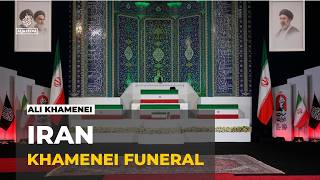
The coffin of Iran's late Supreme Leader Ayatollah Ali Khamenei was placed on public display in Tehran as the country held one of the most significant state funerals in its modern history. Alongside him rested the coffins of his three-year-old granddaughter, his eldest daughter, his son-in-law, and his daughter-in-law — all killed together in a joint US-Israeli strike in February. Thousands filled the streets of Tehran, foreign dignitaries arrived from across the region, and a nation paused to grieve — and to signal something to the rest of the world.
 00:12
Coffins of the Supreme Leader and family members on display at the Tehran funeral ceremony
Watch at 00:12 →
00:12
Coffins of the Supreme Leader and family members on display at the Tehran funeral ceremony
Watch at 00:12 →
The funeral had originally been scheduled for March but was delayed due to the ongoing war on Iran. Now, with the ceremony finally underway, analysts and observers are reading every detail for what it says about Iran's present — and its future.
What Happened at Iran's Supreme Leader Funeral?
The public ceremony began on Saturday in Tehran, where the coffins were placed on display for an enormous crowd of mourners. The procession was then planned to move through holy cities in both Iraq and Iran, honoring the Supreme Leader's religious stature as well as his political legacy. Senior research fellow Abasani, speaking from Tehran at the Center for Middle East Strategic Studies, described the city as buzzing with preparation, with people flowing in from cities across the country.
"The city is expecting a huge amount of people," Abasani noted, emphasizing that this was not just a political event but a deeply emotional moment for ordinary Iranians who felt they had lost a defining national figure. Foreign dignitaries and officials were already paying tribute before the main procession even began.
01:45
Senior research fellow Abasani speaking live from Tehran about the funeral's significance
Watch at 01:45 →
How Did Iran's Supreme Leader and His Family Die?
The Supreme Leader and his family members were killed in a joint US-Israeli military strike in February — a moment that sent shockwaves through Iran and the broader Middle East. The strike killed not only the country's top leader but also his young granddaughter, just three years old, making the loss deeply personal for many Iranians beyond its political dimensions.
The strike came during what analysts describe as a period of direct military conflict, with Iran facing pressure from two of the world's most powerful military forces simultaneously. Despite this, Iran's missile capabilities — and what Abasani called a rare public show of popular support on city streets condemning the aggression — helped sustain the government through the crisis.
Which World Leaders Attended the Funeral?
The attendance list at the funeral became its own geopolitical statement. High-level officials from across the Middle East and Asia made their way to Tehran, reflecting Iran's sustained diplomatic push to strengthen ties with regional and Asian partners. Notably absent, however, were representatives from Western and European nations — a direct consequence of their alignment with the United States and Israel during the recent conflict.
Abasani was direct about this divide: "There are countries who might not be willing to attend or they have not been in good terms with Iran, including some European or Western countries. They sided with the United States and Israel in the war against the country."
03:20
Foreign dignitaries arriving in Tehran to pay tribute at the state funeral
Watch at 03:20 →
The presence of regional leaders, however, was seen as a meaningful endorsement. It signaled that despite the war and its devastating toll, Iran had not been diplomatically isolated within its own neighborhood — a significant outcome that Tehran's foreign policy establishment had worked toward for years.
How Does This Change the Middle East's Geopolitical Balance?
Analysts have been tracking a notable shift in Iran's geopolitical standing following the war. The country fought against two of the world's most powerful militaries and — by the Iranian government's framing — survived. That narrative, whether accepted internationally or not, carries weight at home and in parts of the Global South.
The funeral itself becomes part of that narrative. A massive, visible ceremony attended by regional leaders sends a message: Iran is still here, still connected, and still capable of projecting influence. Abasani argued that the man being buried was seen inside Iran as "the architect of the defense" against the US-Israeli strike — and that his farewell ceremony reinforces rather than undermines that story.
For Iran's negotiating teams currently in talks with the United States, that backdrop of national unity and public support is not just symbolic. It is, according to Abasani, a "driving force" that could strengthen their hand at the table.
Can Iran Stay Unified After Losing Its Supreme Leader?
This is perhaps the most complex question hovering over the ceremony. Iran is not a country without internal divisions. Before the war, large-scale protests — many focused on economic grievances — were a visible sign of public frustration with the government. The question of whether the unity on display at the funeral will outlast the funeral itself is one that analysts take seriously.
Abasani pointed to a key shift in public psychology following the strike: "People are more than ever feeling that threat against the country. Their perception of external threat has been strengthened." When people feel externally threatened, internal grievances can be temporarily set aside. Security becomes the top priority — and the government becomes the provider of that security.
However, Abasani was careful not to overstate this. He acknowledged that the economy remains a pressing concern, and that the government's ability to maintain unity will depend heavily on how it acts in the coming months. Unity born from crisis is fragile. It needs to be reinforced by tangible improvements in people's lives to become durable.
- Rallying around the flag: External threats often produce short-term national cohesion across political factions.
- Economic pressure remains: Pre-war protests over the economy have not disappeared — they have been paused.
- Government performance matters: Whether unity holds will depend on what the Iranian government delivers next.
What Is Iran Negotiating With the US Right Now?
Iran is currently engaged in negotiations with the United States, though the specific terms being discussed were not detailed in the briefing. What is clear is that these talks are happening in the shadow of a recent war, a massive state funeral, and significant national emotion. That context shapes everything.
Abasani suggested that the sense of unity generated by the funeral — and the broader rally-around-the-flag effect from the war — could actually benefit Iran's negotiating position. A government that appears to have strong public backing is harder to pressure into unfavorable concessions. Whether that leverage translates into meaningful diplomatic gains remains to be seen.
Where Was Iran's Supreme Leader Buried?
Following the public ceremonies in Tehran and the procession through holy cities in Iraq and Iran, the Supreme Leader was laid to rest in Mashhad — his birthplace and one of the holiest cities in Iran. The choice of burial location carries both personal and symbolic weight, connecting the leader's origins to his final resting place and cementing his legacy within Iran's religious and cultural geography.
Mashhad, home to the shrine of Imam Reza, is a city of immense spiritual significance for Shia Muslims, making it a fitting — and powerful — final destination for a man who defined the intersection of religious authority and political power in Iran for decades.
The Bottom Line
The funeral of Iran's Supreme Leader is far more than a moment of national mourning. It is a carefully observed geopolitical event, a test of Iran's internal cohesion, and a signal to the world about how Tehran sees itself after surviving one of the most intense military confrontations in its modern history. Whether the unity on display becomes a lasting foundation — or fades as the cameras leave — will define Iran's next chapter more than any single diplomatic meeting or military posture ever could.