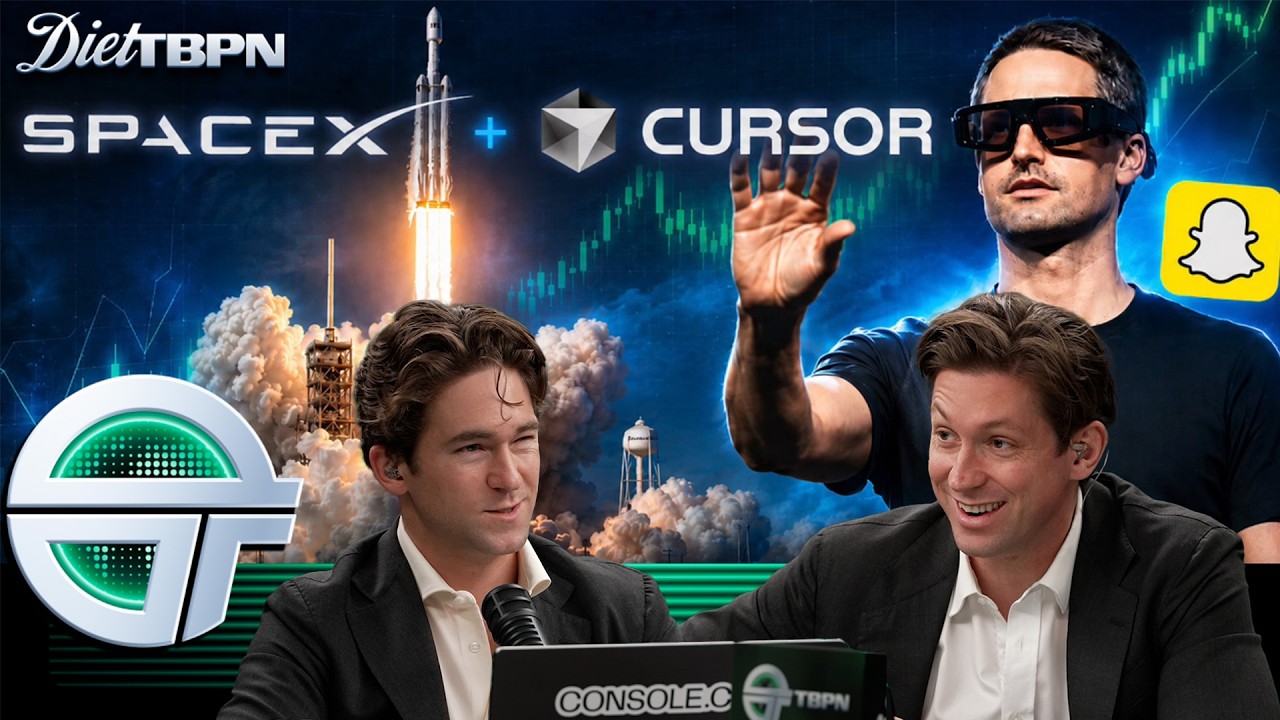

SpaceX acquired Cursor for $60 billion in new stock — and thanks to a monster surge in SpaceX's valuation, the deal effectively paid for itself four times over. The acquisition is being called the largest VC-backed strategic sale in history, and it happened almost overnight, sending push notifications flying and leaving even seasoned investors doing double-takes at their screens.
Why Did SpaceX Acquire Cursor for $60 Billion?
The short answer: SpaceX used freshly printed, high-flying equity to buy one of the most valuable AI companies in the world before its post-IPO lockup window closed. Cursor, the AI-powered coding assistant with billions in revenue, was acquired using SpaceX stock at a moment when that stock was surging. The deal was structured so SpaceX had until Q4 to pull the trigger — and they did.
 00:45
Hosts react in real time to SpaceX after-hours surge notifications
Watch at 00:45 →
00:45
Hosts react in real time to SpaceX after-hours surge notifications
Watch at 00:45 →
As one investor put it, this is brilliant corporate finance: use newly printed, retail-inflated currency to acquire real businesses ahead of the lockup expiring. It's arguably one of the most creative ways to deploy equity into an IPO pump. Cursor had reportedly been in discussions for a while, and institutional investors following SpaceX privately knew the option was almost certainly going to be exercised.
For the Cursor team, investors like Thrive Capital, a16z, and Codeium, the outcome is beyond a home run. We've never seen an M&A exit for a young VC-backed startup north of $50 billion. Sixty billion in an acquisition — not an IPO — is genuinely unprecedented.
What Is SpaceX's Market Cap in 2025?
After hours trading sent SpaceX's market cap rocketing past expectations. The company now sits comfortably in the top five most valuable companies on Earth, neck and neck with Microsoft at just shy of $3 trillion. For context:
03:10
Breakdown of top 5 most valuable companies with SpaceX now in the mix
Watch at 03:10 →
- Nvidia: ~$5 trillion
- Alphabet & Apple: ~$4–4.5 trillion each
- Microsoft & SpaceX: approaching $3 trillion each
SpaceX's market cap more than quadrupled in the run-up to and following the IPO, meaning the $60 billion paid for Cursor represents less than the value added in a single day of trading. The stock was up another 14% after hours at the time of this recording, with one analyst noting that Elon Musk made more money in a single day than Warren Buffett made across his entire career.
Is This the Biggest VC-Backed Acquisition in History?
Yes — definitively. According to commentary from prominent investors tracking the deal, the past five days produced both the biggest VC-backed IPO ever and the biggest VC-backed strategic sale ever. No VC-backed startup had ever been acquired for north of $50 billion before this. Sixty billion in an M&A context is so large that it's easy to lose perspective when trillion-dollar valuations are being thrown around — but it's an extraordinary milestone.
What makes it even wilder is the structure: this wasn't a cash deal. SpaceX issued stock at a sky-high valuation to buy a company with real revenue and real enterprise value. If SpaceX's stock retreats, the math looks different. But right now, the Cursor team and its backers are sitting on one of the most spectacular venture outcomes ever recorded.
What Does Cursor Do and Why Is It Worth $60B?
Cursor is an AI-powered coding assistant — essentially a supercharged development environment that helps engineers write, debug, and ship code faster using large language models. At its peak, Cursor made up 40 to 50% of Anthropic's revenue, which tells you everything about how deeply embedded it became in the developer workflow.
07:22
Discussion of whether SpaceX will pursue more acquisitions after Cursor
Watch at 07:22 →
The company went from being a primary revenue driver for Anthropic to watching Claude Code emerge as a direct competitor. Anthropic initially told Cursor that Claude Code was "just a research effort" — a line that echoes similar messaging given to Figma and Canva around design tooling. Then, of course, it became a real product. The lesson: every AI foundation model company is a general-purpose technology platform, and they will eventually compete with their own best customers.
For SpaceX, Cursor brings something tangible: billions in revenue, a massive developer user base, and a foothold in the AI software layer. Combined with SpaceX's NeoCloud compute ambitions and terrestrial data center expansion, there's a clear path to monetization that goes well beyond rockets.
Will SpaceX Keep Acquiring Companies?
That's the question everyone is asking. Elon Musk has historically been a build-not-buy operator — Tesla, for example, has done very few acquisitions. But the Cursor deal may signal a pivot. If you can use high-multiple equity to acquire real businesses with real revenue, why wouldn't you?
The speculation is already underway: NeoLabs, compute infrastructure providers, NeoCloud operators — could SpaceX be assembling pieces of a vertically integrated AI and compute empire? One deal a month at this valuation would be a completely different operating philosophy, but given the success of this transaction and where the stock is trading, it's not an unreasonable scenario to model.
14:05
Price-to-sales comparison: SpaceX at 150x vs Amazon at 3.6x
Watch at 14:05 →
The key question for retail investors: are more acquisitions already in the pipeline? Because if they are, and the stock continues to run, the playbook writes itself.
How Does SpaceX Stack Up Against Amazon and Microsoft?
The price-to-sales comparison is eye-opening. At current valuations, SpaceX trades at approximately 150x price-to-sales. Compare that to Amazon at 3.6x and Microsoft at 9.2x. That's not a typo.
The bullish read: if Amazon traded at SpaceX's price-to-sales multiple, it would be worth roughly $100 trillion. The bearish read: SpaceX is priced for a future that hasn't happened yet, and the float is thin until lockup expires. When that float opens up, retail investors who piled in at the top could be holding for years.
What makes SpaceX different from a pure comps argument is the narrative premium: rockets, Mars, Starlink, mass drivers on the moon. Inspiration commands a multiple that spreadsheets can't fully capture. That's not an investment thesis — but it is a real market dynamic.
Snap Spectacles 2025: Price, Specs, and Viability
Shifting gears: Snap officially unveiled its Spectacles AR glasses at $2,195, with CEO Evan Spiegel calling them "the next computer." The pitch is that they occupy a sweet spot between bulky, capable headsets (like Microsoft's HoloLens at 580 grams) and lightweight glasses that don't do much. Snap Spectacles weigh in at 132 grams — heavier than Meta's Ray-Ban smart glasses at 70 grams, but dramatically lighter than any true AR headset.
The challenge is the price point. At $2,200, you're approaching Apple Vision Pro territory ($3,499), but without Apple's ecosystem or Meta's hardware subsidy strategy. Meta came in with Ray-Ban smart glasses at around $300 — a price where even casual curiosity converts to a sale. At $2,200, you need true believers.
Snap stock dropped 7% on the announcement. The specs check boxes on field of view and wearability, but the developer ecosystem is unproven. The hope is that a breakout app — maybe a YC-backed startup building exclusively on Spectacles — creates a killer use case that drives adoption. Without that, it's a very expensive piece of hardware looking for a problem to solve at scale.