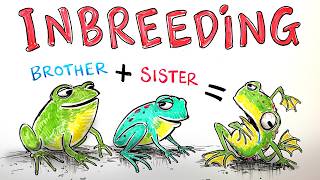
So why does inbreeding lead to poor offspring? The short answer is that it forces harmful recessive genes — ones that normally stay hidden — to pair up and express themselves. But here's what most people don't know: the full story is far more nuanced, and evolution has been quietly navigating this problem for millions of years. The damage is real, but so is the recovery. Let's break down exactly what's happening at the genetic level.
Why Does Inbreeding Lead to Poor Offspring?
To understand why inbreeding is harmful, you first need to understand how genes actually work. Humans are diploid creatures, meaning we carry two copies of every gene — one from each parent. Some genes are dominant, meaning a single copy determines your physical trait. Others are recessive, meaning they only show up when you inherit two copies of that version.
 01:15
Explanation of dominant vs. recessive genes using eye color as an example
Watch at 01:15 →
01:15
Explanation of dominant vs. recessive genes using eye color as an example
Watch at 01:15 →
Here's where inbreeding becomes dangerous. When closely related individuals — say, a brother and sister — have children together, they likely share many of the same genetic variants, including harmful recessive mutations. The probability that their child inherits two copies of a damaging recessive gene skyrockets compared to unrelated parents. That's inbreeding's core problem: it takes rare hidden mutations and suddenly makes them visible — and devastating.
What Are Recessive Genes and Why Are They Dangerous?
A recessive gene becomes harmful in a very specific way. Imagine a gene that produces a critical protein. A mutation scrambles the instructions, and suddenly that protein no longer functions. Under normal circumstances, your body compensates — the working copy of that gene simply ramps up production to cover the gap. You feel nothing. You never know the broken version is even there.
This is why harmful recessive mutations persist in the population: there's no penalty for carrying one copy. Natural selection can't act on what it can't see. The broken gene hitchhikes through generations completely undetected, shielded by its functional partner.
04:30
The estimate that each person carries roughly 8 devastating recessive alleles
Watch at 04:30 →
But pair two carriers together — especially closely related ones — and the math turns ugly. Their child has a real chance of inheriting the broken copy from both parents simultaneously, leaving no working gene to compensate. The result can be severe developmental disorders, metabolic diseases, or worse.
How Many Harmful Recessive Genes Does the Average Person Carry?
This is where it gets genuinely unsettling. Estimates suggest that the average person carries roughly eight devastating recessive alleles somewhere in their genome — mutations severe enough to cause serious harm if expressed. And most of us have absolutely no idea, because we're walking around with one functional copy keeping the other in check.
These mutations are rare individually, so in a large, genetically diverse population, two people randomly mating are unlikely to share the same damaging recessive. The odds of two strangers both carrying an identical rare mutation are low. But relatives? The odds are very different. A sibling may have inherited the same recessive mutation from the same parent. The lottery that protects you in a diverse population stops working when you breed close to home.
What Is Inbreeding Depression and How Does It Work?
Inbreeding depression is the technical term for the decrease in biological fitness — survival, fertility, health — that results from mating between closely related individuals. It's well-documented across the animal kingdom, from laboratory fruit flies to wild cheetahs.
08:45
The pregnant bat thought experiment illustrating the evolutionary upside of founding a new population
Watch at 08:45 →
The severity scales with how closely related the parents are. Sibling or parent-child pairings are the most harmful. First cousins represent a much more distant genetic overlap, which is why — historically — cousin marriages, while not ideal, were practiced widely across many cultures without the catastrophic outcomes seen in closer pairings. Even Charles Darwin, who married his first cousin Emma Wedgwood, understood something was wrong only in hindsight: one of their children suffered from significant health problems, likely a product of deleterious recessives that 19th-century science couldn't yet explain.
Is Marrying a First Cousin Actually Genetically Dangerous?
The risk exists, but it's far lower than popular culture suggests. First cousins share roughly 12.5% of their DNA. That overlap does modestly increase the chance of harmful recessive genes pairing up, but it's nowhere near the danger zone of sibling reproduction. Throughout most of human history, in small communities with limited mate choices, first-cousin marriage was common enough that it left measurable but generally manageable genetic consequences.
That said, in modern society with abundant unrelated mates available, there's little genetic argument for it — the small but real elevated risk serves no purpose when alternatives exist. The story changes dramatically in isolated communities where cousin marriage persists across multiple generations, compounding the risk with each new generation.
Can Populations Actually Recover from Extreme Inbreeding?
Here's the part of the inbreeding story that rarely gets told — and it's genuinely fascinating. Yes, inbreeding initially hammers a population. Fitness drops. Individuals suffer. But then something remarkable happens: the cost drops, often dramatically.
Why? Because forced inbreeding does something selection normally cannot: it makes those hidden recessive mutations visible. When a population is squeezed through a genetic bottleneck — reduced to dozens or even fewer individuals — harmful recessives suddenly start pairing up everywhere. Individuals carrying two copies of damaging mutations fare poorly and leave fewer offspring. Selection, finally able to see the mutations, begins purging them from the gene pool.
Over generations, the population's genetic load of harmful recessives can actually decrease. The survivors are, in a brutal but effective way, genetically cleaner than the original population. This is called purging, and it helps explain one of the more astonishing stories in conservation biology.
How Did Sea Otters and Elephant Seals Survive Near-Extinction?
Northern elephant seals were hunted to fewer than 100 individuals in the late 19th century. Today their population numbers in the hundreds of thousands. Sea otters faced a similar collapse and have since recovered impressively. Both species went through intense inbreeding during their population lows — and both bounced back with thriving, reproductively viable populations.
How? Genetic purging is the leading explanation. The bottleneck forced harmful recessives into the open, selection removed the most severely affected individuals, and the surviving lineages carried a reduced burden of those hidden mutations going forward. It's a harrowing process — many individuals don't survive it — but for a species on the brink, it can be the difference between extinction and recovery.
This has a broader implication for how we think about evolution. Populations haven't just survived bottlenecks — many of today's thriving species almost certainly passed through them. The expectation that inbreeding is an evolutionary dead end appears to be wrong, or at least dramatically overstated.
What Does This Mean for How We Understand Genetics?
The takeaway isn't that inbreeding is fine — it clearly isn't, especially at close degrees of relation. The costs are real and can be severe. But the narrative that inbreeding is always catastrophic and irreversible misses a crucial part of the picture.
- Inbreeding depression is real and hits hardest in the first generations after a bottleneck.
- Genetic purging can reduce that cost over time by exposing and eliminating harmful recessives.
- Many successful species alive today almost certainly passed through severe inbreeding events.
- The genetic lottery we all carry — roughly eight devastating hidden mutations — is manageable in diverse populations but becomes a serious liability when relatives reproduce.
Evolution, as always, is less about ideals and more about what works well enough, often enough, under enough circumstances to keep a lineage going. Inbreeding is a gamble — but under the right conditions, it's a gamble that life has been willing to take, and occasionally win.