
Turning a YouTube channel into a real product business is one of the most talked-about moves in the creator economy — and one of the least successfully executed. Epic Gardening's Kevin Espiritu is one of the rare creators who actually pulled it off. Starting with a blog in the early 2010s, Kevin grew Epic Gardening into a multi-million dollar operation that includes a seed company, a physical products line, a membership program, and a wholesale presence in 75% of independent nurseries across the United States. The secret wasn't some complicated venture-backed playbook. It started with a single metal raised bed and a shipping container he almost sent to the wrong port.
How Do You Turn a YouTube Channel Into a Real Business?
Kevin's answer to how to turn a YouTube channel into a product business is deceptively simple: let your audience pre-validate the product for you. By 2019, Epic Gardening was generating around $250,000 per year through Google ads, YouTube ads, and brand sponsorships. It was real money — but Kevin recognized a critical weakness. Every single revenue stream was tied to traffic. If the algorithm shifted or a brand pulled out, all three streams dropped together.
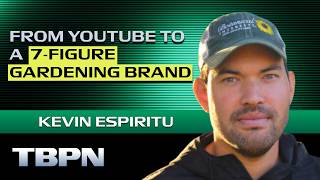 04:15
Kevin explains how his audience kept asking about a specific raised garden bed — and how that became Epic Gardening's first physical product
Watch at 04:15 →
04:15
Kevin explains how his audience kept asking about a specific raised garden bed — and how that became Epic Gardening's first physical product
Watch at 04:15 →
So he started looking at what his audience was already asking about. The answer kept coming back to the same thing: a galvanized metal raised garden bed he'd received from an Australian manufacturer. He tracked down the company and emailed them every quarter for over a year until they finally said yes. That one decision changed the entire trajectory of the business.
The core insight here applies to any creator: your content is not just a media asset. It's a pre-validation engine. If your audience keeps asking about something, that's not just engagement — that's market research telling you what to sell next.
How Did Epic Gardening Start Selling Its First Product?
Kevin's first e-commerce experience was, by his own admission, a disaster in the best possible way. He had $70,000 in the bank, spent $40,000 on a shipping container of raised beds, and initially planned to pick up the container himself at the port of San Diego — which doesn't accept shipping containers. The container went to Long Beach. He looked into renting Costco self-storage and setting up satellite internet to print orders from the unit.
09:42
The story of Kevin nearly shipping a container to the wrong port and planning to unload it from Costco self-storage
Watch at 09:42 →
Friends eventually talked him into using a third-party logistics company. He then posted an Instagram story telling his audience the beds they kept asking about were finally available. He had 550 units. They sold out in two days. He used that cash to buy another container. That sold out in two days too.
By the end of 2019, the product line had matched the entire media business in revenue. The business had effectively doubled — and Kevin hadn't invented a single thing. He was the distributor. The content was the customer acquisition channel. And crucially, his customer acquisition cost was negative — he was being paid to make the YouTube videos that were driving the sales.
Then the pandemic hit. What had been a promising side business exploded. Revenue went from roughly $500K to $2.8 million, then $7.1 million the following year. A Series A raise followed shortly after.
Should You Buy or Build? The Seed Company Acquisition Explained
By late 2021, Kevin had taken Epic Gardening from four contractors and himself to raising institutional capital. The next major move was acquiring a seed company — and the build-versus-buy question here had a clear answer: buy, almost always.
18:30
Kevin breaks down why acquiring a seed company made more sense than building one from scratch
Watch at 18:30 →
Seed is an operationally intensive business. Epic Gardening now sells nearly 800 varieties of vegetables, flowers, and herbs. The supplier relationships are built over years. Buy orders are placed two years in advance. The seed-packing machines are made by a handful of German manufacturers, and a technician literally flies over to fix them. Building that infrastructure from scratch would have taken a decade.
But the strategic logic went deeper than operations. Seeds are the only item in gardening that customers literally need to repurchase every single year. Raised beds, tools, trays — you can skip a year. You can't skip seeds if you want a garden. That recurring purchase behavior is the kind of retention curve most e-commerce businesses spend millions of ad dollars trying to manufacture artificially.
The acquisition also came with a wholesale distribution network spanning 75% of independent nurseries nationwide — infrastructure that would have taken years and a full sales team to build organically. And as a bonus, Kevin had actually started his own gardening journey with the brand he acquired, giving the story an authentic heritage angle that resonated with the existing audience.
The team went from roughly five people to about 90 almost overnight, absorbing the seed company's 60-person headcount. Within a year, Kevin had brought in a president — a former Chief Growth Officer at GameStop — to run operations while he stayed focused on content strategy and brand.
Why Are Seeds One of the Best E-Commerce Products in Gardening?
Compared to raised beds — which are heavy, dimensionally expensive to ship, and a one-time purchase for most customers — seeds are nearly the perfect e-commerce product. High gross margins. Light weight. Repeat purchase behavior baked in by nature itself. The only catch is the complexity of sourcing and testing at scale, which is exactly why the acquisition made more sense than a build.
29:10
Kevin describes the Magnolia Network deal and the math that showed YouTube was a better investment of his time
Watch at 29:10 →
The seed business was also predominantly wholesale when Epic acquired it, with only 15-20% of revenue coming through direct-to-consumer channels. Simply by paying attention to DTC and plugging it into the existing content engine, Epic tripled that revenue without a major overhaul. That's the compounding advantage of owning both the media and the commerce: distribution improvements that would cost a pure-play e-commerce brand a significant paid media budget cost Epic Gardening almost nothing.
How Is Epic Gardening Using AI in the Business?
Epic Gardening launched a membership program that bundles commercial perks — store discounts, free shipping, free returns — with an AI-powered educational layer. The model was trained on Epic's own internal content library and licensed plant databases covering varieties, weather data, and growing conditions. When a member asks a question or uploads a photo of a struggling plant, the system returns an answer aligned with how Epic would actually respond — not a generic GPT reply.
If the AI can't resolve the issue, it routes the user to a live human support agent. It's a two-tier model that keeps the brand voice consistent while scaling customer education far beyond what a human team could handle alone.
On the content side, Kevin described AI as a game-changer for first drafts. Scripting, outlining, and ideation workflows have all gotten faster. The nuance, though, is that gardening advice is deeply bespoke — it varies by climate, soil type, season, and individual growing conditions. That local specificity is exactly where a human expert voice still wins, and it's part of why the channel has stayed relevant for over a decade.
Should Creators Do Hollywood Deals or Stay on YouTube?
Kevin tried the Hollywood path. In June 2020, he signed a deal with Chip and Joanna Gaines's Magnolia Network for a home transformation series. The pandemic complicated the original format, so he pivoted to documenting the buildout of his own newly purchased home — 45 straight days of 10-plus-hour filming days with a skeleton crew.
Meanwhile, his YouTube channel grew from 180,000 subscribers to over one million that same year. When he did the math, he realized that 45 days of YouTube content creation would have generated more direct revenue and more long-term brand equity than the entire television deal.
His current philosophy is more selective. Epic has licensed 200 hours of content to a Samsung FAST channel and co-produced an eight-episode series with Home Depot's YouTube channel. These deals work because they don't require pulling the creator away from the core content engine. For creators at the scale of MrBeast, a Prime Video deal is a no-brainer. For most creators, the opportunity cost of going dark on YouTube for six months rarely pencils out.
How Do You Keep a Gardening YouTube Channel Growing for 13 Years?
Kevin has been on YouTube since 2013 — by his own count, roughly two full YouTuber lifespans. The early strategy was pure SEO: "how to grow basil," "how to prune tomatoes," "what to plant in March." Those videos still exist, but the search landscape for basic gardening queries is now saturated.
The evolution has been toward repeatable formats with seasonal hooks — what to plant in April, how to care for your garden in June — and higher-production formats like garden makeovers and garden tours that can be batch-filmed in a single week. The seasonal structure of gardening itself is a content engine: the calendar resets every year, and so does the audience's need for timely advice.
Kevin's other insight about longevity: treat every platform as its own ecosystem. Trying to funnel Instagram followers to YouTube or YouTube subscribers to a newsletter rarely works at scale. Each platform has to earn its own audience on its own terms. The content strategy adapts to the platform, not the other way around.
The Creator-to-Commerce Playbook, Summarized
- Let your audience validate the product before you build it. If the same question keeps coming up, that's your product roadmap.
- Your content is your customer acquisition cost. If you're getting paid to make videos, your CAC is effectively negative — a structural advantage most e-commerce brands would pay millions for.
- Buy, don't build, when the infrastructure is prohibitively complex. Seed sourcing, wholesale networks, and specialized equipment don't scale fast through organic growth.
- Add a recurring revenue product as early as possible. Seeds, memberships, subscriptions — anything that brings customers back without paid acquisition.
- Protect the content engine. Hollywood deals, brand integrations, and side projects are worth doing only when they don't compromise the output that drives everything else.