
The hedgehog and fox theory of thinking is a philosophical framework that divides people into two categories: those who see the world through one defining lens, and those who embrace complexity, nuance, and multiple perspectives. Originally drawn from an ancient Greek line by poet Archilochus — "The fox knows many things, but the hedgehog knows one big thing" — philosopher Isaiah Berlin formalized the idea in his 1953 essay. And decades later, political psychologist Philip Tetlock used it to explain one of the most unsettling findings in modern research: the most confident experts are often the most wrong.
 00:45
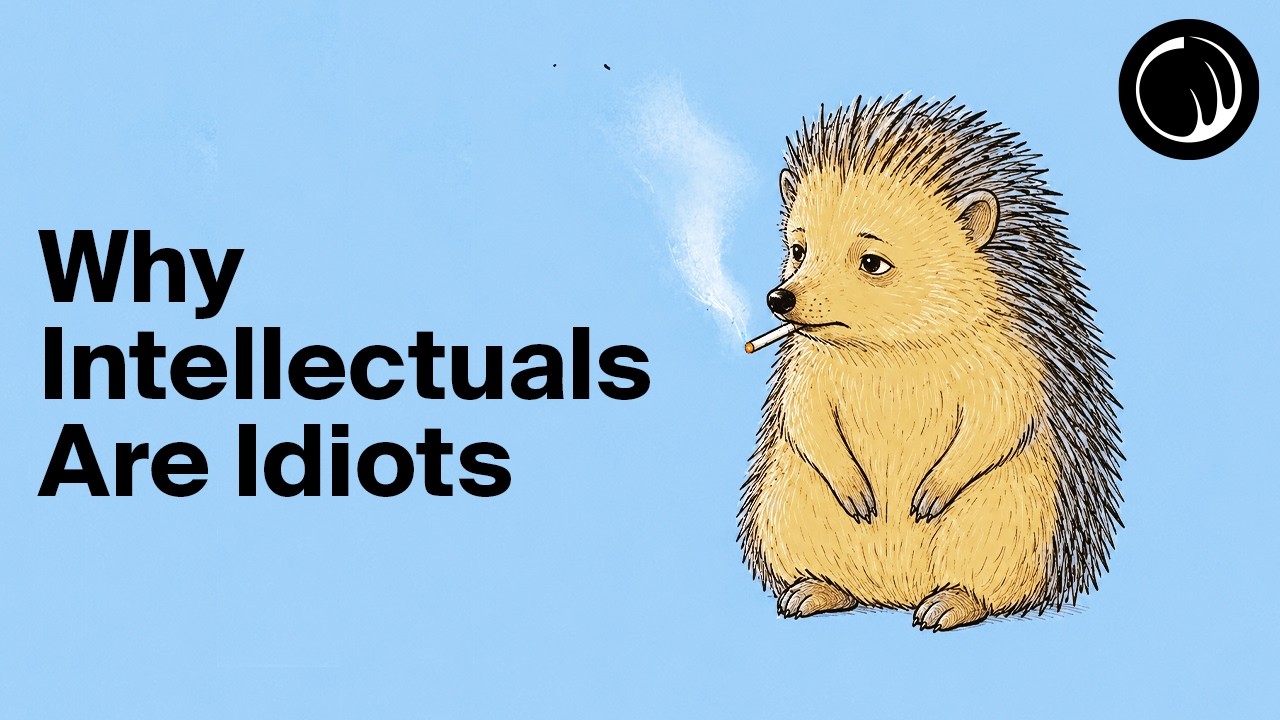
The hedgehog curls into a ball — one strategy, used every time. The fox adapts. This visual contrast sets up Berlin's entire framework.
Watch at 00:45 →
00:45
The hedgehog curls into a ball — one strategy, used every time. The fox adapts. This visual contrast sets up Berlin's entire framework.
Watch at 00:45 →
What Is the Hedgehog and Fox Theory of Thinking?
Isaiah Berlin's framework identifies two fundamentally different cognitive styles. Hedgehogs view the world through a single, organizing principle. They are confident, decisive, and inclined to fit everything they observe into one overarching theory or worldview. Their strength is clarity. Their weakness is rigidity.
Foxes, on the other hand, resist the urge to reduce the world into a single explanation. They pursue many ideas, tolerate contradiction, and remain open to being wrong. They're more likely to say "it depends" than "here's the answer." Their strength is accuracy. Their weakness, at least in the marketplace of ideas, is that nuance doesn't sell.
Berlin described hedgehog thinkers as those who "relate everything to a single central vision, a single universal organizing principle." Foxes, by contrast, "pursue many ends, often unrelated and even contradictory." Neither style is inherently superior — until you start measuring who's actually right.
Why Are Experts So Bad at Making Predictions?
Here's the uncomfortable truth: expertise does not reliably translate into accurate prediction. Most of us assume that a person with decades of experience, advanced degrees, and prominent public standing must have an edge on understanding how the world works. The data says otherwise.
05:10
Tetlock's study results visualized: 28,000 predictions, barely better than chance, with hedgehogs performing worst of all.
Watch at 05:10 →
When Philip Tetlock began tracking expert predictions in the 1980s, he wasn't expecting to find that most experts perform barely better than chance. Yet that is precisely what emerged. Across nearly 28,000 predictions from 284 experts tracked over 18 years, the overall accuracy was only marginally above random guessing — and in some cases, worse.
Part of the reason is what psychologists call the illusion of explanatory depth — our tendency to believe we understand complex systems far better than we actually do. Economists, political analysts, and policy experts routinely operate in domains governed by enormous complexity, feedback loops, and irreducible uncertainty. Confidence, in these environments, is often a performance rather than a reflection of actual knowledge.
What Did Philip Tetlock's 20-Year Study Actually Find?
Tetlock's landmark study, which formed the basis of his book Expert Political Judgment, tracked 284 experts — academics, journalists, analysts, and public intellectuals — nearly all with postgraduate education and an average of 12 years of field experience. The results were humbling across the board.
But buried inside the broadly poor performance was a critical distinction. When Tetlock applied Berlin's hedgehog and fox framework to classify his experts by thinking style, a clear pattern emerged: foxes significantly outperformed hedgehogs. The more confident and theoretically rigid the expert, the worse their predictions. Foxes — those who were more open, more tentative, and more willing to integrate conflicting information — were not only more accurate, but also better calibrated about their own uncertainty.
09:30
The media incentive loop explained: why confidence and charisma get amplified regardless of accuracy.
Watch at 09:30 →
Tetlock wrote that foxes "consistently edge out the hedgehogs, but enjoy their most decisive victories in long-term exercises inside their domains of expertise." In other words, the very domain where hedgehogs feel most authoritative is where the gap between the two styles is the widest — and where hedgehog overconfidence does the most damage.
The irony is almost poetic: the experts most likely to appear on television, write bestselling books, and command large audiences are disproportionately the hedgehogs — the ones with the bold, sweeping frameworks and the unshakeable confidence. And they are, on average, the least accurate.
Why Does Media Reward the Most Overconfident Voices?
If foxes are more accurate, why do hedgehogs dominate public discourse? Because accuracy and popularity are not the same thing — and the incentives of modern media heavily favor the latter.
Think about what media platforms actually amplify: confidence, charisma, certainty, contrarianism, simplicity, and fear. None of these qualities, on their own, are reliable markers of good information. In fact, they're often indicators of the opposite. A pundit who says "this is exactly what's going to happen and here's why" is far more compelling television than one who says "there are several plausible outcomes and significant uncertainty around each."
Tetlock describes this as a "double irony" — a perversely inverse relationship between the qualities that indicate good judgment and the qualities that media prizes. The tenacity required to win ideological combat is not the same tenacity required to think clearly and accurately. We've built an entire expert economy not around the actual clarity of understanding, but around the marketing of clarity.
This matters enormously in an age when anyone can publish anything online, reach a global audience, and do so with the aesthetic trappings of authority. We encounter hundreds of self-styled experts, thought leaders, and advisors every day. And because of how our psychology works — and how platforms exploit that psychology — we are systematically drawn to the most confident voices, not the most accurate ones.
Does Someone's Success Mean Their Advice Will Work for You?
One of the most persistent myths in self-help, business, and personal development content is that success is transferable. If it worked for them, it can work for you. Follow these steps. Adopt this mindset. Copy this routine.
The problem is that each human being is a genuinely unique combination of biology, psychology, socioeconomic background, formative experiences, and random fortune. As neuroscientist Robert Sapolsky writes, we are "nothing more or less than the cumulative biological and environmental luck over which we had no control." You cannot simply replicate the conditions of someone else's success because you cannot replicate the person, the context, or the timing.
Even if two people share identical abilities, a single difference in timing, social connection, or opportunity can produce wildly different outcomes. And when someone attributes their success to ambition or self-discipline, the deeper question remains: where did those traits come from? At some point, we trace everything back to factors outside of any individual's control.
This is not fatalism. It's honesty. And it should make us significantly more skeptical of anyone confidently packaging the secrets to success into a framework that supposedly applies to everyone.
Is Success Mostly Luck or Hard Work?
The honest answer — the fox's answer — is: both, and we can't easily separate them. Hard work, talent, and persistence genuinely matter. But so does the family you were born into, the country you grew up in, the timing of your opportunities, and a thousand micro-coincidences that compounded quietly over the course of your life.
Acknowledging luck doesn't diminish achievement. It simply makes our understanding of success more accurate — and our empathy for those who struggle more honest. The people most loudly insisting that success is purely the product of discipline and mindset are, more often than not, the ones whose luck has been most invisible to them.
How to Think More Clearly and Avoid Overconfident Bias
The good news is that the fox style of thinking is learnable. It doesn't require abandoning conviction or becoming paralyzed by doubt. It requires something more subtle: calibration. Matching your level of confidence to your actual level of evidence and understanding.
- Be suspicious of clean answers. Reality is messy and contradictory. Anyone packaging it into a tidy framework is leaving something important out.
- Notice the language of certainty. Phrases like "this is the secret" or "these steps will transform your life" are hedgehog signals. Phrases like "this worked for me" or "it depends" are fox signals.
- Seek out sources that acknowledge what they don't know. A good analyst or expert should be able to tell you clearly where their knowledge ends.
- Diversify your information sources. Consuming only one type of framing — whether political, ideological, or stylistic — narrows your picture of reality in ways you may not even notice.
- Value the uncomfortable answer. If an idea makes you feel certain and comfortable, that's not necessarily a sign it's true. Intellectual comfort is easy to sell. Intellectual honesty is harder.
Tetlock's foxes didn't win because they had better information or higher IQs. They won because they held their conclusions more lightly, updated more readily, and resisted the seductive pull of the grand unified theory.
The Real Takeaway: Embrace the Uncertainty
Perhaps the most honest — and most difficult — conclusion from all of this is simple: we are dramatically worse at understanding and predicting the world than our confidence implies. That's true of experts. It's true of the rest of us. And it's especially true of those who seem the most certain.
One theory will not resolve the cosmos. One daily routine will not resolve a life. The world is messy, contradictory, and deeply resistant to the clean maps we keep trying to draw over it.
That doesn't make the pursuit of understanding pointless. It makes it more honest. The most valuable thinkers aren't the ones who hand you a definitive map. They're the ones who help you become a better navigator — comfortable with fog, willing to reroute, and humble enough to know that the territory is always larger than anything you can hold in your head.
Maybe. Maybe not.