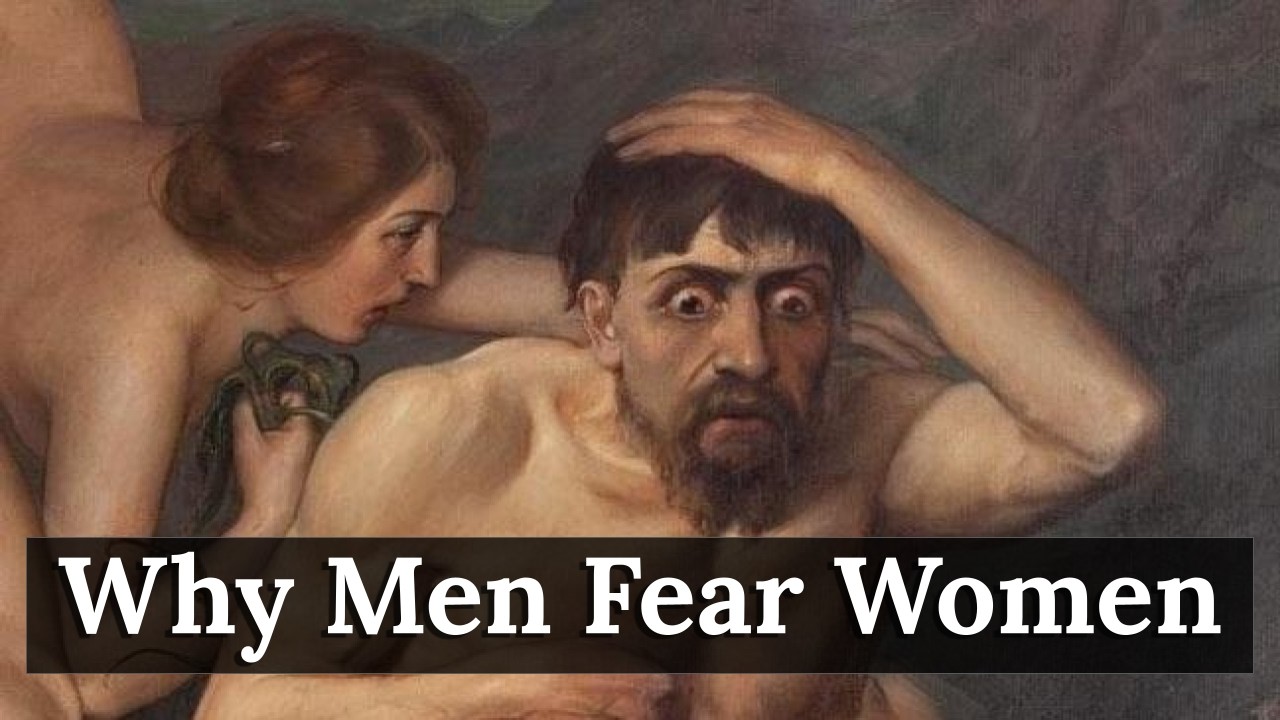

It may seem preposterous to claim that men fear women — after all, men are the physically stronger sex. Yet the evidence from anthropology, mythology, religion, and developmental psychology points to a startling conclusion: men's fear of women is one of the most universal and deeply rooted phenomena in human history. This is not a Western invention, a product of capitalism, or a side effect of patriarchy. It shows up everywhere — from the isolated highland tribes of New Guinea to the philosophers of ancient Greece — and its roots, according to anthropologist David Gilmore, lie in the male developmental psyche itself.
Why Do Men Fear Women More Than Women Fear Men?
The paradox is striking. Given man's physical dominance, why would women represent a source of dread? The answer, argues Gilmore in his book Misogyny: The Male Malady, is that the fear is not physical but psychological — and profoundly intimate. Man does not fear what woman can do to him with her hands. He fears what she represents to him at the deepest level of his psyche.
 02:15
Anthropologist David Gilmore's findings on the New Guinea highland tribes — possibly the most intense documented fear of women anywhere on earth
Watch at 02:15 →
02:15
Anthropologist David Gilmore's findings on the New Guinea highland tribes — possibly the most intense documented fear of women anywhere on earth
Watch at 02:15 →
This fear takes on different forms depending on the culture. In aboriginal highland tribes of New Guinea — communities untouched by outside influence until the mid-20th century — men harbor what anthropologists describe as a full-blown phobia of the female body. Prolonged contact with a woman, they believe, causes the skin to wither and the organs to waste away. Menstrual blood is considered one of the most lethal substances a man can encounter. The female genitalia are seen as a conduit for malevolent forces entering the world.
In Western history, the danger attributed to women shifts from physical to moral and spiritual. Ancient Greek poets wrote that women were the greatest evil Zeus ever created. Medieval bishops linked women to the devil. Philosophers like Schopenhauer and Nietzsche argued women were constitutionally dishonest. D.H. Lawrence wrote of the "colossal evil of the united spirit of Woman" eating out a man's inner life "like a cancer."
Different cultures, different languages, different centuries — yet the same fear. As linguist George Lakoff observed, many languages contain deep metaphorical connections between the words for "woman" and "danger." This convergence is not coincidental.
07:40
Western mythology's femme fatale figures — sirens, nymphs, and mermaids — all embodying male ambivalence toward women across centuries
Watch at 07:40 →
Why Do So Many Cultures Portray Women as Dangerous?
Across mythology, religion, and folklore, women appear again and again as the source of ruin, chaos, and moral corruption. The pattern is so consistent it demands explanation.
In Greek mythology, it is Pandora who opens the box releasing evil into the world. Sirens, nymphs, lamias, and Furies lure men to destruction. In Icelandic myth, women are described as "rivers of poison" — men, like flies drawn to honey, taste sweetness briefly before they drown. The philosopher Dorothy Dinnerstein notes that the image of the siren or mermaid — rising from dark depths to drag men under — is virtually universal in world folklore.
The world's major religions follow the same script. In Genesis, it is Eve who succumbs to temptation and brings about humanity's fall. Islamic tradition records the Prophet Muhammad stating that hell is populated above all by women, and that after his death no greater source of chaos would threaten his nation. Even Buddhism — a tradition defined by compassion — depicts women as enchantresses who lure men from the righteous path.
As Gilmore writes: "misogyny shows no correlation with any particular form of society; it occurs everywhere." It appears in matrilineal societies where women hold high status, among the famously non-violent Semai of the Malay Peninsula, and in some of the most egalitarian cultures on record. The universality of the phenomenon rules out social structures as the root cause. Something deeper is at work.
13:55
Robert Stoller's concept of proto-feminine identity and how it creates the core developmental conflict in boys
Watch at 13:55 →
What Is Misogyny and Where Does It Come From?
Misogyny is commonly defined as contempt, hatred, or prejudice toward women. But Gilmore argues this definition is incomplete. A more accurate understanding must include fear — because much of the hatred expressed by misogynists is, at its core, a mask for terror of the female sex. As Shakespeare wrote in Antony and Cleopatra: "In time we hate that which we often fear."
Because misogyny is so widespread — cutting across geography, religion, economic systems, and historical periods — Gilmore concludes it cannot be explained by environment alone. It must be, in his words, "psychogenic in origin, a result of identical experiences in the male developmental cycle." The source is not out there in society. It is in here, in the structure of the male psyche and the universal experience of growing up male.
What Actually Causes Misogyny in Men?
The developmental story begins at the very start of life. In infancy, the mother is everything — the source of warmth, food, comfort, and unconditional love. Both boys and girls, embedded in this maternal world, unconsciously mirror the mother's gender identity. Psychiatrist Robert Stoller called this a "proto-feminine identity": the earliest sense of self in both sexes is essentially feminine, a mirroring of the mother.
For girls, this poses no conflict. For boys, it creates a fundamental psychological crisis. To develop a masculine identity, a boy must psychologically separate from the mother and actively repudiate the feminine identity he unconsciously formed in his earliest years. He must, as the anthropologist Ralph Greenson put it, "dis-identify with the mother."
This is not a gentle process. Historically, virtually every culture developed harsh rites of passage specifically designed to forcibly tear boys away from the maternal world and initiate them into manhood. The brutality of these rituals reflects the depth of the pull they were designed to overcome — because the bond with the mother, and the state of effortless dependence she represents, is profoundly difficult to leave behind.
How Does Boyhood Shape Men's Fear of Women?
Even after a boy successfully separates from the mother, something lingers. Deep within the male psyche, Gilmore argues, there remain what he calls "regressive wishes" — a longing to return to that early state of total care, comfort, and merger with the feminine. These wishes never fully disappear. They go underground.
As adolescence and adulthood arrive, these impulses become increasingly threatening to a man's sense of himself. To give in to them feels like the extinction of masculinity. And so most men find themselves caught in a profound inner conflict: drawn toward the feminine on one side, fiercely resisting and despising that pull on the other.
The psychological resolution many men unconsciously arrive at is projection. Rather than acknowledging the conflict as internal, they externalize it — attributing the danger to women themselves. The result is what looks like a phobia: an irrational, intense fear of women that, in extreme cases, becomes hatred or contempt. The Salem witch trials, Gilmore suggests, represent this dynamic expanding into collective psychosis.
This also explains why men's feelings toward women are so often marked by intense ambivalence. Catullus captured it perfectly when writing of his mistress: "I love and I hate." The sphinx — half alluring woman, half monstrous beast — is the mythological embodiment of this simultaneous attraction and dread. As Gilmore observes, wherever misogyny appears, its opposite — idealization and longing — appears in equal measure. The men who most loudly denounce women are often those most powerfully driven by need for them.
Why Does the Femme Fatale Archetype Exist Across History?
The femme fatale — the seductive yet deadly woman — is one of the most enduring figures in human culture. From the sirens of Greek myth to the goddess Venus in Wagner's operas to countless iterations in modern film, the image persists because it maps precisely onto the inner experience Gilmore describes.
She is irresistible and destructive. She represents both everything a man wants and everything he fears losing himself to. She is, in short, a projection of man's ambivalence toward his own regressive desires — made flesh and given a face. As the 18th-century poet John Gay wrote: "The fly that sips treacle is lost in the sweets, So he that tastes woman, ruin meets."
The archetype endures not because it reflects the truth about women, but because it reflects the truth about men's inner lives.
Can Men Actually Overcome Their Fear of Women?
Gilmore's answer is cautiously optimistic — but it requires something most people find deeply uncomfortable: genuine self-knowledge. The fear of women, at its root, is a fear of parts of oneself. The "femaleness" within — the longing for dependence, comfort, and merger — is what many men, unable to integrate it, project outward and then despise.
Research by anthropologist James Taggart offers one concrete finding: fathers who are more present and involved in their sons' lives help those sons separate from the mother with less anger toward women. Given that roughly half of boys today grow up without a consistently present father, this is not a trivial data point.
But ultimately, Gilmore argues, the work is internal. It requires men to bring their regressive impulses into consciousness rather than projecting them outward. To recognize that when they fear or hate women, they are fearing and hating something within themselves. "Men who hate women hate themselves even more," he writes. "What they really hate — and fear — is the 'femaleness' within."
Only through that recognition — a genuine acceptance of the divided self — can the millennia-old war between men and women begin, at last, to yield to something better.