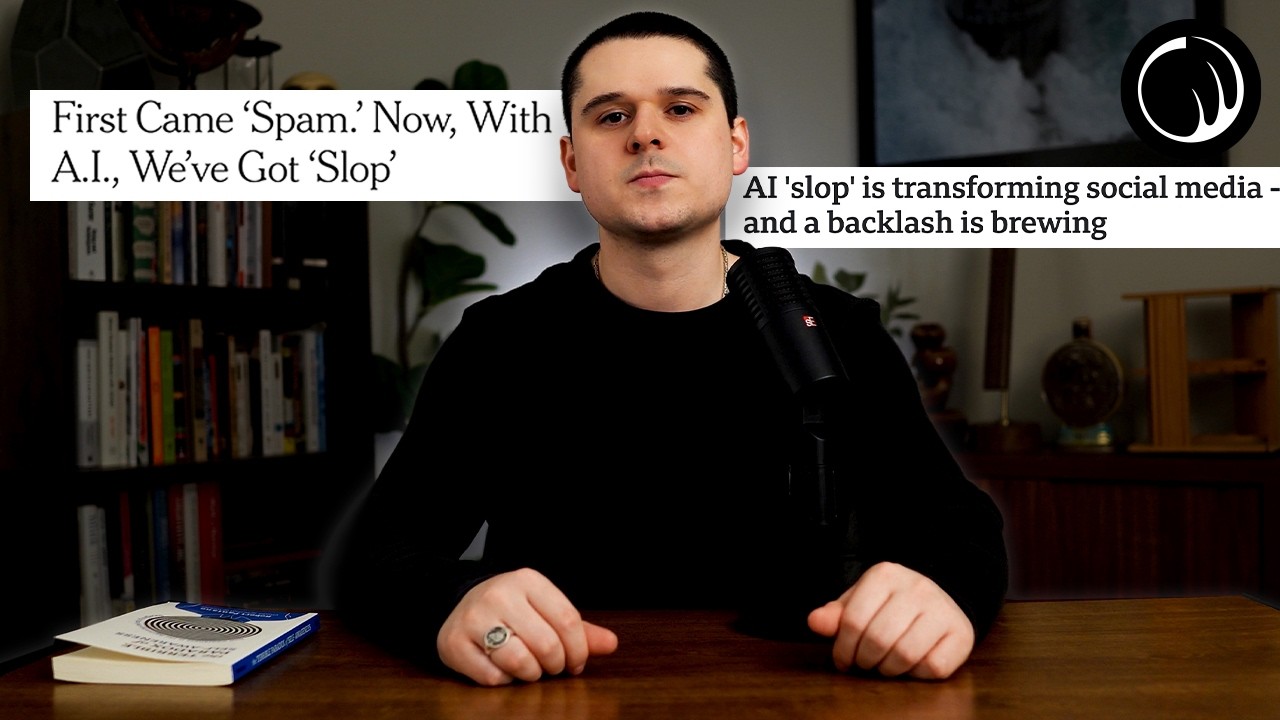

For eight years, the voice behind Pursuit of Wonder belonged to no visible face, no public identity, no social media persona — just words, ideas, and a carefully constructed sense of wonder. Now, that anonymity is over. The creator behind Pursuit of Wonder is Robert Pantano — writer, philosopher, and one-man production studio — and he has finally stepped into the frame he spent nearly a decade deliberately staying out of.
Who Is the Creator Behind Pursuit of Wonder?
The person behind Pursuit of Wonder is Robert Pantano, a writer and independent creator who has been producing the channel entirely on his own since its inception. No team. No company. No outside backing. Every word written, every video edited, every voiceover recorded, every animation built — all of it has been Pantano working alone. He has also authored multiple books under the Pursuit of Wonder name, including The Art of Living a Meaningless Existence and Notes from the End of Everything, both self-published with limited resources and reach.
 00:45
Robert Pantano appears on camera for the first time, marking 8 years of anonymity ending
Watch at 00:45 →
00:45
Robert Pantano appears on camera for the first time, marking 8 years of anonymity ending
Watch at 00:45 →
For most of the channel's life, Pantano kept his identity completely private. No face reveals, no interviews, no social accounts linking back to a real person. Just a voice and a body of work that quietly accumulated hundreds of thousands — and eventually millions — of viewers drawn to its philosophical depth and literary quality.
Who Is Robert Pantano and What Has He Made?
Robert Pantano is a writer first. That identity, he says, has driven everything else. Writing has taken him — figuratively — through history, across the globe, into his own conscious and subconscious mind, and into the perspectives of people and ideas far removed from his own experience. It has, in his words, taken him apart almost as many times as it has put him back together.
Beyond the YouTube channel, Pantano has built a catalog of self-published books exploring existential themes: the meaning of a seemingly meaningless life, the strange experience of being alive and aware of it, and the tension between human vulnerability and the pursuit of something worthwhile. His work occupies a space between literary philosophy and accessible self-reflection — never preachy, always probing.
02:30
Pantano discusses The Terrible Paradox of Self-Awareness and its March 10th release
Watch at 02:30 →
His upcoming book, The Terrible Paradox of Self-Awareness, marks a significant shift. It will be his first traditionally published work, meaning it will be available everywhere books are sold — a milestone that closes a very long loop in his creative life.
What Is The Terrible Paradox of Self-Awareness About?
The Terrible Paradox of Self-Awareness digs into what it actually means to be a conscious being — something that exists in the world and somehow knows it exists, without fully understanding how or why. The book is for anyone who has wrestled with questions of identity, self-consciousness, and the unsettling experience of being perceived by others and by yourself.
Pantano describes it as an exploration of selfhood, of letting go, of embracing uncertainty, and of expressing and becoming oneself without restraint. It is written for people who want to live well inside the absurdity of human existence — to care less about what doesn't matter, to sit with the pain and struggle of being alive, and to somehow find it worth it anyway.
- Theme: The paradox of being self-aware without understanding what the self actually is
- Tone: Philosophical but accessible, literary but grounded
- Audience: Readers drawn to existentialism, consciousness, and honest self-reflection
- Release date: March 10th
Pre-orders, Pantano notes, make a genuine difference for a book's long-term success. They signal to publishers and bookstores that demand exists, which directly influences how widely the book gets stocked and promoted.
04:10
Pantano reflects on fear of being perceived and why he finally decided to show up
Watch at 04:10 →
Why Did Pursuit of Wonder Stay Anonymous for 8 Years?
Pantano outlines several layered reasons for his long anonymity, and none of them are simple vanity or mystery-building for its own sake.
The first is privacy — a straightforward desire to keep his personal life separate from his public work. The second is a philosophical conviction about the relationship between an audience and a piece of work. He believed — and to some extent still believes — that there is something powerful about experiencing someone's ideas without the filter of their face, their personality, or their biography coloring the interpretation. The work speaks; the person steps back.
But he also names something more vulnerable: fear. The fear of being perceived, evaluated, and reduced. Being seen by any audience is unsettling. Being seen by millions is something else entirely — enough, in his words, to feel like it might burn a hole through your brain.
What changed? Partly, the state of the internet itself. In a world where AI-generated content is proliferating rapidly, where audiences are rightfully skeptical of whether anything is made by a real human with real intention, hiding behind anonymity begins to feel like it undermines the very thing that makes the work meaningful. When commenters suggest that videos built from countless hours of careful, human labor might be AI-generated, something shifts. Pantano decided that adding clarity — of authorship, of humanity, of effort — was worth the exposure.
How Did Pursuit of Wonder Actually Begin?
Pursuit of Wonder did not begin as a YouTube channel. It began as a book.
About a decade ago, Pantano wrote a manuscript — a book about the wonders and horrors of being alive. He sent it to publishers and agents. Every single one rejected it. He was unknown, had no platform, and no audience. The math was simple and brutal.
But instead of walking away from the work, he adapted the manuscript chapters into videos and posted them to YouTube. When that initial material ran out, he kept going — researching, writing, producing, and publishing more. The channel grew. Then the books came. Then a traditional publishing deal. Then this moment.
Pantano describes the arc as a circle finally closing. The original manuscript never became a book, but it became something larger: a channel, a catalog of self-published work, and eventually the pathway to a traditional publishing deal for a brand new book. The rejection that felt like a dead end turned out to be a rerouting.
Is Pursuit of Wonder AI Generated or Made by a Real Person?
No — Pursuit of Wonder is not AI generated. Every element of every video is the work of Robert Pantano: the writing, the editing, the voiceover, the animation, the audio mixing, and the funding. It has always been a one-man operation, built without a team, a company, or external backing.
The question itself, though, is part of why Pantano decided to finally reveal himself. As AI content floods digital spaces, audiences are increasingly — and reasonably — uncertain about what is made by humans and what is not. For a creator who has dedicated years to crafting every sentence and every frame with deliberate care, being mistaken for a machine is a strange and frustrating byproduct of the current moment. Showing up, putting a name and a face to the work, is one response to that uncertainty.
What Does It Take to Go From Self-Published to Traditional?
Pantano's journey from self-published author to traditionally published author was not a straight line. His earlier books — The Art of Living a Meaningless Existence and Notes from the End of Everything — were produced with limited resources and distributed with limited reach. He did everything himself, just as he did with the channel.
The Terrible Paradox of Self-Awareness is different. It will be available essentially everywhere books are sold. And it did not arrive by luck. It arrived because years of consistent, independent creative output built an audience large enough to make a traditional publisher take notice.
The lesson embedded in that arc is not glamorous, but it is clear: keep making the work, even when no one is watching, even when the doors are closed, even when the resources are thin. The channel started because a book was rejected. The traditional deal arrived because the channel never stopped.
As Pantano puts it, this moment feels like the final line segment — the connection point that closes a circle he started drawing long before Pursuit of Wonder had a name.