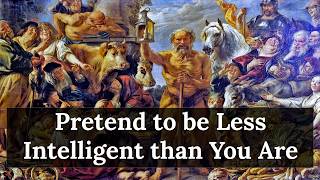
Should you hide your intelligence from others? According to some of history's sharpest minds—Friedrich Nietzsche, Arthur Schopenhauer, Baltasar Gracian, and Socrates himself—the answer is often yes. Openly displaying superior wisdom tends to breed resentment, wound vanity, and create dangerous enemies. The most strategically intelligent move, paradoxically, is to appear less intelligent than you are. As the 18th-century philosopher Montesquieu bluntly put it: "I have always observed that to succeed in the world one should appear like a fool but be wise."
This isn't about being dishonest or playing games—it's about understanding a deep truth of human nature. Wisdom, unlike wealth or status, is uniquely threatening to the people around you. Here's why, and what to do about it.
 00:45
Nietzsche's concept that every profound spirit naturally grows a protective mask around itself
Watch at 00:45 →
00:45
Nietzsche's concept that every profound spirit naturally grows a protective mask around itself
Watch at 00:45 →
Why Should You Hide Your Intelligence From Others?
The core reason to hide your intelligence is simple: superior wisdom is a social liability as often as it is an asset. When you can see through illusions, spot contradictions, and perceive what others miss, you pose an invisible threat to everyone around you—not because you intend to, but because your very existence exposes the limits of their understanding.
Baltasar Gracian, the 17th-century Spanish philosopher and strategist, captured this perfectly: "Know how to appear the fool. The wisest sometimes play this card, and there are times when the greatest knowledge consists in appearing to lack knowledge. You mustn't be ignorant, just feign ignorance."
Friedrich Nietzsche extended this idea further, observing that every profound thinker naturally develops a mask: "Every profound spirit needs a mask: moreover, around every profound spirit a mask is continually growing, thanks to the constantly false, that is, shallow interpretation of every word, every step, every sign of life he gives." The mask isn't deception—it's protection.
02:10
Schopenhauer's argument that intellectual superiority offends by its mere existence
Watch at 02:10 →
Why Does High Intelligence Make People Uncomfortable?
To understand why hiding intelligence matters, you first need to understand why intelligence provokes such strong negative reactions in others. The answer lies in ego and self-worth.
Most people derive a significant portion of their identity and self-esteem from believing themselves to be reasonably intelligent and competent. When they encounter someone who clearly perceives things more deeply, spots what they missed, or questions assumptions they never even considered, it doesn't just feel humbling—it feels like an attack.
Arthur Schopenhauer put it with characteristic bluntness: "To show your intelligence and discernment is only an indirect way of reproaching other people for being dull and incapable… Intellectual superiority offends by its very existence, without any desire to do so."
He went further, identifying just how deeply this cuts: "There is nothing of which a man is prouder than of intellectual ability, for it is this that gives him his commanding place in the animal world… It is an exceedingly rash thing to let anyone see that you are decidedly superior to him in intelligence and wisdom… because he will then thirst for vengeance."
04:30
Nietzsche's 'Mediocrity as a Mask' aphorism — wearing plainness as a strategic shield
Watch at 04:30 →
The fictional novel Flowers for Algernon illustrates this vividly. When a mentally handicapped man is transformed into a genius through a scientific experiment, he makes a haunting observation: "I'm beginning to think that with intelligence… you don't just see more—you see through things. And that makes people uncomfortable." Seeing through things is not always welcome.
How Does Playing Dumb Help You Get Ahead at Work?
Beyond the social discomfort, there are concrete career and professional reasons to strategically veil your depth of understanding. Studies cited by Jeffrey Pfeffer, Professor of Organizational Behavior at Stanford University, reveal that job performance is far less important to career advancement than most people assume. What actually drives promotions is likability and relationships with superiors.
Pfeffer writes: "So great job performance by itself is insufficient and may not even be necessary for getting and holding positions of power. You need to be noticed, influence the dimensions used to measure your accomplishments, and mostly make sure you are effective at managing those in power—which requires the ability to enhance the ego of those above you."
This is not cynical manipulation—it's an acknowledgment of how human beings actually operate. People in positions of authority feel most comfortable with, and most generous toward, those who make them feel competent and respected. When you openly outshine your superiors, you trigger their insecurity and quietly become a threat to their status.
06:15
Socrates discovering that the Oracle named him wisest because he alone knew his own ignorance
Watch at 06:15 →
Robert Greene summarizes the strategic principle in The 48 Laws of Power: "Always make those above you feel comfortably superior. In your desire to please and impress them, do not go too far in displaying your talents or you might accomplish the opposite and inspire fear and insecurity. Make your masters appear more brilliant than they are and you will attain the heights of power."
- Display competence — you must be seen as capable and valuable.
- Conceal depth — avoid appearing wiser, more perceptive, or more insightful than those above you.
- Flatter strategically — let superiors feel their guidance is essential to your growth.
What Is Nietzsche's 'Mediocrity as a Mask' Concept?
Nietzsche dedicated an entire aphorism to this strategy, titled "Mediocrity as a Mask." His argument is both practical and surprisingly compassionate. He wrote: "Mediocrity is the happiest mask which the superior mind can wear, because it does not lead the great majority—that is, the mediocre—to think that there is any disguise. Yet the superior mind assumes the mask just for their sake—so as not to irritate them, nay, often from a feeling of pity and kindness."
The key insight here is that the mask of mediocrity works precisely because it doesn't look like a mask. A pretense of stupidity might be spotted and resented. But a quiet, understated, modest manner simply blends in. People assume you are one of them, and that assumption protects you.
Nietzsche isn't advocating intellectual cowardice. He's pointing out that the superior mind, fully conscious of the social dangers its depth creates, can choose to deploy its insight selectively—in private, in writing, or among genuine intellectual peers—rather than broadcasting it carelessly in every interaction.
How Do You Avoid Resentment for Being Smarter Than Others?
The practical tools for concealing wisdom without being dishonest include:
- Simplicity — speak plainly, avoid displaying the full complexity of your thinking.
- Humor — use self-deprecating wit to signal that you don't take yourself too seriously.
- Modesty — acknowledge uncertainty and gaps in your own understanding genuinely.
- Silence — resist the urge to correct or improve upon what others say in every conversation.
- Questions over statements — ask rather than declare, which allows others to feel insightful themselves.
Schopenhauer acknowledged how difficult this is: "A man may be as humble as possible in his demeanor, and yet hardly ever get people to overlook his crime in standing intellectually above them." Even with perfect humility, intelligence leaks through. The goal isn't invisibility—it's reducing unnecessary friction.
What Did Socrates Mean by 'I Know That I Know Nothing'?
The most famous example of wisdom concealing itself beneath apparent foolishness is Socrates himself. When the Oracle at Delphi declared him the wisest man in Athens, Socrates was genuinely bewildered. He knew, better than anyone, how much he didn't know.
So he went searching for men wiser than himself—politicians, poets, and craftsmen all celebrated for their intelligence. What he found was disturbing: "When I began to talk with him, I could not help thinking that he was not really wise, although he was thought wise by many, and wiser still by himself."
The Oracle's meaning eventually became clear. Socrates was the wisest man in Athens not because he knew the most, but because he was the only one who knew how little he knew. Everyone else mistook their opinions for truth. Socrates alone recognized the vast territory of his own ignorance.
The result? By exposing the ignorance of men with powerful reputations, Socrates made lethal enemies. He was eventually charged with corrupting the youth, and sentenced to death. As he reflected: "This investigation has led to my having many enemies of the worst and most dangerous kind." The wisest man in Athens was killed for being too publicly wise.
Is It Ever Wise to Pretend to Be a Fool?
Beyond social strategy, there is a deeper, more personal reason to occasionally wear the mask of the fool: genuine humility. The performance of foolishness, if practiced honestly, becomes a reminder that wisdom is never complete.
In the presence of life's greatest mysteries—death, consciousness, meaning, the nature of existence—even the most brilliant human mind is largely ignorant. The gap between what we know and what there is to know is effectively infinite. Playing the fool is not just a social tactic; it is an honest acknowledgment of our limitations.
Fyodor Dostoevsky captured this perfectly: "The wisest of all, in my opinion, is he who can, if only once a month, call himself a fool—a faculty unheard of nowadays."
And Shakespeare, as usual, said it most memorably: "The fool doth think he is wise, but the wise man knows himself to be a fool."
The deepest wisdom, then, is not the accumulation of knowledge and the proud display of it. It is the recognition that true understanding begins with wonder—with the honest, humbling awareness of how much remains unknown. Wearing the mask of the fool, whether for social strategy or personal growth, keeps that awareness alive.