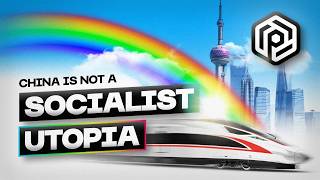
Why Does China Have High-Speed Rail But Not America?
China has 31,000 miles of high-speed rail — more than the entire rest of the world combined. You can travel between almost any two major cities at 200 miles per hour in comfort, without airport security, without delays, without drama. Meanwhile, America has spent $15 billion trying to connect Los Angeles and San Francisco, and after 16 years of lawsuits and false starts, it's still unclear whether that train will ever run. The reason China can do what America cannot isn't simply political will or engineering genius. It comes down to a specific economic model — one built on cheap labor, suppressed wages, and a system of inequality so deeply embedded in law that it functions like a caste system. Those dazzling trains are real. So is the price paid by the people who built them.
 00:45
Boris Yeltsin's 1989 visit to a Texas supermarket — the moment that reportedly shook his faith in the Soviet system
Watch at 00:45 →
00:45
Boris Yeltsin's 1989 visit to a Texas supermarket — the moment that reportedly shook his faith in the Soviet system
Watch at 00:45 →
How Does China Build Infrastructure So Fast?
When visitors first encounter China's infrastructure — the bullet trains, the colossal bridges, the futuristic skylines — the reaction is often something close to what Boris Yeltsin felt walking through an American supermarket in 1989. He couldn't believe ordinary shoppers treated thirty thousand items on shelves like it was just another Saturday. Today, it's Westerners who feel that disorientation, watching fellow passengers play phone games with complete indifference while racing across the Tibetan plateau at 200 miles an hour.
China's ability to build at this scale and speed is genuine and impressive. But it doesn't happen through magic. It happens because construction in China is extraordinarily cheap, and it is cheap because labor is extraordinarily cheap. These two facts are not coincidentally related — they are the same fact. Cheap, abundant labor and massive labor-intensive infrastructure are two sides of the same economic coin. You do not get 31,000 miles of high-speed rail without the labor exploitation that makes it cost-effective to build.
02:10
China's high-speed rail network visualized — 31,000 miles, more than the rest of the world combined
Watch at 02:10 →
For comparison: the US high-speed rail project in California has ballooned in cost and stalled in courts because, in America, land must be purchased at market value, environmental reviews are legally required, and workers must be paid competitive wages. In China, those friction points are dramatically reduced — not because of superior planning, but because workers have far less power to push back, and the state has far more power to push forward.
How Does China's Economic Model Actually Work?
China's economic model is sometimes described as state capitalism, but economist Michael Pettis offers a more precise framing: it functions like a form of trickle-down economics, except the wealth flows from households to corporations and government — not the other way around.
There are several mechanisms that make this work:
- Artificially low interest rates: Returns on bank deposits are kept low, making it cheap for businesses to borrow and expand. Ordinary families, with few investment options, park their savings in real estate — enriching developers and local governments.
- Currency depreciation: Beijing artificially suppresses the value of the Renminbi, making Chinese exports cheaper for foreign buyers. This subsidizes manufacturing but drives up the cost of imports, meaning Chinese workers face both artificially low wages and artificially high consumer prices.
- Regressive taxation: Because China imposes minimum social security contributions, the lowest earners are effectively taxed at the highest rate. Personal income taxes make up just 1% of China's GDP, compared to 10% in the US. There is no property tax or inheritance tax, despite most household wealth sitting in real estate.
The net result: between 1987 and 2023, the share of economic output that Chinese workers actually take home has fallen from 21% to 15%. If workers received the same share of their labor as those in Canada, India, or France, they'd have hundreds of billions more to spend on healthcare, education, and consumer goods. Instead, they get high-speed trains.
Is China More Unequal Than the United States?
Here's a puzzle that points toward the answer: How do consumers in China — officially a developing country — spend as much on luxury goods as Americans, the wealthiest people on earth? The answer is extreme inequality. Roughly 15% of China's population — those with college degrees — lives a life comparable to an upper-middle-class New Yorker or Parisian. The remaining 85%, who have at most a high school education (which in China isn't free), may never earn even half the minimum wage in West Virginia.
06:30
How China's tax system disproportionately burdens low earners through minimum social security contributions
Watch at 06:30 →
China is, by most measures, one of the most unequal countries on the planet. And this is not a flaw in the system — it is a feature. Inequality is an essential component of the economic model that produces those gleaming trains and soaring skylines. The wealth visible to tourists is real. So is the poverty invisible to them.
What Is China's Hukou System and Why Does It Matter?
When China dismantled its state-employment system in the 1990s — a guarantee of jobs, pensions, and benefits known as the Iron Rice Bowl — it left over thirty million workers suddenly on their own. These workers had to migrate to wherever jobs existed and figure out the rest themselves.
To prevent this mass migration from overwhelming city services, China did something extraordinary: it banned its own citizens from accessing the public services their taxes paid for, based on where they were born. This system — called hukou — registers every Chinese citizen to their place of birth. Moving to a city doesn't grant you access to that city's schools, hospitals, or welfare programs. Changing your hukou registration is nearly impossible if you're a poor, rural worker.
Labor scholar Eli Friedman calls this an inverted welfare state: workers must prove they're wealthy enough not to need social services before they can access social services. The rich get public benefits for free. The poor pay out of pocket — or go without. Rural parents working in cities must either leave their children behind, raised by grandparents, or pay tuition at underfunded private schools for migrant children. Either way, they lose.
This system doesn't just reflect inequality. It legally enforces it across generations, ensuring a permanent underclass and a permanent supply of cheap labor — which is precisely what makes those trains affordable to build.
What Was the Iron Rice Bowl and Why Did China End It?
For decades, Chinese workers at state-run companies were guaranteed employment, pensions, healthcare, and housing — a system called the Iron Rice Bowl. It was inefficient, sometimes absurd, but it provided a basic floor of security for hundreds of millions of people. Russia had a similar system.
When both countries abandoned it in the 1990s, they chose different paths through the chaos. Russia, under Putin, struck deals with oligarchs — let them buy privatized state assets at rock-bottom prices, look the other way on corruption, but maintain one red line: never fire workers. The result was a bloated, kleptocratic economy propped up by social peace.
China ripped the bandage off. Workers were laid off en masse, left to migrate and adapt. To manage the political risk of thirty million angry unemployed people, China didn't give them support — it denied them access to services, kept them moving, and kept them cheap. The Iron Rice Bowl was replaced not with a new safety net, but with a legal architecture designed to ensure workers could never accumulate enough stability to demand one.
Why Do Chinese Households Save So Much of Their Income?
At every income level, Chinese households save a higher share of their wages than households in comparable countries. The gap is largest among the poor — and for obvious reasons. When there is no reliable safety net, no unemployment insurance worth relying on, no public healthcare that covers you regardless of where you live, saving isn't a preference. It's survival planning.
This high savings rate has a paradoxical effect on the economy. That money — set aside for medical emergencies, job loss, or old age — is effectively removed from circulation. It can't be spent on goods and services. As Pettis notes, the high-savings model forces ordinary people to spend less so that government and business can spend more. Workers subsidize the state's ambitions with their own financial anxiety.
The result is an economy that produces spectacularly — and consumes modestly. China's factories churn out goods the world buys, while Chinese workers, as Marx once warned, struggle to afford the very products they make. The share of labor compensation in China's real economy has been falling for decades. Those savings sitting in bank accounts earning artificially suppressed interest rates are, in a very real sense, the hidden subsidy behind every mile of high-speed track.
What Should the Rest of the World Take From China's Infrastructure Success?
China's high-speed rail is a genuine achievement. The speed, scale, and ambition are real. But the lesson it offers is more complicated than it first appears. Just as America's high per capita GDP obscures its poverty and inequality, China's dazzling infrastructure obscures the system that produced it — one that prioritizes construction over wages, exports over consumption, and state ambition over worker welfare.
Both left-wing labor activists and mainstream economists have urged China to shift course: raise wages, build a real safety net, let workers share in the wealth they create. China has resisted — and continues to arrest Marxist activists who push for exactly that. The trains run on time. The workers who built them cannot always afford to ride them.
That's the context a tourist doesn't see. It's worth holding in mind the next time you watch a YouTube video of someone marveling, in genuine awe, at how smoothly the Beijing-Shanghai line runs.