
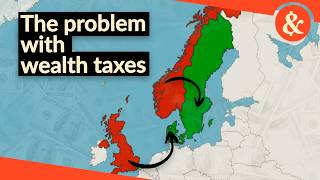
Do wealth taxes work? According to a landmark study published in the American Economic Review — one of the most prestigious journals in economics — the answer is complicated. Researchers dug into decades of Swedish and Danish administrative tax records and found that yes, some billionaires will leave when you raise wealth taxes. But not enough to cause the catastrophic economic collapse the political right predicts. The catch? Wealth taxes still underperform dramatically — not because of emigration, but because of something far sneakier happening inside your own borders.
Do Wealth Taxes Actually Work? Here's the Data
The short answer is: partially, but far less effectively than politicians promise. The study tracked what happened when both Sweden and Denmark abolished their 2% annual wealth taxes — Sweden in 2007, Denmark in 1996. Both countries had sophisticated systems to track wealthy residents and their assets, giving researchers an unusually clean dataset to work with.
 02:15
Chart showing effective tax rates: average Americans at 30% vs Forbes 400 at 28%, and European middle class at 50% vs billionaires at 20-30%
Watch at 02:15 →
02:15
Chart showing effective tax rates: average Americans at 30% vs Forbes 400 at 28%, and European middle class at 50% vs billionaires at 20-30%
Watch at 02:15 →
Here's the headline finding: a 1% increase in the top wealth tax rate decreases the number of wealthy taxpayers by about 2%. That sounds alarming — until you realise that only 0.34% of ultra-rich Swedes were emigrating each year even with the wealth tax in place. In other words, over 99% of wealthy residents stayed put, even under a 2% annual wealth tax.
The right is correct that some billionaires leave. The left is correct that it's nowhere near enough to kill the tax revenue. But here's where it gets interesting — and where both sides have been missing the real problem entirely.
Why Do Billionaires Pay Lower Tax Rates Than You?
Before we get to the data on emigration, we need to understand why billionaires pay such low effective tax rates in the first place. Economist Gabriel Zucman's research shows that while average Americans pay an effective tax rate of around 30%, the Forbes 400 richest individuals pay only about 28%. In Europe it's even more stark — middle-class Europeans pay roughly 50%, while billionaires pay between 20% and 30%.
The reason comes down to how the ultra-wealthy earn their money. Most billionaires don't collect a salary. Their wealth grows through appreciating assets — stocks, private companies, real estate. And here's the legal trick: in most countries, you only pay capital gains tax when you sell those assets.
08:40
Graph of Swedish emigration rates among the ultra-wealthy before and after wealth tax abolition in 2007
Watch at 08:40 →
So if you're Warren Buffett, you can simply hold onto your Berkshire Hathaway shares, watch them compound for decades, and borrow against them to fund your lifestyle — all without triggering a single taxable event. Buffett famously noted he paid less in taxes than his secretary. This isn't a loophole. It's how the system was designed.
What Is a Wealth Tax and How Does It Work?
A wealth tax is economists' proposed solution to this problem. Instead of waiting for billionaires to sell assets, a wealth tax charges a small percentage of their total net worth every single year — typically around 1% to 2%. No selling required. No dividends needed. You simply owe a fraction of everything you own, annually, no exceptions.
In theory, this plugs the loophole completely. You can't dodge it by never selling. You can't avoid it by borrowing instead of earning. Which is precisely why billionaires hate wealth taxes more than almost any other form of taxation — and why they're so quick to threaten to leave when one is proposed.
14:22
Breakdown of wealth tax revenue losses: $0.22 lost to emigration plus $0.54 lost to portfolio restructuring equals 76% of projected revenue gone
Watch at 14:22 →
Do Billionaires Really Leave When Taxes Rise?
This is the central political question, and now we finally have real data. The historical anecdotes are dramatic: the UK's 1970s supertax drove out the Rolling Stones and David Bowie. France's 2012 wealth tax famously lost Gérard Depardieu. Norway faced a notable exodus of billionaires after tightening its wealth tax in 2022. Meanwhile, Denmark's Lego and Maersk families stayed when the wealth tax was abolished — and Sweden saw Ikea founder Ingvar Kamprad and tennis legend Björn Borg return home after Sweden axed its own wealth tax in 2007.
But anecdotes aren't data. The Swedish and Danish records tell a much more nuanced story. Even under a 2% annual wealth tax, the emigration rate among the ultra-wealthy was just 0.34% per year. After the wealth tax was abolished, that rate dropped by 34% — meaning far fewer wealthy people left. But because so few were leaving in the first place, the economic impact of the tax exodus was almost invisible: a few hundredths of a percent on jobs and investment, and about 0.2% on the overall size of the economy.
The political right's nightmare scenario — a mass exodus of job creators crashing the economy — simply doesn't materialise in the data.
What Happens to Jobs When a Billionaire Emigrates?
Here's where the picture does get darker. When a business owner leaves the country due to a wealth tax, the company they leave behind takes a serious hit. The Swedish research found that jobs at those firms fell by a third, investment dropped by a fifth, the firm's output shrank by a third, and tax contributions were roughly cut in half.
An owner leaves, and the company they built begins to decay. That's a real cost. But remember — because so few wealthy people were actually leaving in the first place, the aggregate effect on the national economy was minimal. The damage was real for individual companies, but it barely registered at the macroeconomic level.
How Much Would a Billionaire Tax Actually Raise?
This is where the wealth tax story becomes genuinely sobering. Let's run the numbers for the UK, using the Green Party's proposed 2% wealth tax on wealth over £1 billion. In 2025, there were roughly 156 UK billionaires controlling around £654 billion in wealth. After exempting the first £156 billion, roughly £498 billion remains taxable. A 2% tax on that base theoretically generates about £9.9 billion.
But we need to apply two adjustments from the Swedish and Danish research. First, accounting for the roughly 4% of billionaires who leave, you lose some revenue. Second — and this is the bigger hit — for every £1 that wealth taxes should theoretically collect, billionaires who stay quietly rearrange their portfolios to minimise exposure, costing the Treasury around £0.54 on the dollar. Add emigration losses (£0.22 per dollar) and you've lost 76% of your projected revenue. Only £0.24 of every theoretical pound actually gets collected.
Adjusted for reality, that UK wealth tax brings in closer to £2.4 billion per year — against a total government budget of £1,368 billion. That's 0.17% of government spending. Significant for specific programmes, but nowhere near the transformative revenue source politicians often promise. Norway's real-world wealth tax confirms this: even targeting the broader upper class, wealth tax revenue sits below 2% of total government income.
How Do Billionaires Dodge Wealth Taxes Without Leaving?
This is the mechanism that kills wealth taxes quietly, from the inside. The core problem is that private companies are nearly impossible to value accurately. A publicly traded company like Tesla has a real-time market price. But Ikea? Lego? Their true value includes intangible assets — brand recognition, proprietary technology, customer loyalty — that no government assessor can reliably price.
This creates a massive incentive. If your listed stocks are taxed at full market value but your private company shares are systematically undervalued, you sell the stocks and buy into private firms. Spain discovered this the hard way when it reintroduced its wealth tax in 2011 and exempted business assets. The result: a 42% to 51% collapse in the taxable wealth base as billionaires shifted assets into private companies and expensive primary residences.
Sweden and Denmark saw the same behaviour. Billionaires didn't flee — they restructured. And that quiet, legal reshuffling swallowed more than half of every dollar the wealth tax was supposed to collect.
Should We Tax the Rich More? The Real Answer
Yes — but not through wealth taxes alone. The evidence is clear that in most countries, billionaires pay a lower effective tax rate than the middle class. That's regressive, and there's genuine political will across the spectrum to fix it. Even most conservatives don't argue that billionaires should pay less than teachers and nurses.
The problem is that wealth taxes, as a standalone tool, are a leaky bucket. They raise some revenue, they don't cause a billionaire apocalypse, but they also don't come close to delivering on their political promise. The smarter approach combines multiple mechanisms: reformed capital gains taxes that don't allow indefinite deferral, exit taxes that capture wealth when billionaires do emigrate, inheritance taxes that prevent dynastic wealth from compounding untaxed across generations, and international coordination to eliminate the race to the bottom that lets Monaco and Dubai undercut everyone else.
The Swedish and Danish data gives us something rare in this debate: actual evidence, not ideology. And what that evidence tells us is that taxing the ultra-wealthy is both possible and necessary — but anyone promising a simple wealth tax as a magic solution is selling you something the numbers don't support.