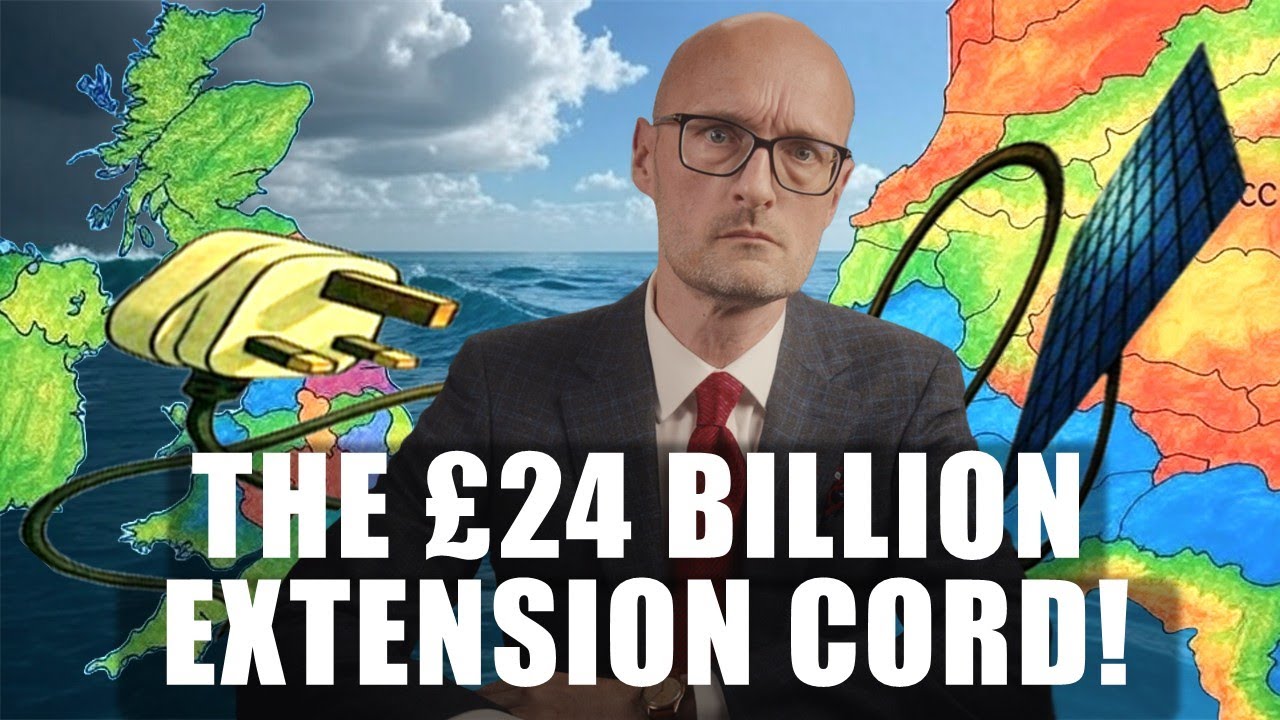

The XLinks Morocco-UK power project failed for a straightforward reason: it was too big, too complex, too expensive, and ultimately too dependent on a government guarantee the UK wasn't willing to give. Ed Miliband, the UK's Energy Secretary, killed the project by refusing to back a 25-year Contract for Difference — a price guarantee worth billions — citing security concerns, delivery risk, and a lack of domestic economic benefit. Without that guarantee, the privately funded project had no foundation to stand on. But XLinks didn't fail because of one bad decision. It failed because it was a monument to everything the developed world has gotten wrong about building infrastructure.
Why Did the XLinks Morocco-UK Power Project Fail?
XLinks was an extraordinarily ambitious proposal: a 77-square-mile solar array, a 580-square-mile wind farm, and a 50-square-mile battery array — all built in the Moroccan desert — connected to the UK via the world's longest undersea power cable, stretching 4,000 kilometres beneath the Atlantic.
 01:15
Map showing the proposed 4,000km undersea cable route from Morocco to the UK
Watch at 01:15 →
01:15
Map showing the proposed 4,000km undersea cable route from Morocco to the UK
Watch at 01:15 →
On paper, it would have supplied 8% of the UK's electricity. In reality, it was a project that had already ballooned from an initial estimate of £16 billion to £24 billion before a single solar panel was installed — a 50% cost increase before construction even began. That trajectory alone should have set off alarm bells. It mirrored the cost explosions seen in HS2 and Hinkley Point C almost exactly.
The project was also technically unprecedented in ways that defied reassurance. The planned battery array would have been 16 times larger than the world's largest completed battery system. The subsea cable would have been the longest ever built, crossing deep-sea environments and multiple international jurisdictions. No company involved had ever delivered anything close to this scale.
Miliband's rejection wasn't just about cost. He specifically flagged national security. A single 4,000km cable supplying 8% of a nation's electricity is not resilience — it's a vulnerability. Recent incidents in the Baltic Sea and around Taiwan have shown how easily undersea cables can be cut, whether by accident, fishing activity, or deliberate sabotage. There is even a Chinese patent for a towed submarine cable-cutting device. Handing that level of energy dependence to a single fragile lifeline was a strategic risk the government wasn't prepared to accept.
05:30
Visual breakdown of HVDC transmission losses over 4,000 kilometres plus battery storage losses
Watch at 05:30 →
How Much Power Is Lost in a 4,000km HVDC Cable?
This is where the physics of XLinks started to unravel. High Voltage Direct Current cables — the technology that would have carried the power from Morocco to the UK — lose approximately 3.5% of their electricity per thousand kilometres. Over 4,000 kilometres, that's a 14% transmission loss before the power even reaches shore.
Add battery storage losses of another 10–15%, and you're losing more than a quarter of all the energy generated in Morocco before it hits the UK grid. To put it plainly: imagine ordering a pizza and the delivery driver eats a quarter of it on the way to your door. That's XLinks.
The project also required a battery array of 22.5 gigawatt-hours — requiring over 5,700 Battery Megapacks and occupying around 50 square miles of Moroccan desert. The material requirements alone — lithium, cobalt, and other critical minerals — potentially exceeded existing known global supplies at that scale. The engineering had outrun the supply chain before the first planning application was filed.
What Is Green Colonialism in Renewable Energy?
Critics didn't just question the engineering. They questioned the ethics. Greenpeace labelled XLinks an example of green colonialism — the Global North identifying cheap, sunny land in the Global South and building infrastructure to extract its energy for export, rather than using it to develop local economies.
10:45
Cost comparison: Hinkley Point C vs South Korean and French nuclear plants per megawatt
Watch at 10:45 →
Africa has extraordinary solar and wind potential. The argument from critics was simple: why should Morocco's desert sun power British kettles when millions of Africans lack reliable electricity access? The energy being harvested could serve local communities, industrialise local economies, and lift living standards across the continent. Instead, the proposal was to ship it 4,000 kilometres north so the UK could hit its net-zero targets.
Supporters of XLinks countered that the project would bring investment and jobs to Morocco. But the bulk of the economic benefit — and the electricity — was clearly designed to flow northward. It's a tension that will only grow as the developed world searches for renewable energy solutions in sunnier, windier, and often poorer parts of the world.
Why Do Megaprojects Always Go Over Budget?
XLinks is not an outlier. It is a case study in what Danish economist Bent Flyvbjerg calls the iron law of megaprojects: nine out of ten go over budget, over time, and under-deliver on promised benefits.
14:20
Ireland's Ardnacrusha hydroelectric plant — built in three years in the 1920s
Watch at 14:20 →
Flyvbjerg identifies what he calls the four sublimes — technological, political, economic, and aesthetic thrills — that seduce planners and politicians into pursuing grand projects at the expense of realism. Megaprojects are media magnets. They make politicians look visionary. They generate headlines and fanfare. The problem is that the incentives to announce a project are completely decoupled from the incentives to deliver one on budget.
The result is what Flyvbjerg describes as the survival of the unfittest: the most optimistic, most misleading projections get approved, precisely because they promise the most while concealing the most risk. By the time the true costs become visible, the project is too politically embedded to cancel — but too expensive to complete as designed.
XLinks fits this pattern almost perfectly. Its costs escalated before a shovel touched the ground. Its scale was unprecedented. Its complexity was compounding. And it depended entirely on a government guarantee that was never formally committed.
Why Is Hinkley Point C So Expensive?
If XLinks is one data point, Hinkley Point C is another — and together they paint a damning picture of British infrastructure delivery. Hinkley Point C is now expected to cost £46 billion, making it the most expensive nuclear power station ever built. It costs four times more per megawatt than comparable plants being built in South Korea, and 25% more than a near-identical plant in France built by the same company, EDF.
Why? Because the UK couldn't just build a proven design. The UK's nuclear regulator required 7,000 design changes to EDF's already-approved reactor. The result required 25% more concrete, 35% more steel, and produced a reactor so extensively modified it's now called the UK EPR — essentially a bespoke new design in everything but name.
And then there's the fish disco. To protect an estimated 45 tonnes of fish per year — less than a single small fishing boat catches — EDF was required to install 288 underwater speakers to blast noise and deter marine life from the cooling water intake. The cost is significant. The diver safety risk is real. The effectiveness is questionable. And it may delay the entire project. Meanwhile, the climate change that poses an existential threat to marine biodiversity continues unchecked.
Why Can't the UK Build Infrastructure Anymore?
Irish economist David McWilliams posed a question that cuts to the heart of this: how did Ireland in the 1920s — a post-colonial state with no money, no industry, and no energy — manage to build the Ardnacrusha hydroelectric plant in three years? At the time, it was the largest hydroelectric dam in the world. Ireland spent 20% of GDP to build it. They also built a national electrical grid that brought power to farms across the country. They just... did it.
McWilliams argues that Western democracies have become victims of what he calls hyperdemocracy — a system where everyone has a veto but no one has responsibility. Well-intentioned regulation, environmental review, NIMBY opposition, legal challenges, and political risk aversion have created a system so overburdened that even routine infrastructure becomes nearly impossible to deliver on time or on budget.
The UK spent £119 million on a tunnel to protect a bat colony during the construction of HS2 — despite no evidence that high-speed trains harm bats. HS2's northern leg was eventually scrapped after costs ballooned past £100 billion. The bats were protected. The north of England was not connected.
Which Countries Actually Build Infrastructure Well?
The contrast with other parts of the world is stark. South Korea builds fleets of nuclear reactors using the same standardised design, repeatedly, mastering replication rather than reinvention. The result is nuclear power delivered on time and on budget — something that now seems almost impossible to imagine in Britain.
Madrid tripled the length of its metro system in just 12 years during the 1990s and 2000s, faster and cheaper than almost any comparable city. A 35-mile metro expansion in Madrid cost around $2.8 billion. New York's one-and-a-half-mile extension of the 7 train to Hudson Yards cost roughly the same amount, adjusted for inflation.
The paradox is painful: the more the developed world cares about doing things perfectly — environmentally, socially, politically — the less it seems capable of doing anything at all. Environmentalists oppose wind farms. Housing advocates block density. Governments outsource delivery while retaining all the risk. The result is paralysis dressed up as due diligence.
The lesson from XLinks, from Hinkley Point C, from HS2, is not that ambition is wrong. It's that ambition without delivery is just expensive theatre. The countries and cities that actually build things do so with speed, simplicity, and replicability — not scale and spectacle. The developed world doesn't lack money or technology. It lacks institutional clarity and political courage. And until that changes, the graveyard of cancelled megaprojects will keep growing.