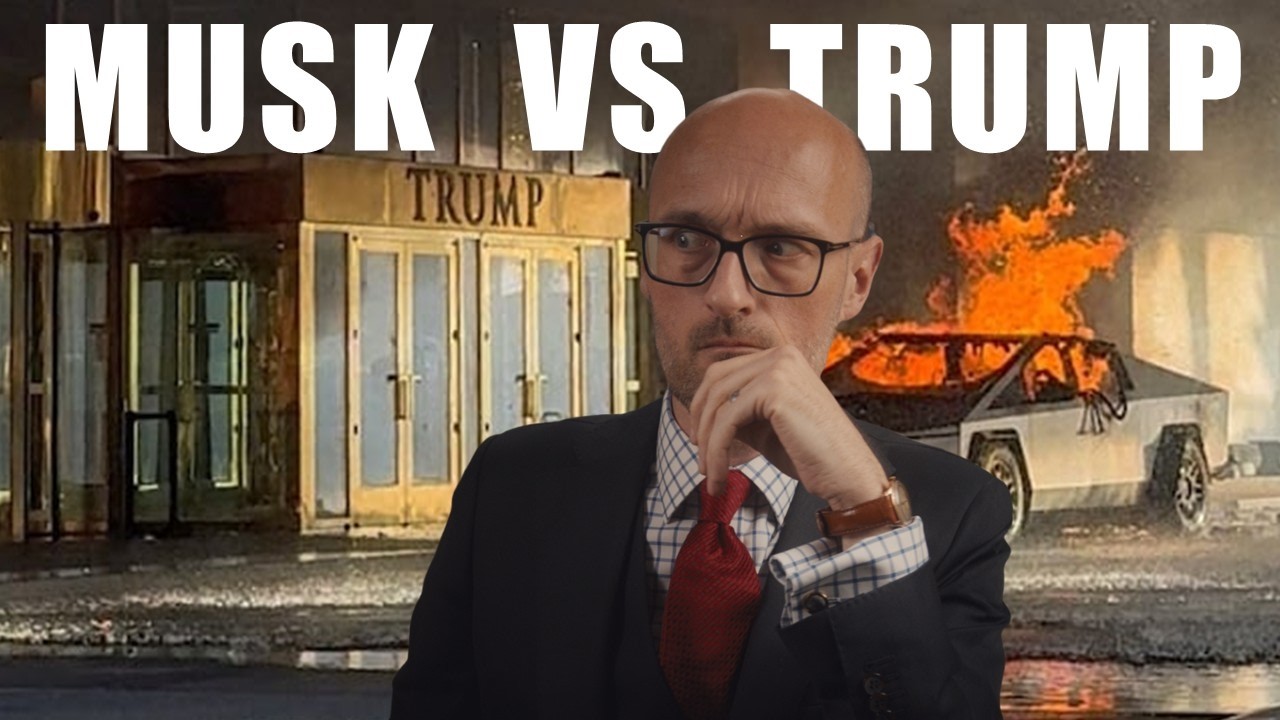

The Elon Musk and Trump falling out happened fast — and it got ugly, fast. The short answer is that Musk publicly called Trump's budget bill a 'disgusting abomination', Trump responded by calling him 'crazy' and threatening to rip up his government contracts, and then things escalated from there into Epstein allegations, alliterative nicknames, and threats to strand American astronauts in space. What makes this so remarkable is that just six months ago, Musk was jumping around on stage behind Trump, sitting in on Cabinet meetings, and wearing a 'Trump was right about everything' hat. So what on earth happened?
 00:45
Elon Musk jumping on stage behind Trump — the image that symbolized the beginning of their political partnership
Watch at 00:45 →
00:45
Elon Musk jumping on stage behind Trump — the image that symbolized the beginning of their political partnership
Watch at 00:45 →
Why Did Elon Musk and Trump Fall Out in 2025?
The immediate trigger was Trump's budget bill. Musk, who had spent months leading the Department of Government Efficiency (DOGE), declared the bill 'outrageous, pork-filled and a disgusting abomination,' arguing it completely undermined everything DOGE had supposedly achieved. Trump initially avoided addressing Musk directly — which, if you know Trump, is itself a remarkable act of restraint — but eventually snapped, calling Musk 'crazy' and suggesting he had 'Trump Derangement Syndrome.'
Then came the nuclear option: Trump threatened to cancel Musk's government contracts. For a man whose business empire is so deeply entangled with federal money, this was an existential threat. Musk fired back by tweeting that he would immediately decommission the Dragon spacecraft — the only vehicle currently capable of transferring US astronauts to the International Space Station. He later walked that back after a Twitter user with 671 followers gently suggested he sleep on it first. The fact that one man's bad mood could theoretically strand astronauts in space raised some uncomfortable questions about how the US government had ended up in that position to begin with.
Musk also implied Trump was connected to the Jeffrey Epstein files. Interestingly, it may not have been the Epstein allegation itself that stung Trump most — both men had been photographed in those circles, and the allegations are not new. The real wound, reportedly, was the implication that Trump had traveled on Epstein's jet — suggesting Trump wasn't rich enough to have his own plane. Given that Trump's private aircraft has been central to his personal brand since the late 1980s, this was a very precisely aimed insult. Trump responded with his sharpest weapon: an alliterative nickname. He called Musk 'Mediocre Musk' and told him to go back to Africa.
08:12
Trump presenting Musk with a gold White House key at the goodbye ceremony before the feud went fully public
Watch at 08:12 →
How Much Did Musk Spend on Trump's Election Win?
Musk spent approximately $250 million getting Donald Trump elected — the largest single financial intervention in an election in American history. He endorsed Trump in July 2024 following the assassination attempt in Pennsylvania, and from that point forward threw his money, his platform, and his personal celebrity behind the campaign.
After the Republican landslide, Musk was not shy about claiming credit. He tweeted: 'Without me, Trump would have lost the election, Dems would control the House and the Republicans would be 51-49 in the Senate.' He added the word 'Such ingratitude' — which, in retrospect, reads less like a boast and more like a warning shot. His reward was a civil service role as a Special Government Employee, which capped his federal working time at 130 days per year, and a seat at the table inside the most powerful government on earth.
What Has DOGE Actually Cut from the US Budget?
This is where the numbers get embarrassing. Musk originally claimed DOGE could cut two trillion dollars from the federal budget. The actual figure achieved was around 2% of that target — approximately $40 billion. To put that in perspective, it is the kind of rounding error you might find down the back of Washington's couch cushions.
14:30
Tesla stock chart showing the 62.5% surge in 2024 followed by the 2025 collapse as the political premium evaporated
Watch at 14:30 →
Musk himself acknowledged he was 'disappointed' with the results, and said the budget bill Trump was pushing 'undermined the work' of DOGE. Critics noted that many of the claimed cuts involved cancelled contracts that were later reinstated, fired workers who were rehired by court order, and savings figures that did not survive independent scrutiny. The gap between the promise and the delivery was, by any measure, vast.
Why Is Tesla Stock Crashing in 2025?
Tesla stock surged 62.5% in 2024 and hit an all-time high — despite the fact that the company reported its first annual sales decline, faced growing competition from Chinese manufacturers, and watched its newest model, the Cybertruck, miss sales targets by 84%. The stock rose not because the business was performing well, but because investors were betting that Musk's political influence would deliver favorable regulatory treatment for his companies. Grok, Musk's own AI chatbot, described this optimism as 'riding more on hope than on grounded reasoning' — and confirmed, when pressed, that it constituted an example of crony capitalism.
In 2025, that thesis is unwinding. With Musk now publicly feuding with Trump and the threat of losing government contracts looming, Tesla has shed $304 billion in market capitalization in the first twenty weeks of the Trump presidency alone. When you remove the political premium from a stock that was already priced as a high-growth company despite stalling growth, there is a lot of air to come out.
Is the Cybertruck the New Edsel? A Sales Disaster Comparison
The comparison is more apt than it might seem. The Ford Edsel, launched in 1957, became history's most enduring symbol of automotive failure. Ford planned to sell 200,000 units per year; it sold 63,000 over its entire lifespan before the model was scrapped. The causes? Ineffective marketing, flawed design, high price, and poor workmanship.
Elon Musk predicted Tesla would sell 250,000 Cybertrucks in its first year, supported by a million pre-order deposits. Tesla sold just under 50,000. The shortfall can be attributed to — and this is not a coincidence — ineffective marketing, a polarizing design, a high purchase price, poor workmanship, and what one might charitably describe as a challenging aesthetic. Unlike the Edsel, however, the Cybertruck's failure barely dented Tesla's stock price in 2024, because the political story was drowning out the business fundamentals.
Did Musk Really Threaten to Kill the SpaceX Dragon Program?
Yes — briefly. In the heat of the feud, Musk posted that he would immediately decommission the Dragon spacecraft, the vehicle SpaceX operates as the sole US provider of crewed missions to the International Space Station. The threat raised immediate alarm because there is currently no alternative American vehicle capable of performing that function, meaning Musk was, in effect, threatening to hold US astronauts' safe return hostage to a Twitter argument.
He walked the threat back relatively quickly, apparently after a user with 671 followers suggested he take a breath before doing anything irreversible. The episode nonetheless crystallized a growing concern: how had the US government allowed a single private individual to gain so much leverage over critical national infrastructure that a personal dispute with the president could theoretically compromise the space program?
Is the Musk–Trump Alliance a Textbook Case of Crony Capitalism?
When asked directly, Grok — Musk's own AI — said yes. The arrangement had all the classic features: a politically connected businessman receiving government contracts, regulatory advantages, and favorable treatment in exchange for financial and political support of those in power. The relationship worked beautifully while both parties were aligned. The moment they fell out, the structural fragility became obvious.
Trump threatened to revoke the government subsidies flowing to Musk's businesses. Musk threatened to expose damaging information about Trump. Both men understood that their power was partly a function of their partnership — and that dissolving it carried real costs for both sides. As one observer put it: if you take the crony out of crony capitalism, what's even left?
The feud also put other political figures in an impossible position. JD Vance, whose wife is the daughter of Indian immigrants, had previously tweeted support for a DOGE staffer who had posted content saying 'Normalize Indian hate' — apparently eager to signal loyalty to Musk. With Musk now calling for Trump to be impeached and replaced by Vance, the vice president's diplomatic silence spoke volumes. Meanwhile, political influencers who had spent a year praising both men faced a binary and career-defining choice: pick a side, or quietly delete everything and hope no one noticed.
The biggest winners from the Trump presidency's first twenty weeks, according to the Financial Times, were European defense companies and Chinese tech giants. Tesla lost $304 billion in market cap. Meta gained $177 billion. Mark Zuckerberg, apparently having reinvented himself with baggy clothes and gold chains, may have quietly become the new Elon Musk — and if the Jim Cramer tweet about the Trump–Musk friendship was any guide, that might not end well for him either.