
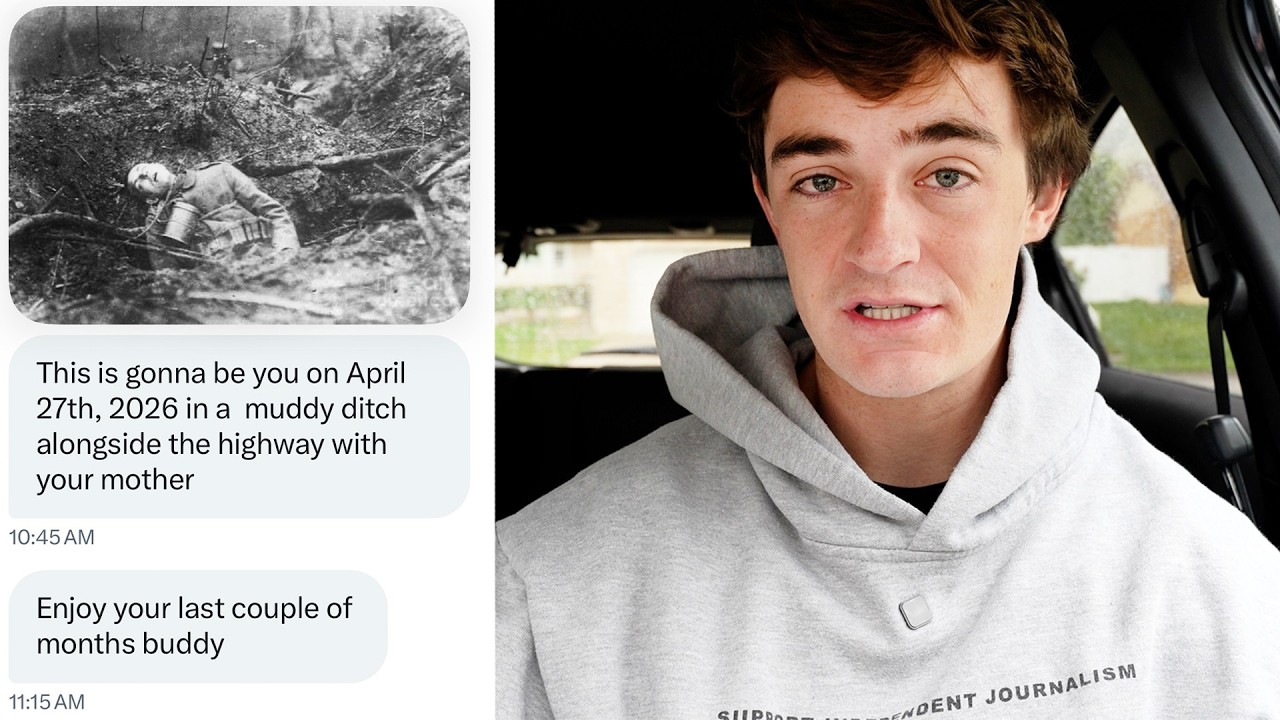
When you expose government fraud in the United States, you might expect to be celebrated. Instead, what often happens is that governors post AI-generated smear images of you, radical strangers post flyers calling for your death on street poles, and you wake up on a specific date — April 27th — knowing that someone on the internet published a photo of you in a ditch with a decapitated head and the caption: "This is going to be you on April 27th, 2026 in a muddy ditch alongside the highway with your mother." That is the reality of what happens when you expose government fraud in America today. This isn't speculation from a podcast desk — this is firsthand experience from inside the arena.
 00:28
The specific death threat posted online referencing April 27th, 2026
Watch at 00:28 →
00:28
The specific death threat posted online referencing April 27th, 2026
Watch at 00:28 →
What Really Happens When You Expose Government Fraud?
Most people assume that blowing the whistle on fraud — especially billions of dollars stolen from taxpayers — would earn applause, maybe a commendation, possibly a news cycle of support. The reality is the opposite. The moment you surface evidence of large-scale fraud, the machinery of political protection kicks in against you, not against the fraudsters.
After exposing what grew into a multi-billion dollar fraud network in Minnesota tied to childcare centers, daycares, and the Feeding Our Future program, the response from officials wasn't accountability — it was deflection. Governors and prominent political figures framed the exposé as the work of a "white supremacist" and a "delusional far-right conspiracy theorist." The same pattern repeated in California after a $170 million fraud investigation cracked open what appears to be a billion-dollar hospice and Medicare fraud industry. Rather than addressing the fraud, the governor posted an AI-generated image designed to make the investigator look predatory.
The political calculus is straightforward: if you can discredit the messenger, fewer people focus on the message. And in a polarized media environment, that strategy works — at least on a small but dangerous subset of the population.
02:15
Street pole flyers in Minnesota calling for action against the investigator
Watch at 02:15 →
How Real Are Political Death Threats in America?
The short answer: extremely real, and growing. The threats documented here aren't vague social media noise. They include specific dates, specific methods, and specific locations — the kind of detail that law enforcement takes seriously and that requires hiring private security just to travel.
Physical flyers appeared on street poles inside Minnesota with language like: "Nick Shirley brought ICE to Minnesota. He helped kill Renee Good. Do not let him in your business. If you see this man, tell him to kill himself." Online, popular streamers with large audiences openly called for violence, saying things like "Kill them. Murder those in the streets. Let the streets soak in their red capitalist blood."
This isn't fringe activity anymore. When high-profile figures amplify this language, it filters down to their audiences. And in a country of 330 million people, even a fraction of a percent radicalized is an enormous number of individuals capable of real-world action. Four assassination attempts on a sitting and former president. The murder of Charlie Kirk in front of thousands of people. The threats are not hypothetical — they are a documented pattern.
How Does Political Radicalization Actually Happen?
Understanding radicalization in America starts with math, not ideology. The mechanism is surprisingly mechanical:
- Step one: A political figure or media personality applies a loaded label — Nazi, fascist, white supremacist — to a target.
- Step two: That label reaches a mass audience, most of whom are reasonable people who simply update their opinion of the target.
- Step three: A small percentage of that audience — even 0.1% — absorbs the label as a call to action.
- Step four: 0.1% of 330 million Americans is still 330,000 people. That is not a fringe. That is an army.
Scale it up slightly. If 1% of the country becomes radicalized against a specific individual or group, that is 3.3 million people. If even a tiny fraction of those individuals act on their radicalization in a public space — a street, a rally, a parking lot — the consequences can be catastrophic. The terrifying part, as laid out here, is that this process is working. It is not an accident. The language is chosen deliberately to trigger a specific reaction in a specific subset of listeners.
07:40
Clip of a popular streamer openly calling for violence against property owners
Watch at 07:40 →
What makes this particularly dangerous is the paradox it creates for anyone doing meaningful public work: the more impactful your actions, the larger the target on your back. Abraham Lincoln. MLK. JFK. The pattern of who gets targeted is not random — it tends to be people creating genuine change.
What Was the Minnesota Feeding Our Future Fraud?
The Feeding Our Future scandal is one of the largest pandemic-era fraud cases in American history. Federal programs designed to feed children during COVID-19 were systematically looted through a network of fake or ghost daycares and childcare centers — many of which had no children on-site at all.
One daycare visited during the investigation had received approximately $3.6 million in federal funds. When investigators showed up, there were no kids. The operator of that daycare later attempted to flee to the United Kingdom but was stopped at the airport and ultimately pleaded guilty in the United States. Prosecutions are happening — but slowly, frustratingly slowly given the scale of what was stolen from American taxpayers.
The total fraud tied to this network runs into the billions of dollars, with funds flowing through autism centers and daycares in addition to the food program. Multiple individuals have been charged and convicted. The investigation is ongoing, and the depth of the fraud keeps expanding the longer investigators pull at the threads.
What Is the California Hospice Medicare Fraud?
The California investigation exposed approximately $170 million in hospice and Medicare fraud — a figure that, upon deeper investigation, appears to represent only a slice of a much larger billion-dollar industry built on billing the federal government for services never rendered or rendered to patients who did not qualify.
Because Medicare is federal money, this fraud isn't just a California problem. Every American taxpayer is funding it. The fraud operates underneath the regulatory radar partly because the hospice industry is under-scrutinized and partly because the financial incentives to look the other way are significant for those connected to the system.
Why Do Politicians Defend Fraudsters Over Whistleblowers?
This is the question that cuts to the heart of why exposing fraud is so dangerous. The answer is political survival. When a fraud network operates within a politician's district or under their administrative watch, exposing that fraud exposes them — their oversight failures, their donor relationships, their governance record.
The politically rational move is to attack the credibility of the person doing the exposing rather than confront the evidence. Call them a conspiracy theorist. Call them a racist. Generate content — even AI-generated images — that reframes them as the villain. This shifts the public conversation from "why did this fraud happen on your watch" to "is this investigator a dangerous extremist?"
Governor Tim Walz, for example, publicly labeled fraud investigators as white supremacists — then quietly dropped his reelection bid. The fraud didn't go away. The label was just a delay tactic, and a temporary one at that. The fraudsters who complain the loudest, it turns out, are almost always the ones with the most to lose.
Why 'We the People' Are the Three Most Important Words
Beneath all the threats, the fraud, and the political theater is a foundational question about what America is actually supposed to be. The Constitution doesn't say "we the Republicans" or "we the Democrats." It says we the people — and that framing matters enormously right now.
America is 250 years old. Every other major civilization had thousands of years to develop. In 250 years, the United States became the economic and cultural center of the world — the place everyone still wants to come to, the currency that still anchors global finance. That didn't happen by accident. It happened because the system, at its best, works for people — all of them.
The danger of the current moment isn't just fraud or radicalization in isolation. It's the erosion of the basic ability to have a conversation across political lines. When people can't be friends with someone of a different political belief, when families stop speaking over partisan labels, when the truth has no defense against a fool determined to believe a lie — that's when the foundation starts to crack.
As Mark Twain put it: "The truth has no defense against a fool determined to believe a lie." You cannot argue someone out of a position they were radicalized into. But you can keep telling the truth anyway. You can keep showing up. You can keep exposing the fraud. And you can trust that the vast majority — well over 90% of Americans — actually want accountability, transparency, and a government that doesn't steal from them. That majority is worth fighting for, even when the 1% makes it genuinely dangerous to do so.


