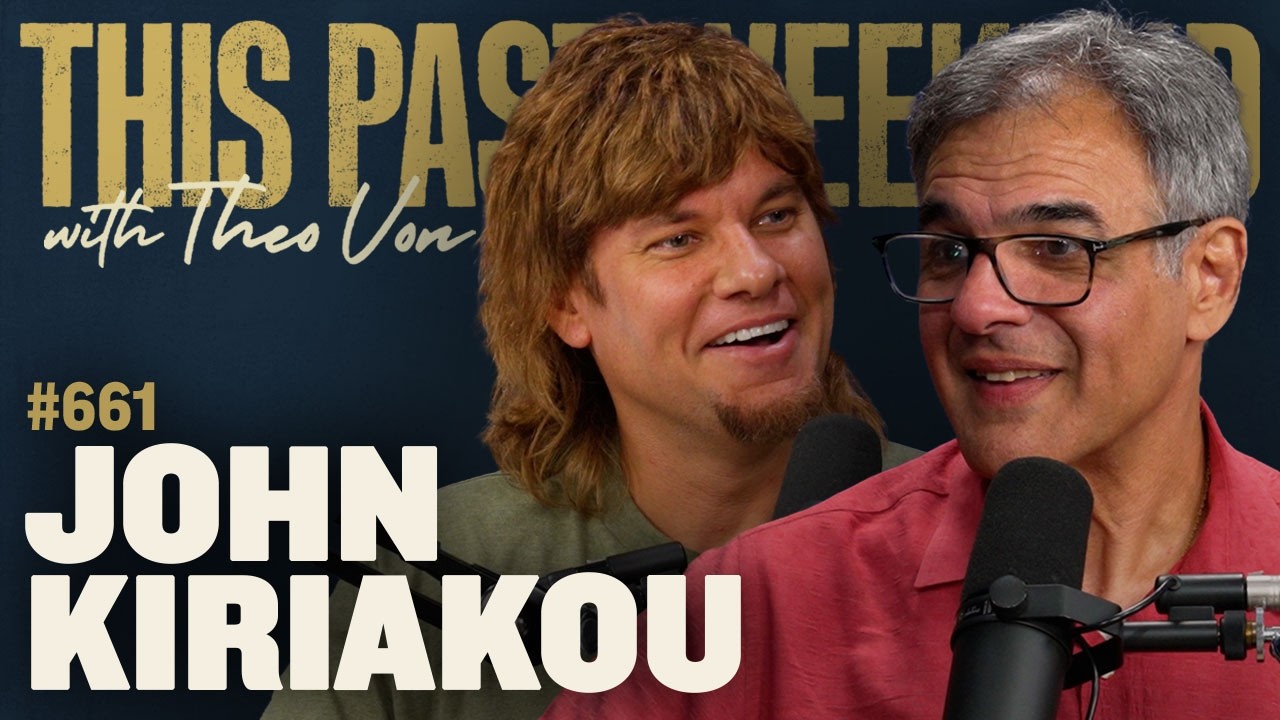

John Kiriakou spent nearly fifteen years as a CIA officer — briefing presidents, running counterterrorism operations in Pakistan, and eventually blowing the whistle on the agency's post-9/11 torture program. He went to prison for it. In a wide-ranging conversation, Kiriakou described what the CIA looked like before and after the attacks that changed everything, why the torture program produced nothing usable in court, and how the surveillance apparatus built in the name of national security now turns inward on American citizens.
How the CIA Recruited — and What It Felt Like to Belong
Kiriakou didn't apply to the CIA through a website. He was recruited by his graduate school professor at George Washington University — a CIA officer working undercover as an academic. The professor, Dr. Jerrold Post, had founded the agency's political psychology division and was talent-spotting students whose analytical instincts matched the culture. After Kiriakou wrote a psychological profile of an abusive union boss that Post judged to be concise, evidence-based, and unflinching, he got the call.
What recruiting looked like then is illegal today. A 1993 equal employment opportunity statute ended the practice of undercover academic recruitment. The CIA moved to cia.gov and open applications — a change Kiriakou describes as a loss of mystique, if nothing else.
Walking into CIA headquarters for the first time mattered to him in a way that still comes through decades later. He would park in the far lot and take the long route just to enter through the main door, cross the giant seal, and pass the wall of honor.
"I felt like I wanted to cry. I was so proud to be there."
His first assignment was as a leadership analyst on Iraq — given the portfolio precisely because, his supervisors told him, nothing ever happened there. Eight months in, Iraq invaded Kuwait. He was twenty-five years old when he walked into the Oval Office to brief President George H.W. Bush.
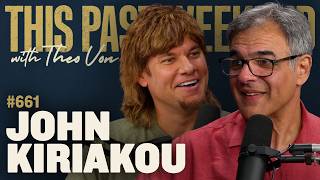 28:45
Kiriakou describing his first White House briefing after Iraq invaded Kuwait in August 1990
Watch at 28:45 →
28:45
Kiriakou describing his first White House briefing after Iraq invaded Kuwait in August 1990
Watch at 28:45 →
July 2001: The Warning Nobody Acted On
On July 6, 2001 — two months before 9/11 — Kiriakou was hosting a routine liaison day for mid-level intelligence officers from a Middle Eastern country. What was supposed to be a standard briefing was replaced by something unusual: Cofer Black, then director of counterterrorism for the entire American intelligence community, walked in unannounced.
Black told the room that something terrible was coming. He didn't know when or where, but al-Qaeda camp commanders were calling their students and telling them they'd see them in paradise. Code words for a massive attack were appearing in intercepted communications — references to vast quantities of honey, enormous weddings, huge football matches. He begged the visiting officers for any sources inside al-Qaeda. They stared at him and said nothing.
After the visitors left, Kiriakou went to Black's office and asked if the briefing had been theater. Black told him it was entirely serious.
On September 11th, Kiriakou was at CIA headquarters preparing to drive to the White House for a meeting with National Security Adviser Condoleezza Rice — about a thousand-page government book on U.S. foreign affairs with Greece, Turkey, and Cyprus that contained the names of three elderly CIA sources. The meeting was about pulling those pages. As he went to tell his boss the car was ready, the secretary's small television showed the World Trade Center on fire. He assumed it was a navigation accident. As he said so, the second plane hit.
51:20
Kiriakou recounting watching the second plane hit the World Trade Center on a secretary's television
Watch at 51:20 →
The Torture Program: What It Was and Why It Produced Nothing
Not a single CIA officer had been trained in interrogation techniques when the agency started capturing al-Qaeda suspects in early 2002. Kiriakou arrived in Pakistan in January of that year as chief of counterterrorism operations, with orders to catch fighters crossing out of Afghanistan. He and his team worked from the al-Qaeda training manual they'd seized in an early raid — and watched prisoners execute the resistance techniques described in it in real time.
The torture program was conceived and approved in October 2001, designed by two contract psychologists, James Mitchell and Bruce Jessen, at a cost of $108 million. Its techniques included waterboarding, prolonged sleep deprivation, the cold cell — in which naked prisoners were chained to an eyebolt in the ceiling so they couldn't sit or lie down — and sensory deprivation in complete darkness and silence for weeks at a time. Female interrogators were used specifically to humiliate prisoners in ways that violated Islamic norms around nakedness. Rectal feeding was used as a form of cultural degradation rather than medical necessity.
Kiriakou didn't witness these techniques firsthand. He learned of them after becoming executive assistant to the deputy director for operations — a role that put virtually every cable crossing the agency's counterterrorism operations on his desk.
The program's fatal legal flaw became apparent years later: everything obtained under torture is inadmissible. The men accused of planning 9/11 — Khalid Sheikh Mohammed and others — confessed in detail. None of it can be used in court. When a plea agreement offering life without parole was reached during the Biden administration, it was vacated under political pressure from 9/11 families and then thrown out by the courts. The accused remain at Guantánamo, neither convicted nor released, twenty-four years on.
Kiriakou is unequivocal: the CIA created the problem. If the torture program had never existed, there would be admissible evidence. There isn't.
Saudi Arabia, Israel, and the Questions 9/11 Never Answered
Kiriakou describes capturing Abu Zubaydah in Faisalabad, Pakistan in late March 2002 after a six-week chase. Among the items confiscated was what the CIA called a diary — actually a set of drawings, most of them classified top secret because they depicted his own torture. Inside were the cell phone numbers of three Saudi princes.
When CIA Director George Tenet confronted the Saudi ambassador, and the president called the king, the agency demanded access to those three princes. Within weeks, one died on the operating table during bariatric surgery. A second was killed in a single-car accident on the highway between Riyadh and Jeddah. A third died of thirst while camping in the desert. Kiriakou is certain Saudi Arabia eliminated them before they could be questioned.
On Israeli foreknowledge, his position is more carefully stated but unambiguous: he does not believe Israel was involved in planning or executing 9/11, but he believes Israeli intelligence had advance warning and chose not to share specific details. His reasoning is strategic — the attacks predictably triggered a prolonged American military presence in the Middle East and the removal of governments that threatened Israeli security. The five Israeli men arrested in New Jersey on the morning of 9/11, later described in media as the "dancing Israelis," have never faced charges or provided a full public accounting.
78:15
Discussion of the 'dancing Israelis' — five Israeli citizens detained in New Jersey on September 11, 2001
Watch at 78:15 →
The Surveillance State and What the CIA Has Become
Kiriakou draws a sharp line between the CIA he joined and the institution that exists today. Executive Order 12333, signed by Gerald Ford after the Church and Pike Committee investigations, prohibited assassinations and required judicial approval before collecting Americans' data. After 9/11, President Bush effectively suspended those constraints. The Special Activities Division and a counterterrorism special activities group were given standing orders to cycle through kill lists on a weekly basis. Intelligence collection became secondary.
Edward Snowden confirmed what Kiriakou and others had suspected: the NSA and CIA were conducting mass surveillance of American citizens — a direct violation of the NSA's own charter. A facility in Utah now holds enough storage capacity, according to Snowden's disclosures, to retain every phone call, email, and text message from every American for the next 500 years.
The legal architecture enabling this was built quietly. The National Defense Authorization Act of 2016 introduced national security letters — administrative orders that compel service providers to hand over user data without a judicial warrant. The same act, for the first time in American history, authorized the federal government to propagandize its own citizens, removing the longstanding prohibition that had kept outlets like Voice of America directed exclusively at foreign audiences.
Kiriakou notes that the companies most deeply embedded in the new data center build-out — Palantir, Nvidia, and others — either received CIA seed funding or are run by former senior agency officials. He doesn't think the scale of these facilities is explained by commercial data needs. The proposed Stratos campus in Utah would cover 40,000 acres and require more than double the current energy consumption of the entire state.
His practical advice for anyone hoping to stay off the grid is bleak: it requires abandoning all technology entirely. Short of that, the data is being collected regardless of what any individual does to prevent it.
After twenty-plus years away from the agency, two years in federal prison, a presidential pardon application, and a new book compiling CIA surveillance and counterintelligence tradecraft for a general audience, Kiriakou says he still believes the United States is the best country in the world — which is precisely why he keeps talking.
John Kiriakou's new book, The Ultimate Guide to CIA Skills, Tactics, and Techniques, is available now. His podcast, John Kiriakou's Briefing Room, launches in approximately four weeks at youtube.com/@realjohnkiriakou.