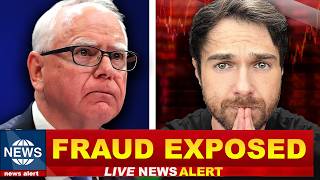
A young YouTuber walked up to daycare centers in Minnesota and asked some basic questions. What he found — and what happened next — exposed something far larger than a regional scandal. His video surpassed 100 million views, the federal government froze roughly $200 million in childcare funding to the state within days, and a congressional hearing was called to examine whether Minnesota's governor and attorney general were, as one chairman put it, "asleep at the wheel or complicit." But the real question the video raised wasn't about Minnesota. It was about why a 20-something with a camera caught what the entire apparatus of American government had apparently missed.
What Happened in Minnesota
The investigation centered on daycare centers allegedly claiming millions in federal childcare subsidies for services that were never rendered — or facilities that barely existed. Estimates of total fraud in Minnesota since 2018 run as high as $9 billion. When confronted with the story, Governor Tim Waltz did not call for arrests or promise to return taxpayer money. Instead, he framed the coverage as an act of scapegoating and invoked white supremacy. That response — striking to many observers for what it didn't say — went viral in its own right.
Federal funding was eventually frozen, but the timing matters: the freeze came after millions of people watched the video, not because any internal audit flagged a problem. No regulator caught it. No inspector general raised an alarm. The IRS did not notice. The system that is supposed to protect taxpayer money did nothing — until public outrage made inaction politically untenable.
Meanwhile, in Washington state, a senator had already pre-filed legislation that would make it harder for the public to access information about daycare operators. The proposed response to potential fraud, in other words, was less transparency.
The Voting and Verification Problem
Nick Shirley, the YouTuber who broke the story, identified a structural vulnerability that helps explain how large-scale fraud could persist undetected. Minnesota operates under some of the most permissive voter verification rules in the country. A legal citizen can vouch for up to eight other individuals on election day without those individuals presenting any independent documentation. Their word, and one person's ID, is sufficient.
It goes further. Staff members at certain residential facilities — group homes, shelters, assisted living centers, and child care centers — can vouch for an unlimited number of residents at their location. One employee, one facility, unlimited vouching.
 18:45
Nick Shirley explaining Minnesota's voter vouching rules and how they allow one person to vouch for unlimited residents at a facility
Watch at 18:45 →
18:45
Nick Shirley explaining Minnesota's voter vouching rules and how they allow one person to vouch for unlimited residents at a facility
Watch at 18:45 →
To be precise: permissive vouching rules do not automatically produce fraud. But they do create a system in which fraud is structurally easier to conceal. If the same network of entities receiving fraudulent government payments also controls voter registration at residential facilities, the overlap between financial fraud and electoral manipulation becomes worth examining. As Shirley put it, this is "stuff that will change the shape of a country or a state or a city."
Minnesota Is Not the Whole Story
The Department of Housing and Urban Development recently disclosed that in 2024 alone, over $5 billion was misappropriated from housing assistance programs. Breaking that number down:
- $77 million went to people who were not alive
- $150 million went to Social Security numbers that did not exist
- $288 million paid excessive rent, potentially including luxury housing
- $5.2 billion went to inactive accounts on SAM.gov — the federal government's master database of entities authorized to receive taxpayer money
That last figure is particularly hard to explain away. Payments to inactive SAM.gov accounts are supposed to stop automatically. For billions of dollars to flow to those accounts, someone — or some process — would have had to override the default. Either the system failed at its most basic technical function, or the payments were deliberately routed around verification controls.
The Government Accountability Office estimates that over the past two decades, the federal government has misappropriated roughly $2.7 trillion — and that figure reflects only what has been discovered and reported as of late 2024. The real number is almost certainly higher.
To put the broader fraud estimates in human terms: if fraud, waste, and abuse across the federal government totals $1.5 trillion annually — a figure some analysts cite — that is equivalent to the entire lifetime federal tax contributions of 2.5 million working Americans, paid every single year, achieving nothing.
Why the Institutions Failed
The more uncomfortable question is not whether fraud exists — at this scale, that is no longer seriously in dispute — but why the institutions designed to prevent it did not. The IRS knows exactly how many Venmo transactions exceeded $600. The government can track individual tax liability down to the dollar. But trillions in misappropriated funds went unaddressed for years, surfacing only when a young independent journalist started knocking on doors.
This is not a partisan failure. Both parties have controlled federal and state governments during the period this fraud allegedly occurred. When Elon Musk proposed the Department of Government Efficiency with the explicit goal of auditing government spending, the response from officials across the political spectrum was resistance — because opening the books risked implicating everyone. Neither side has demonstrated a consistent willingness to apply accountability rules to itself.
The result is a trust collapse that may be more damaging than the fraud itself. When people believe the system is corrupt — that rules apply selectively, that honesty is penalized and dishonesty rewarded — something foundational breaks. People stop believing that paying taxes, voting, or following rules produces any return. They stop treating America as a country governed by shared principles and start treating it as a transaction they're losing.
What This Moment Actually Means
The Minnesota story resonates not because daycare fraud is a new phenomenon, but because it crystallized something millions of people already suspected: that the institutions meant to protect them are either incapable of doing so or have no particular interest in trying. The fraud itself — as serious as it is — may be less consequential than what it revealed about who is watching, and who isn't.
Legitimacy in a democracy rests on one basic premise: the rules apply to everyone. When that premise breaks down visibly, and when it takes a YouTuber rather than a regulator to make it visible, the credibility of every institution attached to that system comes into question. That is not a left or right problem. It is a structural one, and it will not be fixed by press conferences or partisan point-scoring. It requires the kind of accountability that, so far, almost no one in a position of power has shown any appetite for.