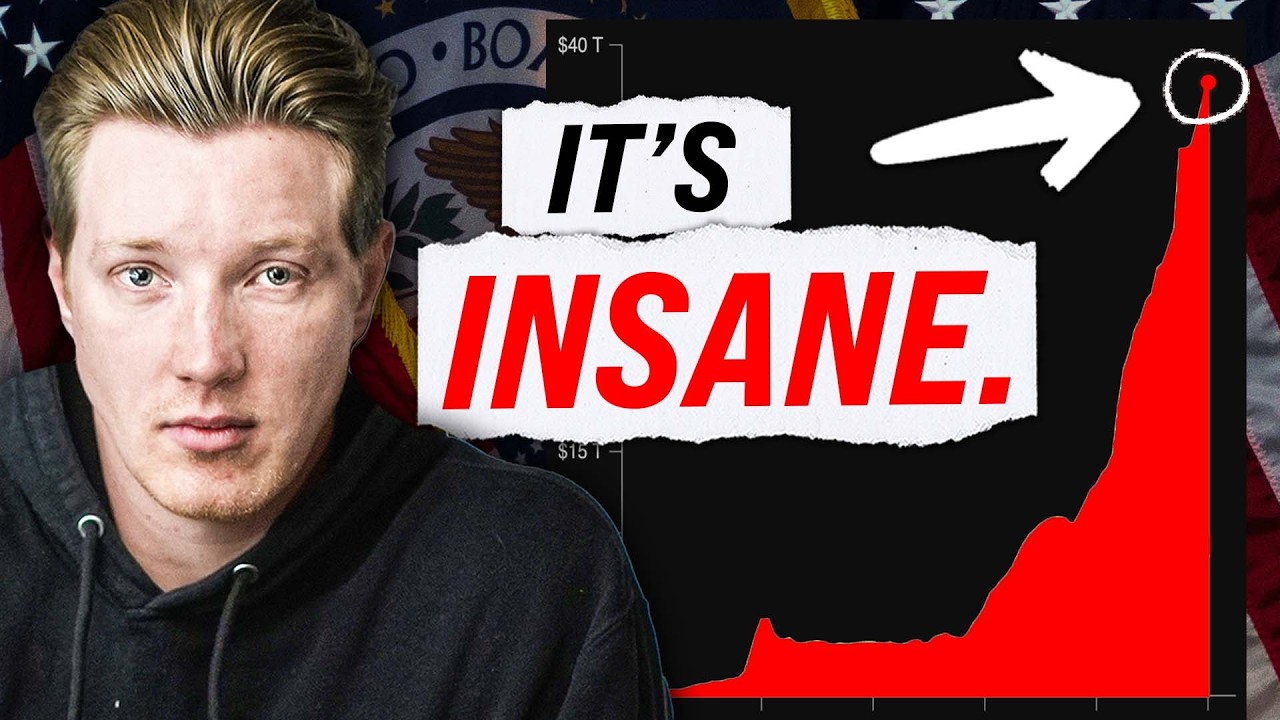

The US national debt is bad — genuinely, historically bad. As of right now, America is $39 trillion in debt, a figure so large it barely registers as a real number. To make it personal: if you split that debt equally among every American citizen, every man, woman, and child would owe roughly $116,000. And despite the United States having the strongest economy on Earth — combining size, productivity, innovation, and financial power that no other country currently matches — this one issue remains dangerously unchecked. According to House Budget Chairman Jody Arrington, it is nothing short of an existential threat to the future of the nation.
So how did it get this bad, why is it getting worse, and is there actually a way out? Let's break it down properly.
How Bad Is the US National Debt Right Now?
The $39 trillion figure is staggering on its own, but the scarier part is the speed at which it's growing. As Arrington recently pointed out, it took the United States roughly 200 years to accumulate its first trillion dollars of debt. Today, America adds that same amount in a matter of months. That's not a linear problem — it's an accelerating one.
Think of it like a person's finances. You have income and you have expenses. America's income comes from federal taxes, corporate taxes, Social Security and Medicare levies, customs duties, and more. Its expenses cover Social Security, Medicare, health programs, defense, infrastructure, education, veterans' benefits, and interest payments on existing debt. The problem is simple and brutal: America spends significantly more than it earns, every single year. Not once since the turn of the century has the US run a surplus. The country, as a nation, is not profitable.
When you spend more than you earn, you borrow. And just like a person taking out a mortgage or a car loan, the US government borrows by issuing Treasury bonds — essentially IOUs it sells to whoever will buy them. That includes foreign governments like Japan and China, major financial institutions like JPMorgan and Bank of America, pension funds, insurance companies, the Social Security Administration, and ordinary investors like you and me.
Why Does the US National Debt Keep Growing?
Here's where things get uncomfortable. The US doesn't just have one big $39 trillion loan sitting in a drawer somewhere. That debt is made up of millions of individual bonds, each locked in at whatever interest rate existed when it was issued. When interest rates were near zero in 2020, those bonds were basically free money — the government borrowed at almost no cost.
But here's the trap: when a bond matures, the government can't just pay it back. It doesn't have the cash. So instead, it does what's called refinancing — it issues a new bond to pay off the old one. That's not a problem when rates are low. It becomes a serious problem when rates are higher, because the new bond comes with a higher interest rate attached. And that means the annual interest bill goes up.
This is exactly what's been happening. As interest rates rose to combat the post-pandemic inflation surge, the cost of rolling over America's debt pile has climbed dramatically. The debt keeps growing not just because of new spending — it keeps growing because the interest itself is compounding.
How Much Does the US Pay in Interest on Its Debt?
In 2020, America's total annual interest expense was $523 billion. That was already an eye-watering number. But in 2025, that figure has more than doubled to $1.22 trillion. Per year. Just in interest. Not building roads, not funding schools, not paying soldiers — just servicing the debt.
To put that in context:
- America now spends more on interest than on national defense
- More than on healthcare
- More than on education, roads, bridges, veterans' benefits, and social services combined
- Interest is now the second-largest spending category in the entire federal budget, behind only Social Security and Medicare
That's not a rounding error. That's a structural shift in where American money actually goes. And the trend is pointing in one direction.
How Do Interest Rates Affect the National Debt?
This is why you'll hear President Trump repeatedly calling on the Federal Reserve to lower interest rates. Lower rates mean that when old bonds mature and get refinanced, the new bonds carry less punishing interest payments. The logic is straightforward — lower rates reduce the debt burden.
But here's the problem: the Federal Reserve raises rates specifically to control inflation. And inflation is currently being stoked by forces that aren't going away quietly. Take the conflict in the Middle East as one example. Roughly 20% of the world's oil supply passes through the Strait of Hormuz. Any disruption there — like Iran blockading that shipping lane — creates an oil supply shock. Less supply, same demand, higher oil prices.
Higher oil prices don't stay in the fuel tank. They flow through to transport costs, manufacturing, fertilizer, airlines, food production — essentially everything. Economists call this cost-push inflation: prices rising not because the economy is booming, but because it costs more to produce things. And crucially, even though this inflation isn't caused by an overheating economy, the Federal Reserve still has to respond to it by keeping rates elevated.
The result? America is currently trapped in a higher interest rate environment at the exact moment it needs rates to fall to manage its debt load. The geopolitical instability driving that inflation only makes the problem worse.
What Is the Big Beautiful Bill and Does It Worsen the Deficit?
If the interest rate trap wasn't bad enough, the fiscal decisions being made right now are actively adding fuel to the fire. The administration's proposed legislation — widely dubbed the "One Big Beautiful Bill" — has been scored by the Congressional Budget Office, and the numbers are not encouraging.
According to the CBO:
- The tax cuts in the bill will reduce federal revenue by an estimated $4.5 trillion over 10 years
- New spending increases add another $325 billion to the tab
- Spending cuts elsewhere trim an estimated $1.4 trillion
- The net result: the bill is projected to increase deficits by $3.425 trillion over the next decade
That's not a small margin of error. That's $3.4 trillion the US government will need to borrow — on top of the deficits it's already running. At a time when inflation concerns are already present, running ever-growing deficits doesn't just make the debt problem larger. It actively works against the conditions needed to bring interest rates down.
What Is a Debt Spiral and Could It Happen to America?
This is where economists start using phrases like "existential threat" and "debt spiral risk." A debt spiral is exactly what it sounds like: you borrow money to pay the interest on the money you've already borrowed. The debt pile grows. The interest on that larger pile grows. You have to borrow even more. Repeat.
When interest payments start competing with productive spending — on defense, infrastructure, education, healthcare — a country's ability to invest in its own future shrinks. The constraint isn't ideological at that point. It's mathematical.
America is not there yet. No one is saying the US goes bankrupt tomorrow. But the direction of travel is what concerns serious economists and policy makers. As Arrington bluntly stated, Congress appears "paralyzed, unable to meet the urgency of the moment."
How Can the US Actually Get Out of Debt?
Mathematically, there are only three paths out. None of them are easy:
- Cut spending — But the biggest budget items are Social Security, Medicare, defense, and healthcare. Cutting those is politically toxic and directly harms tens of millions of Americans who depend on them.
- Raise taxes — Also politically unpopular. Both parties have historically resisted large tax increases, and the current administration is moving in the opposite direction.
- Grow your way out — Hope that economic growth outpaces the debt accumulation. This has worked at certain points in history, but it becomes increasingly difficult when interest costs are themselves growing faster than the economy.
There's a fourth option that sometimes gets whispered about: printing money. Yes, the government could theoretically inflate its way out of debt by printing trillions of dollars. But that just transfers the cost onto every American through a weaker dollar and higher prices. You pay for the debt either way — just through your wallet rather than your tax return.
What makes the current situation genuinely dangerous isn't any one of these factors alone. It's the combination: a $39 trillion debt pile, refinancing at higher rates, inflation trapping those rates elevated, and new legislation set to add trillions more to the deficit. The strongest economy on Earth has a structural flaw that its political system seems unable — or unwilling — to fix. And that, more than any foreign adversary or market crash, is what economists are losing sleep over.