
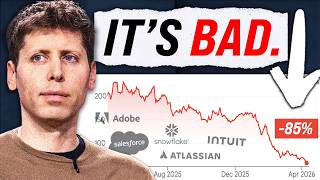
Software stocks are crashing in 2025 — and no, it's not because the businesses are falling apart. Companies like Salesforce, Adobe, Snowflake, and Atlassian are down anywhere from 30% to a staggering 85% from their peaks, yet most of them are still growing revenue at double-digit rates. So why are software stocks crashing so hard? The short answer: AI has completely changed the narrative, and when Wall Street changes its narrative, it doesn't wait around for the fundamentals to catch up.
What Exactly Is the SaaS Apocalypse?
If you've been anywhere near financial media over the past few months, you've probably heard the term SaaS apocalypse thrown around. It's the name investors have given to the brutal, sweeping sell-off hitting software-as-a-service companies across the board. We're talking about some of the most established, profitable, and deeply embedded software businesses on the planet — getting absolutely dunked on by the market.
 01:45
The two core fears investors have about AI replacing SaaS tools and destroying per-seat pricing models
Watch at 01:45 →
01:45
The two core fears investors have about AI replacing SaaS tools and destroying per-seat pricing models
Watch at 01:45 →
But here's the strange part: the businesses themselves haven't collapsed. Revenues are growing. Customers aren't disappearing. Profit margins are holding up. So the apocalypse isn't in the income statements — it's in investor expectations. And that distinction matters enormously if you're trying to figure out whether these sell-offs represent real danger or genuine opportunity.
Why Are Software Stocks Crashing in 2025?
There are two distinct fears driving the SaaS sell-off, and it's worth understanding both clearly.
Fear #1: AI Agents Could Replace SaaS Tools Entirely
The worst-case scenario investors are pricing in is existential. The argument goes something like this: if AI agents can now handle customer support tickets, automate workflows, generate marketing content, and analyze data — why do you need five separate SaaS subscriptions to do all that? Instead of paying for Zendesk, Intercom, Salesforce Service Cloud, and a handful of other tools, a business could theoretically pay for one AI platform that does everything. That's a brutal scenario for companies whose entire model is built around selling multiple specialized tools.
04:10
Salesforce's revenue, earnings, and free cash flow trends showing continued growth despite the stock's 50% decline
Watch at 04:10 →
Fear #2: The Per-Seat Pricing Model Is Broken
Even if AI doesn't make these companies entirely redundant, it threatens their core pricing structure. Most SaaS companies charge on a per-seat model — you pay per employee who uses the software. The more people on your team using the platform, the more you pay. But what happens when AI reduces headcounts? If a business cuts its team from 100 people to 50, that's a 50% drop in licenses sold — even if the company itself is still running just fine. Investors are terrified of this scenario, and they're selling first and asking questions later.
Is Salesforce Stock Worth Buying Right Now?
Salesforce is the poster child for the SaaS apocalypse conversation. The company holds somewhere between 20–24% of the global CRM market — miles ahead of Microsoft in second place. And from its peak in December 2024, the stock has roughly halved. That's a dramatic move for a business that is, by almost any measure, still fundamentally sound.
Here's what the actual numbers show: over the past three years, Salesforce's revenue, earnings, and free cash flow have all been trending upward. Yes, growth has slowed since 2022 — but a slowdown in growth is very different from a collapse in business. The balance sheet is in decent shape too. Assets comfortably exceed total liabilities, the debt-to-equity ratio is low, and roughly two-thirds of their debt could be paid off immediately with cash on hand.
07:30
Adobe's financial health metrics on Simply Wall Street — balance sheet, debt levels, and DCF valuation
Watch at 07:30 →
The real question isn't whether Salesforce is struggling — it clearly isn't. The question is whether its switching moat is strong enough to survive the AI transition. Salesforce is deeply embedded in thousands of businesses worldwide. Ripping it out and replacing it with an AI-native alternative isn't a weekend project — it's a multi-year migration that carries enormous risk. That switching cost is real, and it's not something the market seems to be giving much credit for right now.
When you run a discounted cash flow analysis on the current share price, the numbers suggest a steep discount to intrinsic value. That's not a buy signal on its own — but it is a strong signal that this one deserves a deeper look.
Is Adobe Stock Actually Undervalued in 2025?
Adobe's story is remarkably similar to Salesforce's — except the stock has fallen even further. From its 2022 peak, Adobe has shed over 60% of its market cap. And yet, just like Salesforce, the underlying business has not collapsed.
11:20
Atlassian's dramatic 85% decline from 2021 highs alongside its still-growing revenue chart
Watch at 11:20 →
Think of Adobe as three businesses layered on top of each other. First, you have the PDF workflow business — Acrobat, document signing, the tools that basically every office worker on the planet has used. Second, there's Creative Cloud — Photoshop, Premiere Pro, Illustrator, Lightroom, After Effects, Firefly. And third, you have the Adobe Experience Platform — the marketing and analytics layer that helps companies run campaigns, personalize content, and measure results.
Revenue, earnings, and free cash flow are all still trending in the right direction. The balance sheet is healthy. Total debt could be wiped out immediately with cash and short-term treasuries. There are no obvious red flags in the financials — none. Yet the market has decided to price it like a company in serious trouble.
Adobe also carries one of the strongest switching moats in software. It is the industry standard in creative tools. Businesses don't just use Adobe — they build entire creative workflows around it. Migrating away from Adobe isn't just expensive; it's disruptive in a way that most companies simply won't tolerate. The DCF analysis at these price levels screams undervaluation — which is exactly why this one deserves serious due diligence.
Should You Invest in Atlassian Stock Right Now?
Atlassian is where the story gets a little more complicated. Unlike Salesforce or Adobe, which focus on customers and marketing, Atlassian focuses on internal company workflows. Jira for project tracking, Confluence for documentation, Trello for task management, Bitbucket for code repositories. If you work in tech, you've almost certainly used at least one of these.
From its 2021 highs, Atlassian stock is down an eye-watering 85%. Even just since February 2025, shares have dropped roughly 78%. Part of that is valuation correction — the stock was trading at a price-to-sales ratio above 40 with no GAAP earnings. That kind of multiple requires near-perfect execution indefinitely, and any wobble gets punished hard.
But there's a specific AI fear here too. A big chunk of Atlassian's customer base is software engineers — and software engineers are increasingly being replaced or reduced thanks to AI coding tools. Fewer engineers means fewer Jira seats. That's the thesis, and it's not entirely unreasonable.
What the financials actually show: revenue growth is still healthy, but free cash flow has flatlined. The company still doesn't produce GAAP profits. It has $1 billion in debt against $1.6 billion in short-term cash, and a three-plus year cash runway. It's not about to go under — but it is the riskiest of the four companies covered here. The DCF suggests roughly a 67% discount to intrinsic value, but with a business that isn't yet consistently profitable, that number needs to be taken with appropriate caution.
Is Snowflake Stock Worth Buying After the Crash?
Snowflake occupies a unique position in the software ecosystem. If Salesforce stores customer data and Adobe creates content, Snowflake is the platform that helps companies store, organize, and analyze all of their data so they can actually make decisions. It was perfectly positioned for the AI boom — after all, AI is only as good as the data you feed it. And yet the stock is down roughly 60% from its 2021 highs, with another 30% drop year-to-date in 2025.
The valuation correction here makes some sense. At the height of the SaaS boom, Snowflake was trading at a price-to-sales ratio above 100. That's not a typo. As growth naturally moderated from hypergrowth to merely very strong, that multiple had to compress dramatically. But the bigger threat for Snowflake isn't AI making it redundant — it's the cloud giants. Amazon, Microsoft, and Google all have competing data platforms and every incentive to push customers toward their own ecosystems. That's a legitimate long-term risk.
That said, right now? Revenue is still growing strongly. Customers are expanding usage. Free cash flow is recovering. The company holds $4 billion in cash against $2.3 billion in debt. The business is not in crisis — the narrative is. And just like the others, current DCF analysis suggests significant undervaluation at these levels.
Will AI Actually Replace SaaS Companies?
Here's the honest answer: maybe, eventually, for some of them. But that future is not happening today. The businesses covered in this piece are not collapsing. Their revenues are growing. Their customers aren't fleeing. Their balance sheets are intact. What's happening is a massive repricing of future expectations — and that is precisely the environment where long-term value investors have historically found their best opportunities.
Volatility and knee-jerk reactions are what create mispricings. Efficient market hypothesis would tell you these stocks are priced perfectly. But a 60–85% decline in fundamentally sound businesses doesn't look efficient — it looks emotional. If software sits within your circle of competence, right now is the time to sharpen your pencil, run your own numbers, and figure out which of these companies has a moat strong enough to survive whatever AI throws at it. The market is in panic mode. That's usually when the best deals emerge.