Jamie Dimon's biggest risks to the US economy, according to his annual shareholder letter, are three powerful forces that are all converging at exactly the same time: the ongoing conflict in the Middle East, America's out-of-control deficit spending, and a stock market that is priced for absolute perfection. The world's most closely-watched banker isn't fear-mongering or predicting a crash next week — but he is sounding a clear alarm that these three issues colliding at once will drastically reduce the probability of good market outcomes in the not-too-distant future. Let's break down each one and, more importantly, what you should actually do about it.
What Are Jamie Dimon's 3 Biggest Risks to the US Market?
In his letter to shareholders and in recent interviews, Dimon identified three distinct but deeply interconnected threats. What makes this particularly serious is that each risk amplifies the others. They aren't isolated problems — they're a feedback loop. Here's the big picture before we dig into each one:
- Risk 1: The Middle East conflict and its inflationary impact on oil, food, and global supply chains
- Risk 2: The US government's ballooning deficit and the growing risk of a debt spiral
- Risk 3: Asset prices — stocks and real estate — sitting at historically extreme valuations
None of these are new concerns on their own. What has Dimon genuinely worried is the combination. When all three hit simultaneously, the margin for error shrinks to almost nothing.
What Is Stagflation and Why Is It the Worst-Case Scenario?
The Middle East conflict is Risk Number One, and the reason it's so dangerous comes down to oil. Dimon was direct: ballistic missiles, nuclear ambitions, and an unresolved war in one of the world's most strategically important regions represent "an enormous risk for mankind." But beyond the human cost, the economic consequences are what investors need to understand.
When oil prices spike, the effects aren't contained to the gas pump. Transport costs rise. Fertilizer becomes more expensive, pushing up food prices. Manufacturing costs climb. Plastics, logistics, agriculture — everything gets more expensive, virtually at once. That hits people's wallets hard, and when consumers tighten their belts en masse, economic growth starts to slow.
Here's the cruel twist: normally, when growth slows, central banks cut interest rates to stimulate the economy. But if inflation is still running hot — driven by expensive oil and food — cutting rates would only add fuel to the inflationary fire. So central banks are stuck. They can't stimulate without making inflation worse. And that, in plain English, is stagflation: a slowing economy with rising inflation happening at the same time.
Stagflation is widely considered the worst possible macroeconomic environment. It was last seen prominently in the 1970s and it decimated household wealth and market returns for years. Dimon explicitly raised it as a real possibility, saying the war "usually ends up in some form of recession... it could be stagflation in recession, which is the worst." That's not a throwaway comment from a man who chooses his words carefully.
How Bad Is the US Debt Crisis and What Happens If It Blows Up?
If the Middle East conflict is the match, America's debt situation is a room full of gasoline. Dimon describes it as probably the most dangerous long-term risk — the one that will have to be addressed at some point, whether politicians want to deal with it or not.
The basic problem is straightforward: the US government spends more than it earns every single year. To cover that gap, it borrows money by issuing bonds. The more bonds it issues, the more supply there is in the market. And when supply outpaces demand, you have to offer a better deal to attract buyers — meaning higher interest rates and better yields. That's expensive for a country that already owes $39 trillion.
It gets worse. Around 60% of US government spending — roughly $4 trillion out of $6 trillion total — is essentially locked in. Medicare, Medicaid, Social Security. That can't easily be cut. So when interest payments rise, the only realistic option is to borrow more money to pay the interest. More debt, more interest expense, more borrowing. That's the definition of a debt spiral, and it's the nightmare scenario.
Dimon's frustration isn't just with the math — it's with the political inertia. As he put it: "It's just we haven't had the will yet to actually deal with it." Both Democrats and Republicans talk about deficits when they're out of power and quietly ignore them when they're in charge. The clock is ticking, and Washington keeps hitting snooze.
What Are Bond Vigilantes and Why Should You Care?
Here's where the debt crisis can go from a slow burn to a sudden crisis. Dimon warned specifically about so-called bond vigilantes — large institutional investors who, when they lose confidence in a government's fiscal discipline, start demanding much higher interest rates to buy that government's bonds. Or they stop buying altogether.
If that happens to US Treasuries, interest rates don't gradually drift higher over years. They can spike sharply, in a very short period of time. Markets get volatile. Everything reprices fast. And given that the US dollar and US Treasuries underpin the entire global financial system, the ripple effects would be felt everywhere. It's not a theoretical risk — bond vigilantes have done this before to other countries. The question is whether the US ever reaches that tipping point.
Is the US Stock Market Overvalued Right Now?
So we have an oil shock feeding stagflation risk, a debt crisis building in the background, and bond markets that could get rattled. Now add a stock market priced for perfection — that's Dimon's third risk, and arguably the one most relevant to everyday investors right now.
Dimon noted in his letter that asset prices are sitting in the upper 15% of historical valuations. Two metrics make this concrete:
The Shiller PE Ratio
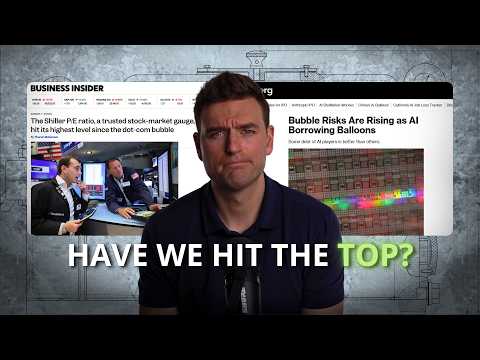
The Shiller PE (also called the CAPE ratio) looks at the cyclically adjusted average earnings of the S&P 500 over the last 10 years and compares that to the index's price. It's deliberately hard to manipulate because it smooths out short-term earnings swings. Historically, investors have paid around 18–20 times earnings for the S&P 500. Today? The Shiller PE sits at approximately 40x earnings — the second highest reading in history, behind only the dot-com bubble peak. The market is priced for everything to go right.
What Is the Buffett Indicator and What Is It Telling Us?
The Buffett Indicator compares the total market capitalization of all US stocks to the country's GDP. Anything above 120% is considered elevated. Today, the US market cap is over 200% of GDP — the highest it has ever been. That means the stock market is worth more than double the entire annual economic output of the United States. Warren Buffett has called this metric one of the best single measures of whether the market is fairly valued, and right now it's flashing red.
The implication is simple: when stocks are priced for perfection, any disappointment gets punished hard. And with oil shocks, stubborn inflation, and rising interest rates all in play, disappointment becomes a lot more likely. As Dimon explained, interest rates act like gravity on stock prices — the higher they go, the harder it is for stocks to rise, and the easier it is for them to fall.
How Should Long-Term Investors Handle These Risks?
Here's the part that actually matters for you. Dimon isn't saying sell everything and go hide under a mattress. And neither is Warren Buffett, who faces the same macro landscape. But both are being very deliberate about what they buy and at what price.
The key framework is bottom-up investing rather than top-down macro prediction. Instead of trying to forecast exactly when inflation spikes or when the bond market cracks — a nearly impossible task — you focus on individual companies. You judge every potential investment on its own merits: Does it have a durable competitive moat? World-class management? A real margin of safety in its valuation?
Buffett's Berkshire Hathaway is sitting on a record pile of cash right now precisely because great opportunities that meet all those criteria are hard to find when everything is priced at historic highs. But patience is the strategy. When sectors come under pressure — and with all three of Dimon's risks in play, some will — that's when quality businesses become available at fair or even cheap prices. That's the moment to act, not to wait and try to time some macro event perfectly.
The uncomfortable truth is that we don't know if the debt crisis becomes a problem in six months or six years. We don't know if this war escalates or resolves. But we do know that stocks are expensive, risks are elevated, and patience combined with discipline is historically the most reliable path through turbulent markets.