We haven't detected alien signals yet — and the most surprising explanation might not be that aliens don't exist, but that they're communicating in a way we are physically incapable of intercepting. The answer could lie in quantum communication, a form of information transfer so specialized that it would be nearly invisible to any civilization without the right equipment. If advanced alien civilizations are using quantum communication to talk across the stars, their messages could be whizzing past Earth right now, and we'd never know.
What Is the Fermi Paradox and Why Does It Matter?
The Fermi Paradox is one of the most haunting puzzles in science. The observable universe contains millions of billions of stars, many with planets orbiting them at habitable distances. When you crunch the numbers, the probability of intelligent life arising somewhere else — or in countless places — seems almost inevitable. And yet, silence. No confirmed alien signals. No visitors. Nothing.
 00:18
Visualization of just how many stars and planets exist in the observable universe — the statistical foundation of the Fermi Paradox
Watch at 00:18 →
00:18
Visualization of just how many stars and planets exist in the observable universe — the statistical foundation of the Fermi Paradox
Watch at 00:18 →
Italian-American physicist Enrico Fermi famously summarized this tension with a simple question: Where is everybody? Decades of searching for extraterrestrial intelligence (SETI) have turned up nothing conclusive, which forces us to ask whether we're looking in the wrong place — or with the wrong tools entirely.
Why Haven't We Detected Any Alien Signals?
The dominant assumption in SETI has always been that aliens, if they exist, would broadcast signals using radio waves or something similarly omnidirectional. But what if that assumption is completely wrong? What if advanced civilizations have moved beyond radio the same way we've moved beyond telegraph — and what they've moved to is quantum communication?
Unlike radio waves, which can spread in all directions and be picked up by anyone with a receiver, quantum communication is fundamentally different. It has strict physical requirements that make it essentially impossible to intercept unless you're the intended recipient with the right equipment. That distinction is crucial — and it reframes the entire Fermi Paradox.
01:45
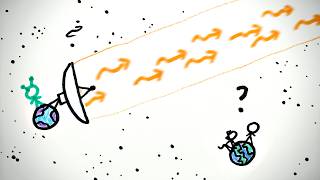
Diagram showing the difference between broadcasting a radio signal in all directions vs. narrowcasting a quantum signal at a specific target
Watch at 01:45 →
What Is Quantum Communication and How Does It Work?
Quantum communication involves sending photons that are either entangled or exist in a carefully controlled superposition of quantum states. The payoff is enormous information density. Two key protocols illustrate this:
- Superdense coding: A single quantum bit (qubit) can be used to transmit two classical (non-quantum) bits of information — effectively a 2x efficiency gain.
- The Hidden Matching Problem: Certain types of information require exponentially more classical bits to transmit than quantum bits. Quantum wins — massively — for specific communication tasks.
For interstellar communication, this efficiency matters enormously. The distances between stars are so vast that even light takes years to cross them. You don't want to waste a decade waiting for a reply only to hear, "Sorry, you cut out — can you repeat that?" Quantum communication's density advantage means you can pack far more meaning into every photon you send.
That said, both protocols come with important caveats — more on those below.
03:10
Scale comparison of a 100km quantum telescope vs. Earth's largest existing radio telescopes
Watch at 03:10 →
Why Would Quantum Communication Need a 100km Telescope?
Here's where quantum communication gets physically demanding — and where the Fermi Paradox connection becomes clear. Unlike radio signals, quantum information cannot be broadcast in all directions. The laws of physics require that the receiver must collect more than 50% of the photons that were sent in order to reconstruct the message. If fewer than half the photons arrive, the information is lost — irretrievably.
This means quantum communication cannot be broadcast. It must be narrowcast — precisely aimed, like a laser, directly at the intended receiver. And the mathematics of that constraint are brutal:
- The transmitting and receiving telescopes must be genuinely enormous — not simulated large arrays like the Very Large Array (VLA), but physically massive structures.
- You have to use photon wavelengths that travel cleanly through Earth's atmosphere and across interstellar dust without scattering.
- To communicate with Alpha Centauri, the nearest star system, you'd need a telescope roughly 100 kilometers in diameter. For more distant targets, even larger.
This isn't something you can fake with clever engineering tricks. You actually have to build the full 100km structure to capture enough photons. Interstellar quantum communication is extraordinarily hard — but that difficulty is precisely the point.
Could Aliens Already Be Communicating Quantumly Around Us?
Now put the pieces together. Imagine a galaxy filled with advanced civilizations that have built vast networks of 100km+ telescopes and are exchanging quantum messages across interstellar distances. What would that look like from Earth?
It would look like exactly what we observe: nothing. Here's why:
- Signals are narrowcast, not broadcast. Quantum messages are aimed precisely at their intended receiver. They don't spray out in all directions — almost all photons travel directly from sender to recipient telescope, with very few straying off course.
- We couldn't intercept enough photons anyway. Even if a quantum signal happened to pass near Earth, our largest telescopes are nowhere near 100km in size. We'd catch a tiny fraction of the photons — far less than the 50% needed to reconstruct the message.
- Aliens could see we're not ready. Any civilization with telescopes large enough to send quantum messages would also have telescopes powerful enough to observe Earth and notice we don't have quantum-capable infrastructure. They'd know that sending us a message is pointless — so they simply wouldn't bother.
The implication is striking: alien quantum communications could be filling the galaxy right now, crisscrossing the space around us constantly, and we would be completely oblivious. Not because the signals aren't there, but because we lack the physics to notice them.
Does Quantum Communication Actually Solve the Fermi Paradox?
It goes a long way. The quantum communication hypothesis elegantly explains why SETI's radio-frequency searches have come up empty: we've been listening on the wrong channel entirely, with equipment that's orders of magnitude too small to participate in the conversation.
The logic chain runs like this:
- Quantum communication is significantly more efficient than classical communication for interstellar distances.
- Advanced civilizations would almost certainly adopt it.
- Quantum communication requires narrowcasting with huge telescopes.
- Those signals would almost never hit Earth by accident.
- Even if they did, we couldn't decode them.
- Aliens capable of quantum communication could tell we can't receive it — and wouldn't bother contacting us.
Result: silence, exactly as observed. The Fermi Paradox isn't a paradox at all — it's just a technology gap.
That said, genuine open questions remain. If aliens wanted to make first contact, why wouldn't they just send a simple radio signal first? And if any civilization had deployed a galaxy-spanning telescope network, couldn't they just... visit? These are real objections, and they don't have easy answers. But as a partial solution, the quantum communication hypothesis is one of the most physically grounded explanations the Fermi Paradox has ever received.
What Is Superdense Coding and What Are Its Limits?
It's worth unpacking the caveats behind quantum communication's efficiency claims, because they're significant.
Superdense coding sounds like a straightforward 2x improvement: send one qubit, transmit two classical bits. But there's a catch — the receiver must already possess an entangled qubit that was pre-shared by the sender. Without it, the protocol doesn't work. That means either you brought a large supply of pre-entangled qubits when you built your receiving telescope (a massive logistical challenge across light-years), or the sender has to transmit two qubits anyway — at which point you could have just sent two classical bits instead.
The Hidden Matching Problem is more impressive on paper: it provably requires exponentially more classical bits than quantum bits for a specific type of information transfer. The quantum advantage here is real and mathematically proven. But the protocol also requires the receiver to already hold some prior information, and it hasn't been fully generalized into a practical communication system yet.
So the efficiency gains are real — but they're not free. They come with engineering prerequisites that are themselves enormously demanding. For an advanced civilization that has already solved those prerequisites, though, quantum communication would be the clear and obvious choice for talking across the stars.
The universe may not be silent because it's empty. It may be silent because we're still learning to listen.