The paradoxes of space navigation are genuinely mind-bending. We're not talking about minor quirks — we're talking about facts so counterintuitive that even experienced space enthusiasts do a double-take. For example: there's a specific orbit that takes more fuel to reach than escaping the solar system entirely. And then there's this gem: you can save fuel by flying millions of miles past your destination and then coming back. If you've ever wondered why orbital mechanics feels like it was designed to break your brain, buckle up.
What Are the Strangest Paradoxes of Space Navigation?
Orbital mechanics is packed with counterintuitive surprises. In a previous discussion of space navigation, we covered how catching up to someone in the same orbit requires you to slow down first, and how speeding up twice gets you into a higher but ultimately slower orbit. But three more paradoxes go even deeper — and the last one is genuinely one of the most surprising facts in all of physics.
 00:45
Diagram showing the two burns of a Hohmann transfer and how speed changes along the elliptical orbit
Watch at 00:45 →
00:45
Diagram showing the two burns of a Hohmann transfer and how speed changes along the elliptical orbit
Watch at 00:45 →
- There is a single worst orbit in the solar system — one that costs more fuel than any other destination, including leaving the solar system entirely.
- You can overshoot your destination by a factor of thousands and still end up using less fuel than going directly.
- The most fuel-efficient transfer strategy involves overshooting all the way to infinity — which, admittedly, takes infinite time.
Let's break each of these down properly.
How Does a Standard Orbital Transfer Work?
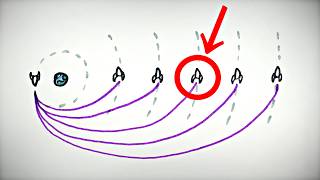
Before diving into the weird stuff, it helps to understand the baseline. The simplest way to move between two circular orbits is called a Hohmann transfer. It requires exactly two engine burns:
- First burn: You speed up, launching yourself onto an elliptical path whose highest point reaches your target orbit.
- Second burn: When you arrive at that highest point, you're moving too slowly to stay in a circular orbit there. So you speed up again — this is called the circularization burn — to match the speed needed for that orbit.
Both burns cost fuel. The first burn makes intuitive sense: more speed equals a higher orbit. But the second burn is where things get strange, and it's the key to understanding all three paradoxes ahead.
Why Is There a 'Worst' Orbit That Costs the Most Fuel?
Here's where it gets weird. You'd naturally assume that the farther out an orbit is, the more fuel it takes to reach. But that's not actually true beyond a certain point.
02:30
Graph showing fuel cost vs. target orbit distance, with the peak at ~15x starting radius clearly labeled
Watch at 02:30 →
When you arrive at the top of your elliptical transfer orbit, your speed follows a rough 1/r relationship — it drops off quickly as r (your distance from the Sun or Earth) grows. But the speed required to stay in a circular orbit at that radius only drops as 1/√r, which is much slower. So early on, as your target gets farther out, the gap between your arrival speed and the required circular speed actually grows — meaning the circularization burn gets harder and harder.
But past a certain point, that gap starts shrinking again. When you factor in both burns — the initial boost onto the transfer ellipse and the final circularization — the combined fuel cost peaks at a destination that is roughly 15.5 times farther out than your starting orbit. For spacecraft leaving Earth orbit around the Sun, that puts the worst destination squarely between Saturn and Uranus.
Beyond that? It starts getting easier to reach farther orbits, not harder.
Is It Really Cheaper to Escape the Solar System Than Reach Saturn?
Yes — and by a meaningful margin. Because the fuel cost peaks around 15 times your starting orbital radius and then decreases, orbits beyond the asteroid belt actually cost less fuel than that worst-case zone between Saturn and Uranus. And escaping the solar system entirely costs about 30% less fuel than reaching that hardest circular orbit.
04:15
Three-step illustration of a bi-elliptic transfer: initial boost, far-point redirect, and final circularization from above
Watch at 04:15 →
The same principle applies at smaller scales. Getting into geostationary orbit — only 6.5 times farther out than low Earth orbit — requires nearly as much fuel as reaching the Moon, which is 60 times farther out. Medium-range transfers are uniquely punishing, which leads directly to the next paradox.
What Is a Bi-Elliptic Transfer and Why Does It Save Fuel?
This is the one that breaks most people's intuition. The bi-elliptic transfer is a three-burn maneuver that saves fuel by deliberately overshooting your destination — sometimes by a factor of hundreds or thousands — before coming back.
Here's how it works:
06:10
Chart comparing fuel savings vs. overshoot distance for bi-elliptic transfers, showing diminishing but consistent gains
Watch at 06:10 →
- Burn 1: You boost yourself onto a transfer ellipse that overshoots your target by 100x, 1,000x, or more.
- Burn 2: At the farthest point of that overshoot (where you're barely moving and gravity is almost nothing), you do a tiny burn to redirect yourself onto a new ellipse that comes back down toward your actual destination.
- Burn 3: You arrive at your destination from above, moving too fast, and slow down to circularize.
The critical insight is what happens when you circularize from above versus below. Arriving at your destination from below (as in a standard Hohmann transfer), your speed is proportional to 1/r — you might only have 1–5% of the speed you need, so you have to fire your engines hard to accelerate. But arriving from above, your speed is proportional to 1/√r — just like the circular orbit speed — and you're only about 1.4 times too fast, meaning you only need to slow down by roughly 30%.
That's a dramatically easier circularization burn. And the middle burn, way out in deep space where gravity is almost nonexistent? That costs almost nothing. The result is a net fuel saving — and it kicks in whenever your destination is more than about 12 times farther out than your starting orbit.
Can Overshooting Your Target Orbit Actually Save Fuel?
It can — but it's important to be realistic about how much. The savings are real but modest:
- Destination 20x farther out, overshoot to 40x: save about 1.7% of fuel.
- Destination 100x farther, overshoot to 1,000,000x: save about 7.6% of fuel.
What's the catch? Time. Overshooting 10x farther than your target takes roughly 600 times longer than a direct transfer. Overshooting 100x takes 20,000 times longer. Overshooting 1,000x takes 700,000 times longer. That's not a rounding error — it's a civilization-scale difference in travel time.
So the bi-elliptic transfer is the answer to a very specific question: what if fuel is critically limited and time doesn't matter?
What Is an Infinite Bi-Elliptic Transfer and Is It Useful?
Taking the logic to its extreme: the more you overshoot, the less fuel you use. And that trend continues all the way to infinity. The theoretical infinite bi-elliptic transfer — where you overshoot all the way out of the solar system, coast to effectively infinite distance, make a near-zero burn, and fall back — is the single most fuel-efficient way to change orbits when your destination is more than 12 times farther out.
The maximum savings are about 8% compared to a direct Hohmann transfer. It's not enormous, but in a domain where every kilogram of fuel is precious, 8% is genuinely significant.
The only problem — and this is a real problem — is that it requires infinite time. Practically speaking, missions choose a compromise: overshoot far enough to get most of the fuel benefit without waiting an absurdly long time. But the concept itself is beautifully weird: the best possible orbital strategy involves going infinitely far in the wrong direction first.
Why Orbital Mechanics Keeps Surprising Us
These paradoxes — the worst orbit, the efficiency of overshooting, the infinite transfer — all stem from the same underlying mathematics of gravity. Gravitational potential wells don't scale the way our intuition expects. The relationship between distance, speed, and energy in orbit is deeply nonlinear, and every time you think you've got a handle on it, another surprise emerges.
The takeaways are clear: there is a worst orbit (roughly 15x your starting radius), medium-range transfers are surprisingly expensive, and overshooting can actually save fuel once your destination is far enough out. Space navigation rewards counterintuitive thinking — and punishes anyone who assumes the shortest path is the cheapest one.