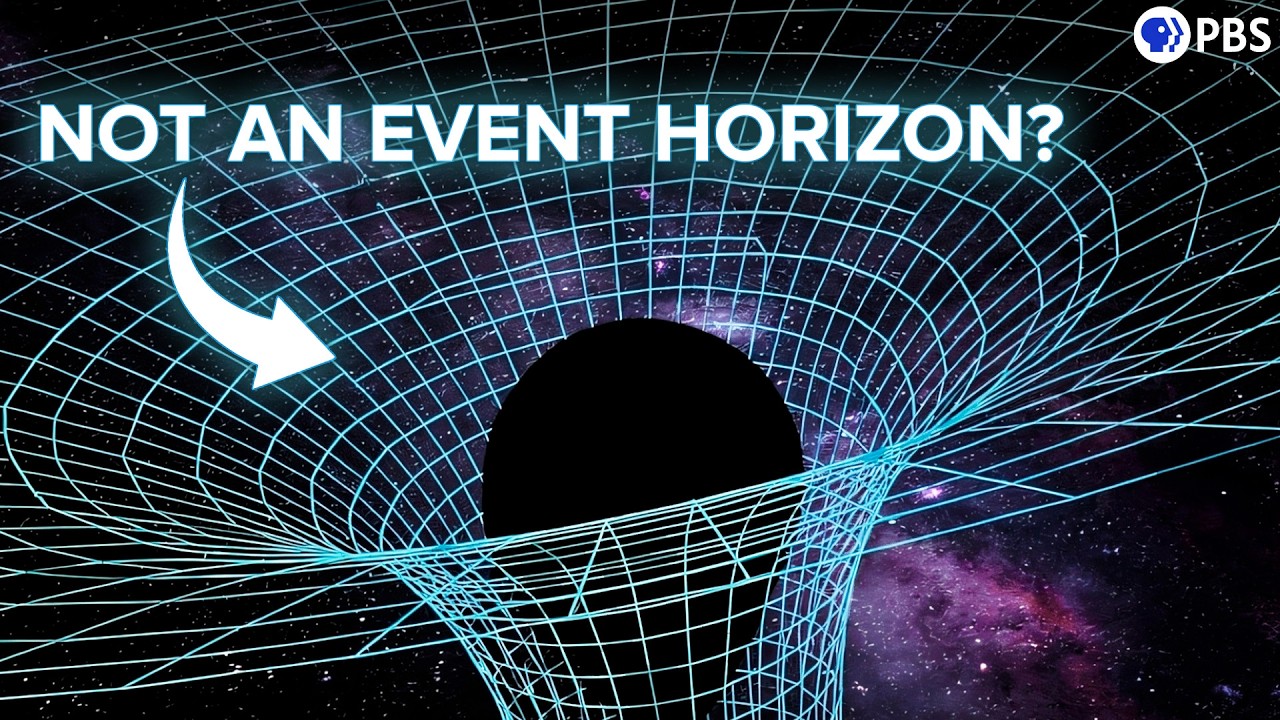

An event horizon is the boundary of the causal past of future null infinity — which is physicist-speak for the point of no return in spacetime beyond which nothing, not even light, can ever escape to the wider universe. Most of us picture it as the dark, glowing edge of a black hole. That picture isn't wrong exactly, but it is dangerously incomplete. The true event horizon isn't a fixed surface floating in space right now. It's a global property of spacetime itself, defined by everything that will ever happen in the universe, including events billions of years from now.
What Is an Event Horizon Really?
The classic image of an event horizon — a crisp, dark sphere surrounded by a swirling accretion disc — captures something real but misses the deeper physics. Formally, the event horizon is defined by Stephen Hawking and George Ellis in their landmark book The Large Scale Structure of Spacetime as the boundary of the causal past of future null infinity.
 03:45
Penrose diagram of an infinite flat universe showing future null infinity as diagonal edges
Watch at 03:45 →
03:45
Penrose diagram of an infinite flat universe showing future null infinity as diagonal edges
Watch at 03:45 →
Let's unpack that. Future null infinity is the destination of all light rays that successfully escape to an arbitrarily large distance from any massive object. The causal past of that destination is every event in spacetime that could, in principle, send a signal fast enough to eventually reach that far edge. The event horizon is the boundary separating the regions that can reach future null infinity from the regions that cannot — no matter what.
This means the event horizon is not about what's happening to light right now. It's about what will happen to light across all of future time. That's a crucial and deeply strange distinction.
How Does an Event Horizon Actually Form?
Here's where things get genuinely mind-bending. The event horizon doesn't simply snap into existence the moment a star collapses into a black hole. In fact, according to the formal definition, the event horizon begins forming before the black hole fully exists.
07:12
Vaidya spacetime diagram showing the event horizon expanding outward before the black hole forms
Watch at 07:12 →
Consider the Vaidya spacetime, a theoretical model devised by Indian physicist Prahalad Vaidya. Imagine a spherical shell of radiation — pure light — collapsing inward toward a central point. You're sitting at that center, completely unaware, because no signal can outrun the incoming radiation to warn you. According to the formal definition, the event horizon begins growing outward from the center at the speed of light, expanding until it intercepts the infalling radiation shell. That interception is the moment the black hole truly forms, but the horizon was already there, already growing, already trapping the region inside it.
This has a stunning practical implication: if you were at the center of that collapsing shell and fired a light-speed distress signal outward, whether that signal escapes or not depends not on the local conditions at the moment of launch, but on whether it exits the region that will eventually become the event horizon. Send it early enough and you escape. Send it a fraction too late and it was always doomed — the event horizon was already above it, even if no black hole had formed yet.
Can an Event Horizon Form Before a Black Hole Exists?
Yes — and this is one of the most counterintuitive results in all of black hole physics. Because the event horizon is defined teleologically, by the ultimate fate of light rays across all future time, it can exist in a region of perfectly ordinary-looking spacetime with no singularity, no extreme gravity, and no obvious sign of a black hole.
The event horizon grows outward from a nascent point, and it only reaches its final size when the collapsing mass or energy crosses inside it. At that moment, the black hole comes fully into being. But the region inside the future event horizon was always sealed off from the rest of the universe, even before a single physical oddity appeared there.
11:30
Penrose diagram comparison: eternal black hole vs. collapsing radiation shell forming an event horizon
Watch at 11:30 →
This is not just a theoretical quirk. It changes how we must think about the safety of any region of spacetime. You cannot determine from local conditions alone whether you are inside a forming event horizon. You would need to know the complete future history of your entire cosmic neighborhood.
What Is a Penrose Diagram and Why Does It Matter?
Physicists use a tool called a Penrose diagram to visualize these causal structures clearly. A Penrose diagram maps all of spacetime — including infinite distances and infinite future and past — onto a finite two-dimensional diagram. Time increases upward, one spatial dimension runs horizontally, and light always travels at exactly 45 degrees on the diagram because the coordinates are chosen to make that true.
The edges of the diagram represent infinities: the top and bottom points are infinite future and past, the diagonal edges are future and past null infinity — where light rays end and begin. Adding a black hole to the diagram reveals the event horizon as a clean diagonal line. Everything below and to one side of that line is causally sealed: no path shallower than 45 degrees, meaning no path slower than light, can cross from inside to outside.
This visual makes Hawking and Ellis's definition tangible. The event horizon is the precise boundary of the region that cannot send any signal to future null infinity. Inside that boundary, even outward-directed light rays eventually curve back and terminate at the singularity.
15:50
Apparent horizon visualization during black hole merger simulation — the joint horizon snapping into existence
Watch at 15:50 →
Apparent Horizon vs. Event Horizon: What's the Difference?
Because the true event horizon is defined across all of spacetime and future time, it's deeply impractical for studying black holes that are actively feeding, merging, or growing. Enter the apparent horizon — a more local, more immediate concept.
The apparent horizon is the outermost surface from which all outward-directed light rays are converging inward rather than diverging outward. In plain terms, it's the surface where light, even if aimed directly away from the black hole, is still being pulled back in right now. It doesn't care about the infinite future. It's a snapshot of local inescapability.
This distinction matters enormously:
- The event horizon is global, teleological, and observer-independent. Everyone agrees on it, but you can only fully identify it once you know the complete future of spacetime.
- The apparent horizon is local and frame-dependent. It can shift between reference frames, and under certain spacetime slicings, it can even appear to vanish — though you would still be trapped behind the true event horizon.
When researchers simulate merging black holes on supercomputers, what they visualize is the apparent horizon. The two inspiraling black holes show warped, distorting apparent horizons that warp as they approach. But the joint apparent horizon of the final merged black hole doesn't gradually grow from the two — it snaps into existence at the moment the two event horizons merge. The apparent horizon is not a substitute for the true event horizon. It's a distinct, genuinely interesting object in its own right.
Crucially, the apparent horizon is always guaranteed to lie inside or exactly on the true event horizon. So it provides a conservative, local estimate of where the black hole boundary is at any given moment.
Why Do Physicists Call the Event Horizon Teleological?
The word teleological comes from the ancient Greek telos, meaning final purpose or ultimate end. Physicists use it to describe the event horizon because the horizon is defined entirely by the final fate of light rays — where they end up in the infinite future — rather than by any property of the current moment.
This makes the event horizon philosophically strange. It's a boundary determined not by what is, but by what will be. The location of the event horizon today depends on whether the black hole will grow tomorrow, next century, or a billion years from now. If a massive object falls into a black hole next year, the event horizon today is slightly larger than it would be if that object were diverted. The horizon already knows about the infalling mass, so to speak, before it arrives.
This is not a paradox but it is a profound reminder that general relativity treats spacetime as a single four-dimensional structure. The event horizon is a feature of that entire structure, not merely a feature of any one moment within it.
Could an Event Horizon Be Forming Near You Right Now?
Technically, yes — and you would have absolutely no way of knowing. If a sufficiently massive structure somewhere in the universe is destined to collapse into a black hole billions of years from now, the event horizon of that future black hole is already propagating outward through spacetime. If that horizon happens to be passing through your current location, you are already inside it.
You would feel nothing. Local spacetime near a large enough event horizon can be perfectly smooth and unremarkable. No alarm goes off. No local measurement distinguishes inside from outside. Only the complete future history of your region of the universe would reveal the truth — and you'd have to wait until the end of time to be certain.
This isn't cause for practical alarm. For any event horizon to encompass Earth, the collapsing structure would need to be staggeringly massive and already on a collision course with our cosmic neighborhood. But as a conceptual illustration of what the true event horizon really is — a causal structure embedded across all of spacetime — it's a powerful reminder that the universe keeps its deepest secrets in the future, not the present.
The event horizon is one of the most precisely defined concepts in all of physics, and yet it is simultaneously one of the most elusive. It is not where the black hole looks dark. It is not where local gravity becomes overwhelming. It is the edge of all possible futures — the line past which the universe simply runs out of exits.