Newcomb's Paradox asks a deceptively simple question: should you choose one box or two? It's a thought experiment that splits real people almost 50/50, with both sides convinced they're making the rational choice. But beyond the philosophy, there are deep scientific questions most discussions ignore entirely — is a near-perfect predictor even physically possible, and what do quantum mechanics, causal calculus, and simulation theory actually tell us about the right answer? The result is one of the strangest rabbit holes in all of science.
What Is Newcomb's Paradox and What Should You Choose?
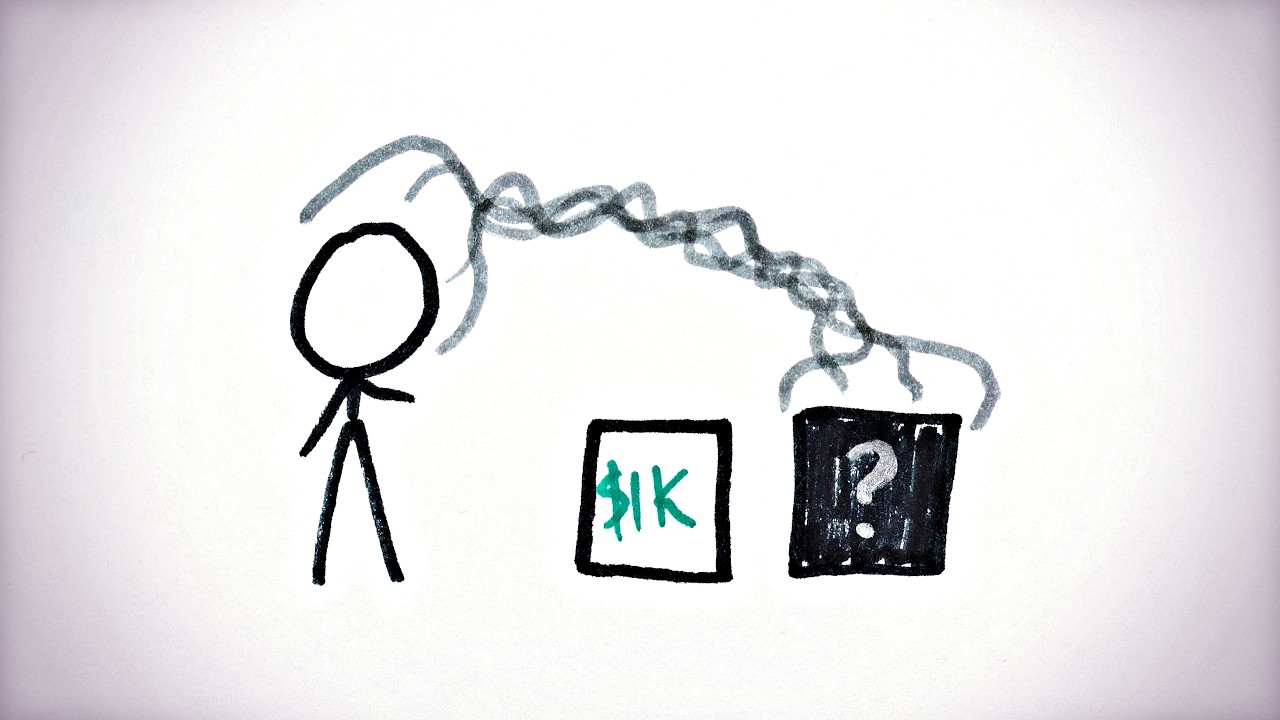
The setup is this: a being — an algorithm, a superintelligence, whatever you want to call it — has already made a prediction about what you'll do. You walk into a room with two boxes. One is open and contains $1,000. The other is closed and contains either $1,000,000 or nothing. You can take only the closed jackpot box, or you can take both boxes.
The catch: before you arrived, the predictor filled the jackpot box with $1,000,000 only if it predicted you'd take just that one box. If it predicted you'd take both, the jackpot box is empty. And crucially, this predictor has been right almost every single time it has ever played this game.
- One-boxers argue: The predictor almost always gets it right. If you choose both boxes, it will have predicted that, left the jackpot empty, and you'll walk away with just $1,000. Choose one box and you walk away with a million.
- Two-boxers argue: The money is already in the boxes. No matter what the predictor did, taking both boxes gets you an extra $1,000 compared to taking one. You can't change the past, so always grab both.
Both arguments feel airtight. That's what makes this a paradox. But calling it a draw ignores scientific tools that can actually cut through the confusion.
What Does Causal Calculus Say About the Right Choice?
Causal calculus is a mathematical framework that goes beyond simple correlation to infer actual causality. Apply it to Newcomb's Paradox and something interesting immediately falls out.
The predictor and your decision are tightly correlated — that's given by the setup. Causal calculus says a strong correlation like this can't be coincidence. It means one of three things must be true: the predictor's prediction causes your choice, your choice causes the predictor's prediction, or both share a common cause.
The timeline rules out the first two options. The predictor acts before you decide, so your choice can't retroactively cause the prediction (that would require time travel). And the predictor is kept isolated from you after making its prediction, so it can't nudge your decision. That leaves only one possibility: a shared common cause. Something in your past — your personality, your reasoning style, maybe even watching a video like this one — determines both what the predictor puts in the box and what you ultimately choose.
This analysis points clearly toward taking one box. The predictor isn't magic; it just knows your causal history well enough to predict the same outcome your past self is already steering you toward.
Why the Intervention Argument Doesn't Win
Causal calculus also has a concept called intervention — and this is where two-boxers think they have their trump card. If a spectator who could see the contents of the boxes stepped in and chose for you, they should always take both, because from their outside perspective, there's always a free $1,000 sitting there. Causal calculus confirms this: an intervening spectator breaks the correlation between the common cause and the choice, so the extra $1,000 is genuinely free money for them.
But here's the thing — you are not a spectator intervening in your own life. You are your own decision process. The predictor's whole job was to predict exactly that process. Invoking intervention only works if you assume you're somehow separate from your own reasoning, which defeats the entire premise.
Is a Perfect Predictor Being Even Physically Possible?
For the paradox to have any real-world weight, the predictor has to be very accurate. But how accurate can any predictor actually be? The brain is a staggeringly complex system — billions of neurons firing simultaneously, sensitive to tiny fluctuations in timing, chemistry, and context. A small detail, a half-remembered memory, a moment's hesitation — any of these could tip your decision at the last second.
To predict you reliably, the predictor would essentially need to build an extraordinarily precise model of your brain and your environment. Think of a double pendulum: even a tiny error in copying its initial state leads to wildly different behavior over time. Your brain makes a double pendulum look simple. The predictor's model of you would have to be nearly perfect to get the right answer consistently.
And here's where it gets philosophically unsettling: if that model is accurate enough, you can't tell whether you're the real you or the simulated copy. The copy would have to be so faithful to the original that it would feel, think, and experience everything the same way. Which means there's a real chance your apparent decision is actually feeding directly into the predictor's forecast — and you have no way to know.
What Is the No-Cloning Theorem and Why Does It Matter?
Physics actually has something formal to say about whether a near-perfect copy of you is achievable. The no-cloning theorem is a law of quantum mechanics stating that it's physically impossible to make a perfect copy of an arbitrary quantum state without destroying the original.
If any part of your brain's decision-making relies on quantum-level processes — even just tiny quantum fluctuations affecting which neuron fires when — then the no-cloning theorem makes an accurate-enough copy of your mind fundamentally impossible, not just practically difficult. The predictor can't build a perfect simulation of you because the universe won't allow it. This seems to torpedo the entire premise of Newcomb's Paradox.
But quantum mechanics is generous — it also offers a way to save the paradox.
Can Quantum Entanglement Solve Newcomb's Paradox?
Quantum entanglement offers a loophole. If the predictor could somehow entangle your choice with the contents of the jackpot box, it could achieve 100% accuracy without ever cloning your mind at all. The system would be placed in a quantum superposition of two states: choose one box and the jackpot is full, and choose both boxes and the jackpot is empty.
When the superposition collapses — either at the moment of choice or through the many-worlds branching — the two outcomes are perfectly correlated by definition. You'd feel completely free to choose, and the predictor would still be perfectly right. It's the same principle as entangled electrons: each one appears to choose its spin randomly, but when you compare the two, they always match.
In this scenario, the answer is unambiguously one box — because taking one box and getting the million dollars are literally the same entangled outcome. The catch is whether entanglement on the scale of a human brain and a box of money is physically achievable. Right now, it almost certainly isn't. But it's not ruled out by any fundamental principle the way perfect cloning is.
Does Simulation Theory Change Your Decision?
Remember that unsettling point about the copy being indistinguishable from you? It cuts even deeper than it first appears. If the predictor needs a near-perfect simulation of you to make its prediction, and you genuinely cannot tell whether you're the original or the simulation, then there's a real sense in which your decision might directly determine what's in the jackpot box — not through time travel, but because the simulated you's choice is the very thing the predictor uses as its forecast.
If you might be the simulation, choosing one box is clearly correct. Your choice would be causing the outcome, and choosing one box causes a million dollars to appear for the real you.
How Can a Predictor Be Accurate Without Reading Your Mind?
Here's the most grounded and perhaps most important point: a predictor doesn't need to be a supernatural superintelligence to be highly accurate. It just needs to get most people to do the same thing.
Human behavior is predictable in aggregate. Game design, framing, room color, word choice — all of these can prime people toward a particular choice. If 85% of participants are nudged toward taking both boxes, a predictor who always guesses "both boxes" will be right 85% of the time without knowing anything specific about any individual player. That's not mind-reading. That's just understanding human nature.
A five-year-old who confidently predicts everyone will take two boxes — because who's going to trust a five-year-old with a million dollars? — would probably achieve stunning accuracy, simply because most people would assume the jackpot is empty and grab the guaranteed $1,000. The paradox's statistics could hold up in the real world without any quantum magic required.
So What's the Final Answer — One Box or Two?
The honest answer is that it depends on which version of the paradox you're actually playing. Causal calculus, simulation theory, and quantum entanglement all point toward one box when the predictor is genuinely accurate. The no-cloning theorem casts doubt on whether genuine accuracy is possible, which opens the door for two-boxing. And if the predictor is just exploiting human psychology, your best move depends entirely on whether you can figure out what most people in your situation would do.
What the paradox really reveals isn't a flaw in logic — it's a deep tension in how we think about free will, causality, and prediction. The fact that it still splits smart, thoughtful people down the middle isn't a failure of reasoning. It's a sign that the question is touching something genuinely unresolved about the nature of decision-making itself.
So: one box or two? How accurate was the prediction that you still wouldn't know?