
There is something instructive about watching a world-class scientist walk onto a mat and admit, without embarrassment, that he has no idea what he is doing. That is exactly what happened when neuroscientist Andrew Huberman took his first Brazilian jiu-jitsu class at 10th Planet Austin, guided by head instructor Gabe Tuttle. The moment was captured not as a spectacle but as an example — of intellectual humility, of the beginner's mind, and of why jiu-jitsu has a way of hooking people from the very first session.
What Jiu-Jitsu Actually Is
Jiu-jitsu is a martial art built around controlling another human body. Sometimes practiced in a traditional uniform called a gi, sometimes without one, it is a game of positional dominance — attaining superior angles, limiting your opponent's options, and ultimately applying a submission. Submissions come in two main forms: joint locks, which threaten to break a limb, and chokes, which threaten to render someone unconscious. The match ends when the losing partner taps twice, the universal signal of surrender.
That double tap is deceptively significant. Performed thousands of times over a jiu-jitsu career, it becomes a ritual dismantling of the ego — a repeated, physical acknowledgment that someone else solved the puzzle faster than you did. For people who spend their lives being competent, that experience is rare and, arguably, essential.
The Technique: Arm Drag to the Back, Finished with a Choke
For Huberman's first lesson, Tuttle chose a foundational sequence: taking the back from butterfly guard using an arm drag, then finishing with a rear naked choke.
Starting Position and the Arm Drag
The drill begins in butterfly guard, where both partners are seated facing each other. The goal is to redirect the opponent's arm across your body — the arm drag — which creates a window to slip behind them and attach to their back. Tuttle emphasized maintaining elbow tension throughout the movement to keep control of the arm and set a bottom hook as you arrive at the back.
 03:10
Gabe Tuttle demonstrating the arm drag from butterfly guard to back take on Lex Fridman
Watch at 03:10 →
03:10
Gabe Tuttle demonstrating the arm drag from butterfly guard to back take on Lex Fridman
Watch at 03:10 →
The Seat Belt and the Choke
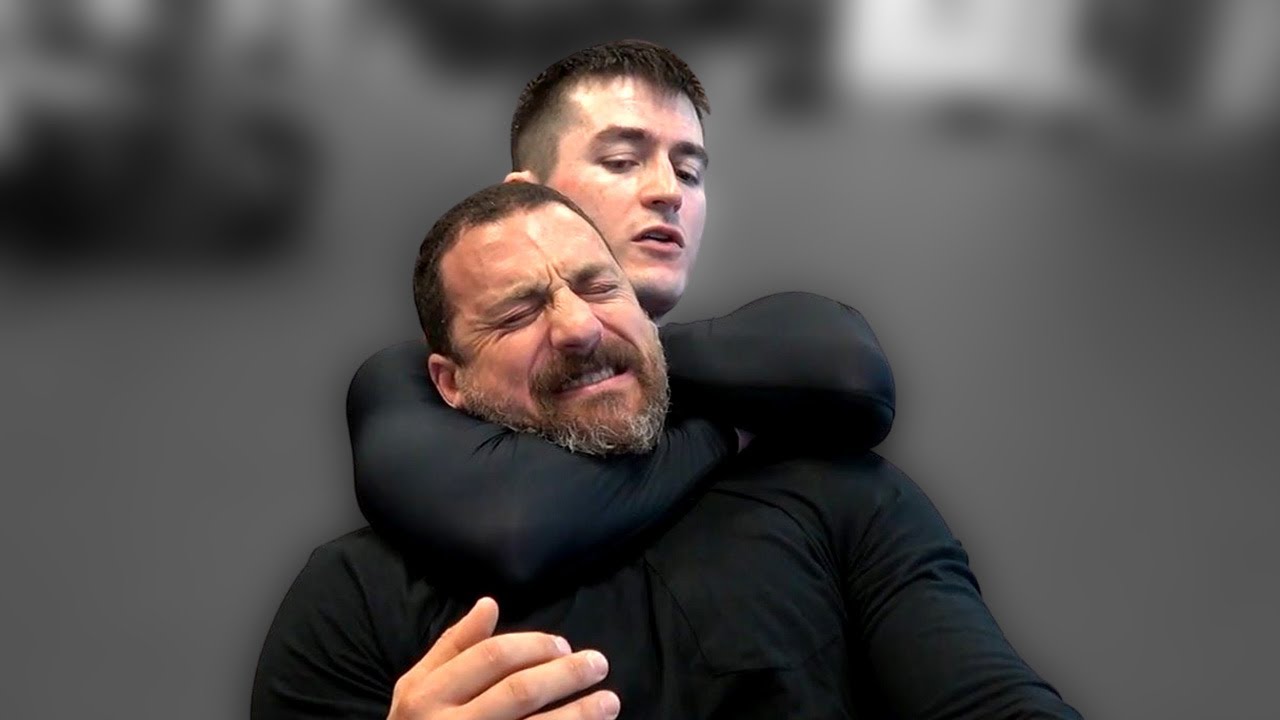
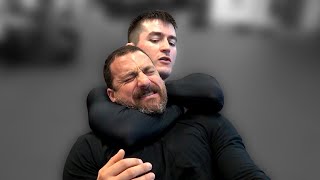
Once on the back, the controlling position is called the seat belt: one arm over the opponent's shoulder, one arm under their armpit, hands clasped together at the chest. From here, the finish is a rear naked choke. Tuttle broke it down precisely — the top hand forms a claw around the neck while the bottom arm swims through and squeezes. The key mechanical detail is to expand the chest outward as you apply pressure, which dramatically increases the force of the choke regardless of how far the opponent tucks their chin.
05:30
Tuttle demonstrating the rear naked choke grip and chest expansion mechanics
Watch at 05:30 →
Huberman, who had the grip applied to him, immediately noticed the crushing sensation. Tuttle pointed out that even a deeply tucked chin does not fully escape the choke — it can transfer the pressure to the jaw instead.
A Spontaneous Neuroscience Lesson on the Mat
Midway through drilling the choke, someone asked why people see visual artifacts — butterflies, stars — when blood flow to the brain is restricted. Huberman's answer was immediate and characteristically precise: the eyes are direct extensions of the brain and demand a disproportionately large share of blood and glucose at all times. When that supply is cut off, neurons in the visual system begin firing spontaneously, producing the lights and patterns people report seeing just before losing consciousness.
The same mechanism explains why a hard strike to the head causes someone to "see stars" — sudden mechanical pressure triggers spontaneous neural discharge in the visual cortex and retina. Huberman noted he could feel the onset of that sensation in real time as the choke was applied.
07:45
Huberman explaining visual artifacts from chokes — spontaneous neuron firing in the eyes
Watch at 07:45 →
The Ego on the Mat
The session closed with a brief exchange about what makes jiu-jitsu psychologically unusual. Tuttle introduced a second technique — the arm-in guillotine, a favorite of Joe Rogan — to illustrate how the game works in both directions: arm drags attack when an opponent is moving toward you, while guillotines punish attempts to stand or drive forward. The two threats create a dilemma that forces mistakes.
09:15
Tuttle demonstrating the arm-in guillotine choke as a counter to the stand-up
Watch at 09:15 →
Huberman's reflection on the experience was candid. Allowing someone to mount you, control you, and put you in a genuinely helpless position is not something most adults encounter in daily life. That discomfort, he suggested, is precisely the point. Relinquishing the ego — not as a philosophical exercise but as a physical, inescapable reality — is something jiu-jitsu forces on you whether you are ready for it or not.
By the end of the class, his verdict was unambiguous: "I love it. I think I'm hooked." For anyone who has ever been curious about jiu-jitsu but hesitant to start, watching a neuroscientist with nothing to prove show up as a complete beginner may be the most persuasive argument available.