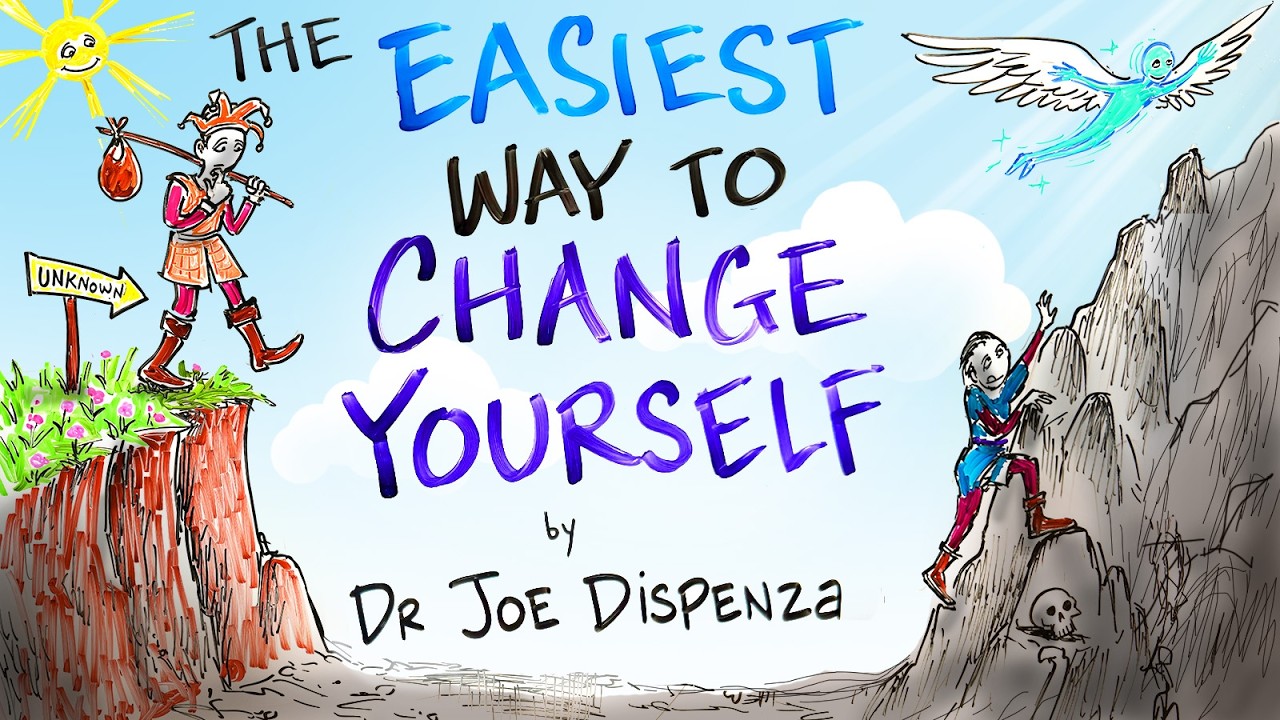

If you've ever wondered how to change your life and break unconscious habits, the honest answer might surprise you: positive thinking won't cut it. According to neuroscience, by the time we reach middle age, roughly 95% of who we are is an unconscious set of thoughts, behaviors, and emotions that have been automatically programmed into our biology. Real change means confronting that programming head-on — and it starts with becoming aware of thoughts you didn't even know you were having.
This isn't motivational fluff. This is how your brain actually works — and once you understand the mechanics, change becomes something you can engineer rather than just hope for.
 00:45
The moment where the core problem is defined — 95% of who we are is unconscious programming by midlife
Watch at 00:45 →
00:45
The moment where the core problem is defined — 95% of who we are is unconscious programming by midlife
Watch at 00:45 →
Why Do New Year's Resolutions Always Fail?
Every January, millions of people set the same intentions. Lose weight. Be kinder. Save more money. And by February, most of those promises are gone. Why? Because intention without a change in choice is just a wish.
If you keep making the same choices, you keep doing the same things. You keep creating the same experiences. You keep feeling the same emotions. And your neurocircuitry, neurochemistry, hormones, and even your gene expression stay exactly the same — because you stayed the same.
The brain works on a simple principle: neurons that fire together, wire together. Repeat the same thoughts and actions enough times, and those circuits become hardwired. The emotions that follow — whether triggered by a person, a situation, or even your own thoughts — get conditioned subconsciously into the body like a software program running in the background. You're not consciously choosing those reactions anymore. They're automatic.
That's why surface-level change doesn't work. Swapping one habit for another without addressing the deeper programming is like repainting a house with a crumbling foundation. The underlying current always wins.
02:30
The body fighting back against change — why familiar suffering feels safer than unknown possibility
Watch at 02:30 →
Why Is Change So Hard Even When You Want It?
Here's where it gets fascinating — and a little uncomfortable. When you decide to make a different choice, your body actually fights back.
If the body has been conditioned long enough to operate as the mind, it starts sending signals back to the brain — nudging you to think the familiar thought, make the familiar choice, and return to the familiar feeling. Even if that feeling is suffering. Because suffering, when it's been your baseline for long enough, feels safer than the unknown.
Think about that. Your brain is literally wired to prefer known pain over unknown possibility. That's not weakness — that's ancient biology. For hundreds of thousands of years, uncertainty meant danger. Is that a tiger in the bushes or just a shadow? The unknown was a threat. So your nervous system learned to avoid it.
This is why crossing from your old self to your new self — what you might call crossing the river — is described as a neurological, biological, chemical, hormonal, and even genetic death of the old self. It's the phoenix burning itself down. And most people would rather cling to the familiar shore than take a chance on what's waiting on the other side.
05:10
Mental rehearsal explained — how closing your eyes and visualizing new behavior literally grows brain circuits
Watch at 05:10 →
How Do You Actually Change Your Life for Good?
The first step is not positive thinking. It's awareness. Specifically, becoming conscious of the unconscious thoughts that are quietly running your life.
You know those voices? Start tomorrow. It's too hard. You're not good enough. You'll never change. You're too much like your parents. Those aren't random intrusions. They're deeply conditioned programs. And the goal isn't to silence them — it's to become so aware of them that you would never unconsciously follow them again.
- Catch the thought before it becomes a choice.
- Catch the behavior before it becomes a habit.
- Catch the emotion before it drags you back into the past.
If you want to be happy but you're constantly blaming, complaining, judging, and feeling sorry for yourself — those behaviors are chemically incompatible with happiness. They will keep producing the same emotional state, no matter how much you say you want things to be different.
The moment you catch yourself about to go unconscious — and you choose differently anyway — that's not just growth. That's the actual mechanism of change.
What Is Metacognition and Why Does It Trigger Change?
Sometimes people don't wake up until life forces them to. A diagnosis. A loss. A betrayal. A crisis so severe that for a moment, you stop being inside the jar and actually get to read the label.
That experience — of seeing yourself almost through someone else's eyes, from the outside — is called metacognition. It's thinking about your own thinking. And it's the neurological prerequisite for real change.
When you're in that state, you're no longer identified with your program. You're watching it. And the moment you can see your unconscious self clearly, you've already begun to separate from it.
The good news? You don't have to wait for a crisis. You can learn and change from a state of joy and inspiration just as powerfully as from pain and suffering. The difference is that most people need rock bottom to finally stop defending the old self long enough to see it.
How Does Mental Rehearsal Actually Rewire Your Brain?
Your brain doesn't distinguish very well between a vivid imagined experience and a real one. This isn't a metaphor — it's measurable neuroscience.
When you close your eyes and mentally rehearse a new behavior in detail — how you'll respond to a difficult person, how you'll carry yourself in a challenging moment, what it feels like to already be the person you're becoming — your brain begins to grow the circuits for that behavior. Literally. The neural pathways form as if you had already done it.
Practice it consistently, and those circuits strengthen. What starts as hardware becomes software. The behavior starts to feel natural, automatic, and — crucially — like you.
Your brain stops being a record of the past and starts being a map of the future.
Can You Emotionally Rehearse Your Future Before It Happens?
This is where the science gets genuinely remarkable. Your body, it turns out, is strikingly objective. It doesn't reliably know the difference between a real experience that produces an emotion and an emotion you generate purely through thought.
So if you can hold a clear vision of your future — your health, your relationships, your purpose — and generate a genuine elevated emotion around it (gratitude, love, joy, inspiration), your body begins to respond as though that future is already real. Heart-centered emotions in particular seem to produce the most dramatic biological changes.
Here's how to use this:
- Sit quietly and ask yourself: what would it actually feel like to be the version of me I want to become?
- Make the vision specific and immersive enough that it produces a real emotional response.
- Come out of that state and make a decision — not a vague intention, but a firm, energized commitment — from that elevated place.
- Return to that state regularly. Consistency is what converts experience into identity.
When the emotion is strong enough, the decision becomes a long-term memory. People who have transformed their lives often say the same thing: I remember the exact moment I made up my mind. That clarity, that emotional charge — that's not accidental. That's the body and brain locking in a new direction.
How to Catch the Unconscious Thoughts Holding You Back
Change ultimately comes down to a single repeated act: catching yourself before you go unconscious.
Notice how you speak. Notice what you complain about. Notice the stories you tell about why you can't, why you won't, why it's too late or too hard or too risky. Every one of those is a thought you've been thinking so many times it feels like truth.
A belief, after all, is just a thought you keep thinking over and over again. Which means the voice in your head — the one narrating your limitations — is not the authority on what's possible. It's just a habit. And habits can change.
The process isn't linear and it isn't always comfortable. But every time you push past the point where you want to quit — that moment of maximum resistance — you are literally in the zone where the brain changes the most. The unknown, that uncomfortable void beyond your edge, is not a danger zone. It's a creation zone.
That's where the new self lives. And it's been waiting for you the whole time.