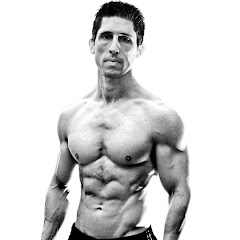
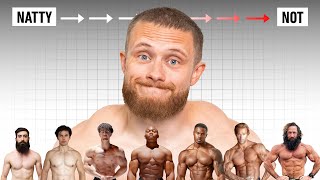
Most people try to determine whether someone is natural by eyeballing their physique — but where they draw that line varies wildly. Some believe Will Tennyson is the upper limit of natural development. Others are convinced Simeon Panda is drug-free. Millions believed Liver King's physique came from eating raw organs, not a $10,000-a-month steroid protocol. The confusion is real, and it leads to genuinely useless debates. To cut through the noise, the best approach combines three tools: history, science, and common sense.
When Did Steroids Actually Become Available?
Steroids are, for the most part, chemical variations of testosterone. Trenbolone is testosterone with a carbon atom removed. Nandrolone has a few fewer double bonds. Testosterone propionate and enanthate are testosterone molecules with an ester attached at different lengths, controlling how quickly they release into the bloodstream. Before any of these existed, we have a clean baseline for natural development.
Testosterone was first isolated in 1935 by Dutch pharmacologist Ernst Laqueur at the University of Amsterdam — extracted, remarkably, from thousands of bull testicles. By the early 1940s, psychiatrists were experimenting with it as a treatment for depression and low libido in men. It worked, but it wasn't publicly available and nobody had connected it to athletic performance yet.
That changed at the 1952 Olympics in Helsinki, when Soviet weightlifters suddenly and suspiciously swept three gold medals. The first natty-or-not scandal had begun. Two years later, in 1954, Dr. John Ziegler injected bodybuilder John Grimek at the York Barbell Club in Pennsylvania, and the sport was never the same.
This means American bodybuilders were almost certainly not using steroids before the 1950s — which makes the physiques from that era a reliable natural baseline.
What Pre-Steroid Era Bodybuilders Actually Looked Like
In a 1947 photo, Steve Reeves is 21 years old, 6'1", 215 lb, and approximately 10–12% body fat. He wasn't the biggest man of the era, but nearly everyone — even today's most skeptical observers — agrees his physique is achievable without drugs.
 05:20
Photo of Steve Reeves, 1947, showing his physique at 6'1
Watch at 05:20 →
05:20
Photo of Steve Reeves, 1947, showing his physique at 6'1
Watch at 05:20 →
If that's not convincing enough, go back further. Eugene Sandow, the man the Mr. Olympia trophy is named after, was photographed in 1897 — six years before the airplane existed — at 5'9", 185 lb, and around 10% body fat. His training advice at the time was to use 5–10 lb dumbbells for 10–15 reps. He was a pioneer working with almost none of the knowledge or equipment available today.
06:10
Photo of Eugene Sandow, 1897, alongside primitive gym equipment of the era
Watch at 06:10 →
The point is not that Sandow was the ceiling of natural development. The point is that more than 500,000 scientific studies on exercise science and nutrition have been published since then, and millions of people have pursued bodybuilding with far better tools. Sandow's physique is a floor, not a ceiling.
The Science: Fat-Free Mass Index and the 25 Ceiling
The most important study on natural muscular development was published by Kouri and colleagues in 1995. Researchers recruited 74 natural lifters and 83 steroid users from gyms in Los Angeles and Boston, confirmed their status via urine testing, and then measured height, weight, and body fat using hydrostatic underwater weighing. They calculated each person's Fat-Free Mass Index (FFMI) — lean body mass divided by height squared — a single number representing how muscular someone is regardless of height.
09:45
Scatter plot from the 1995 Kouri study showing FFMI distribution for natural vs. enhanced lifters
Watch at 09:45 →
The results were striking. On average, steroid users were more muscular — no surprise. But steroid use didn't guarantee greater size than every natural lifter. Some enhanced individuals were still smaller than 86% of the natural group. Many natural lifters clustered between FFMI 24 and 25, right alongside enhanced athletes.
The critical finding: not a single one of the 74 natural lifters had an FFMI above 25. Every lifter with an FFMI of 25 or higher was on steroids. The authors concluded that only rare individuals — possibly those with genetic or congenital anomalies — could exceed an FFMI of 25 without drugs.
Does the 25 Ceiling Actually Hold?
Not quite — and this is where history pushes back on the science. When you look at pre-steroid era Mr. America winners from 1939 to 1949, several exceeded the supposed natural ceiling:
- Bert Goodrich (1939): FFMI 24.3
- John Grimek (1940): FFMI 24.0
- Frank Leight (1942): FFMI 25.5
- Five additional winners between 1943 and 1949 also broke through the 25 threshold
12:30
Table listing pre-steroid era Mr. America winners with corresponding FFMI values
Watch at 12:30 →
A 2017 study on Division I and Division II college football players found that the average FFMI for offensive linemen was 25.1 — that was the average. While some of those athletes may have used PEDs at some point, it's implausible that all of them were. The Kouri study had only 74 natural subjects. With a larger sample, a normal distribution would almost certainly emerge, and the hard cutoff at 25 would soften into a tail. An FFMI above 25 is genuinely uncommon naturally — but it is not impossible.
To put this in perspective: Ronnie Coleman, eight-time Mr. Olympia champion, competed at 5'11", 290 lb, and 5% body fat — an FFMI of 38.5. He was obviously not natural at his peak. But the gap between 25 and 38.5 illustrates just how extreme steroid use can push the numbers.
Genetics, Outliers, and What's Actually Achievable
A landmark study on muscle-building genetics enrolled 342 women and 243 men in an identical 12-week bicep training program. Despite running the exact same protocol, outcomes varied enormously. Most participants grew their biceps by about 20%. A few unlucky subjects gained nothing. And a handful of genetic outliers grew 40%, 50%, even 55% — all on the same program as everyone else.
That study had 585 participants — a tiny fraction of the world's population — and it still produced extreme outliers. The same logic applies to muscular development broadly. Someone will always be at the far right tail of the distribution. That doesn't mean steroids. It means genetics.
So what are realistic natural limits for the average man who trains hard, eats well, and stays consistent? Based on the evidence, most men can expect to reach an FFMI of 22 to 24, with 25 achievable for those with good genetics and years of dedicated training. At around 12% body fat, that translates to roughly:
- 5'6": ~165 lb
- 5'9": ~185 lb
- 6'0": ~200 lb
- 6'3": ~220 lb
Going above those numbers doesn't automatically mean steroids — but for most people, this range represents a realistic natural ceiling. The outliers exist. They're just rare, and rarity isn't the same as impossibility.