Most people train their biceps and triceps with the right intentions but the wrong mechanics. At Gold's Gym Venice — the original mecca of bodybuilding — Jeff Cavaliere of Athlean-X walked through an arm training session built on a single principle: every exercise choice should maximize muscular tension while protecting the joints around it. The result is a system that produces better contractions, safer movement, and longer athletic longevity.
Bicep Curls: The Details That Change Everything
The Offset Grip and Resisted Supination
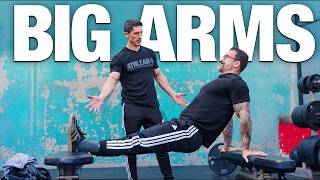
On standard dumbbell curls, Cavaliere recommends shifting the dumbbell toward the thumb side of the hand. This creates a counterbalance — the weight wants to pull the wrist into pronation, so you must actively resist it. That resistance recruits more of the bicep through the supination motion rather than letting the curl become a passive hinge. At the top of each rep, a small additional lift of the elbow — shoulder flexion — creates a fully balled-up, peak contraction. The target rep range is 6 to 12, heavy enough to require effort, light enough to maintain quality mechanics throughout.
On alternating curls, Cavaliere adds a subtle torso rotation toward the working side as the dumbbell rises. This isn't cheating — it's the body's natural way of adding stability to support a stronger contraction. The body already wants to do it; allowing it simply makes the exercise more effective, not less.
 02:10
Demonstration of offset grip and resisted supination on dumbbell curl
Watch at 02:10 →
02:10
Demonstration of offset grip and resisted supination on dumbbell curl
Watch at 02:10 →
The Preacher Curl Machine: How Most People Get It Wrong
The seated preacher curl creates a mechanical problem most lifters ignore. Sitting down and leaning into the pad establishes a fulcrum at the elbow, placing excessive stress on the joint. The fix is to stand over the machine and drive the elbows back into the pad as hard as possible. This activates the lats — essentially a straight-arm pushdown motion — which stabilizes the entire shoulder girdle. With a stable base, the biceps have far more leverage to produce force. As Cavaliere puts it, borrowing a phrase from Paul Chek: you can't fire a cannon from a canoe. A wobbly foundation wastes force. Standing over the pad, driving the elbows back, and stopping the bar just short of the gravitational dead zone at the top keeps tension on the muscle throughout the set.
06:45
Cavaliere demonstrating standing preacher curl setup with elbows driven back into pad
Watch at 06:45 →
Mechanical Drop Sets for Long Head Bicep Development
The long head of the bicep crosses the shoulder joint, which means shoulder position determines how much stretch — and therefore how much growth stimulus — the long head receives. To target it, the arm must be placed behind the body. The incline curl achieves this by positioning the shoulder in extension at the bottom of the movement, placing the long head on full stretch.
From there, Cavaliere uses a mechanical drop set sequence: the same weight is used across three positions, each mechanically easier than the last, allowing continued productive reps past the point of initial failure.
- Position 1 — Incline curl: Arm behind the body, maximum long head stretch. Perform 5 reps with an offset grip and controlled supination at the top.
- Position 2 — Seated curl: Sit upright. The long head is no longer fully stretched, so the mechanical disadvantage is reduced. Perform 5 more reps with the same weight.
- Position 3 — Drag curl: Lean forward, chest toward knees, and drag the dumbbells up along the body. The arm is again behind the torso, but gravity is less of a factor, making the final 5 reps achievable.
The total is 15 reps at a weight you could only do 10 with in a single position — all of them effective, none of them wasted.
17:30
Mechanical drop set sequence: incline curl to seated curl to drag curl
Watch at 17:30 →
Tricep Training: Three Heads, One Guiding Principle
Incline Tricep Extension Over Overhead Variations
The triceps have three heads — lateral, medial, and long. The lateral and medial heads only extend the elbow. The long head also crosses the shoulder, so like the long head of the bicep, its position relative to the shoulder determines how fully it's loaded. To stretch the long head of the tricep, the arm must go overhead.
The traditional lying skull crusher goes behind the head to achieve this stretch, but can cause shoulder discomfort for people with limited mobility. Overhead dumbbell extensions require even more shoulder range of motion. Cavaliere's solution is the incline bench tricep extension. By lying on an incline, the dumbbell naturally sits behind the head without requiring full overhead shoulder mobility. Standing up from that position, the arms are still well in front of vertical — a fraction of the demand of a true overhead extension, but with most of the long head stretch preserved.
Elbow position matters equally. Flared elbows shorten the range of motion and, more critically, drive the shoulder into internal rotation under load — the same problematic position as an upright row. Keeping the elbows tucked and pointing forward allows external rotation, which clears space within the shoulder joint for all the tendons running through it.
26:00
Comparison of overhead tricep extension versus incline bench tricep extension for shoulder mobility requirements
Watch at 26:00 →
Bench Dips: Fixing the Shoulder Dump
The bench dip is one of the most common tricep exercises and one of the most commonly butchered. Hands placed flat behind the hips with fingers forward causes the shoulders to dump forward — anterior displacement — which only worsens at the bottom of the dip as the arm extends further behind the body. Over time, with the high rep counts typical of body weight work, this inflames the bicep tendon and supraspinatus.
The fix is simple: turn the hands outward. This isn't really about hand position — it's about rotating the shoulder into external rotation, which creates space inside the joint. From there, the chest stays up and out, and the ascent travels up and slightly back rather than straight up. At the top, with elbow extension and shoulder extension occurring simultaneously, all three heads of the tricep reach maximum contraction. No added weight required to make it genuinely difficult.
The PJR Pullover and Lat-Tricep Connection
The lats and the long head of the triceps work together functionally — both extend the shoulder and both are involved in pulling and pressing patterns. A PJR pullover exploits this relationship: start in a standard dumbbell pullover position, stop halfway through the arc, then extend through the elbows to complete the movement. It combines a full long-head stretch with a strong contracted position, while simultaneously engaging the back.
A cable variation using two handles mirrors this — rowing the handles back and down behind the body, then extending the elbows from that position. The result feels similar to the bench dip contraction: the arm is behind the body, the elbow is extending, and everything that stabilizes the shoulder girdle is working together.
The Unifying Principle: Stability Enables Strength
Every technique in this session returns to the same idea — a muscle can only produce maximal force when the structures around it are stable. Driving elbows into the preacher pad engages the lats. Turning hands out on bench dips stabilizes the shoulder. Keeping the torso firm during drag curls protects the lower back. None of these are restrictions on the primary muscle. They're the conditions under which the primary muscle can actually do its job. Training this way doesn't just build bigger arms — it builds arms that keep working for decades.