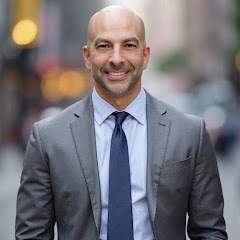
If every longevity intervention disappeared tomorrow except one, what would you keep? For physician and longevity researcher Peter Attia, the answer is unequivocal: exercise. Not because the other interventions — managing blood pressure, treating elevated lipids, quitting smoking — don't matter, but because no single intervention produces a greater reduction in all-cause mortality. And when you factor in quality of life in your final decade, the case becomes even stronger.
Why Exercise Dominates Every Other Longevity Lever
The data supporting exercise for longevity is, in Attia's view, simply better than the data for any other intervention. Smoking cessation, hypertension management, lipid control, and diabetes reduction all meaningfully reduce disease-specific and all-cause mortality. But cardiovascular fitness and muscular strength — including muscle mass — produce greater benefits across the board.
The argument becomes even more compelling through the lens of healthspan, not just lifespan. For most people, the degradation of quality of life in their final decade is fundamentally a movement problem: loss of strength, loss of stability, declining cardiorespiratory capacity, and chronic pain. If you want to preserve function at the end of life, the work has to start decades earlier.
The Centenarian Decathlon: Making the Abstract Concrete
One of the most common objections Attia hears from patients in their 30s, 40s, and 50s goes something like this: I can do everything I want to do right now without difficulty. Why do I need to train harder? His answer involves a tool his practice has developed to transform that abstract concern into a tangible, actionable plan.
The exercise is called the Centenarian Decathlon. Here is how it works:
- Patients rank the 10 most important physical activities they want to be able to perform in their last decade of life — everything from walking 18 holes of golf to hiking on uneven terrain at a sustained pace.
- Each activity is deconstructed into its specific movement patterns and physiological requirements: ankle mobility, hip stability, grip strength, VO2 max, and so on.
- Those requirements are then projected backwards by decade. If you need to be able to hike at a given pace at age 90, what does that require at 80? At 70? At 50? At 35?
- The patient is then measured against those benchmarks today.
The result, Attia says, is almost universally the same: a significant gap between where the person is now and where they need to be now in order to account for the natural rate of physical decline. The financial analogy is apt — just because you have more money today than you'll need on your retirement date doesn't mean you'll have enough ten years into retirement, once you factor in spending. The same logic applies to physical capacity.
 12:30
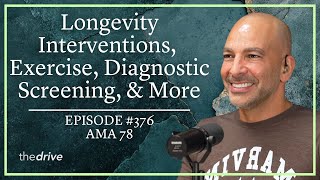
Illustration of the Centenarian Decathlon framework — projecting physical requirements backward by decade from age 90
Watch at 12:30 →
12:30
Illustration of the Centenarian Decathlon framework — projecting physical requirements backward by decade from age 90
Watch at 12:30 →
The key insight is timing. It is never too late to begin training. But it can be too late to reach every goal. If you want to ski at 90, the time to think seriously about that is at 30 — so that you can compound the benefits over decades rather than scrambling to catch up at 80.
Lifespan vs. Healthspan: A False Dichotomy
A common tension in longevity discussions is whether to optimize for lifespan or healthspan — with some people arguing they would sacrifice years of life for better quality of life. Attia finds this framing misleading. In practice, most people want both, and most interventions that improve one improve the other.
The critical variable is how you pursue lifespan extension. Attia identifies two broad strategies:
- Medicine 2.0 strategy: Manage chronic disease better so people live longer with it. This is the dominant approach in modern healthcare today.
- Medicine 3.0 strategy: Delay the onset of chronic disease entirely, elongating the period of life spent free of it.
When lifespan extension is pursued through the second lens — compressing or eliminating the period of chronic disease — healthspan comes along automatically. The two goals are not in conflict; they are the same goal approached correctly.
Where the tension does become real is at the extremes. If someone's definition of healthspan is achieving elite athletic performance — winning competitive CrossFit events or becoming a world-class combat sports athlete — the training required at that level carries substantial orthopedic and neurological risk that may work against long-term health. Head trauma and cumulative joint damage are genuine trade-offs. For most people pursuing reasonable physical vitality, however, the conflict between lifespan and healthspan optimization essentially disappears.
Treating Elevated ApoB: Causality Is the Deciding Factor
A frequent clinical scenario: a 40-year-old who is metabolically healthy, insulin-sensitive, physically fit, with a high VO2 max — but with elevated ApoB or LDL-C and a coronary artery calcium (CAC) score of zero. Should you treat the lipids?
Attia's answer is yes, and the reasoning comes down to causality rather than current risk. The central question is not whether this particular person will develop atherosclerotic cardiovascular disease (ASCVD), but whether ApoB is causally related to ASCVD. On that question, he argues, the evidence is unambiguous — among the clearest causal relationships in all of medicine.
A few important caveats he raises:
- High cardiorespiratory fitness and insulin sensitivity are genuinely protective against ASCVD, but they do not neutralize the atherogenic role of ApoB particles. Every LDL particle remains a potential seed for plaque, regardless of metabolic health status.
- A zero CAC score carries approximately a 15% false-negative rate. Attia has personally observed multiple cases where a zero CAC score was followed shortly by a CT angiography revealing soft plaque — early disease the calcium score missed entirely.
The analogy he uses is instructive: if a healthy, non-smoking 40-year-old started smoking last month, and the most sensitive lung scan available showed zero evidence of cancer or COPD, no physician would say keep smoking until we see a problem. You would address the causal risk factor immediately — not because you can guarantee disease will follow, but because causality is established and intervention reduces risk. ApoB and ASCVD follow the same logic.
The aggressiveness of treatment scales with the full clinical picture. A patient with an ApoB of 150 and pristine coronary arteries might be managed to a target of around 60. The same ApoB in a patient with established plaque would warrant a much more aggressive target — closer to 30. But in both cases, the case for treatment is grounded in the same causal reasoning.
The Core Principle: Act on Causality, Not Just Current Evidence of Disease
Running through Attia's answers across these different domains — exercise timing, lifespan versus healthspan, lipid management — is a single underlying principle: the time to act on a known causal risk factor is before evidence of harm accumulates, not after. Whether it is building the physical reserves needed to function at 90, eliminating the period of chronic disease rather than managing it, or treating elevated ApoB in a metabolically healthy patient, the logic is consistent. Waiting for measurable damage before intervening is the approach medicine has historically taken. The case Attia makes, across all of these questions, is that we can do better.