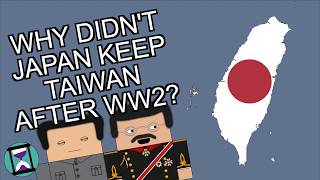
Taiwan was given to China after World War II primarily because of a promise the United States made to Chinese leader Chiang Kai-shek at the 1943 Cairo Conference. The Allies needed China to stay in the war, and handing over Taiwan — which Japan had controlled since 1895 — was part of the deal. But as with most wartime promises, the reality was far messier, far more reluctant, and far more consequential than anyone anticipated.
Why Was Taiwan Given to China After WWII?
The short answer: the US needed China's help to defeat Japan, and Taiwan was the price. By 1943, the war in the Pacific was grinding forward, and keeping China in the fight was critical. Japanese land forces were massively tied up fighting the Chinese, and Washington couldn't afford to lose that pressure. So when Chiang Kai-shek sat down with Roosevelt and Churchill in Cairo, the Americans were prepared to be generous — or at least to appear generous.
 02:15
Map showing Japan's imperial holdings in Asia before 1945, including Taiwan (Formosa), Korea, and Manchuria
Watch at 02:15 →
02:15
Map showing Japan's imperial holdings in Asia before 1945, including Taiwan (Formosa), Korea, and Manchuria
Watch at 02:15 →
Roosevelt promised Chiang the return of Manchuria and Taiwan, two territories Japan had seized from China. It sounded like a firm commitment. It wasn't. The Americans were deliberately vague about how and when these territories would be returned, and there was significant internal debate about whether an international trusteeship period should come first. Roosevelt even floated the idea of handing over Okinawa to sweeten the deal — a promise he had no intention of keeping. The goal was to keep China fighting, not to draft a postwar settlement.
Britain, for its part, was told to go along with it, despite having its own trade interests in Japanese-controlled Taiwan and deep suspicions about China's long-term ambitions in Asia. Churchill wasn't consulted on the Taiwan promise before it was made. He was simply informed and expected to accept it. Which, grudgingly, he did.
What Happened to Taiwan After Japan Surrendered?
When Japan finally surrendered in 1945, the Allies divided up its empire into zones of occupation. Taiwan was placed under Chinese Nationalist authority — that is, the Republic of China, led by Chiang Kai-shek's Kuomintang (KMT) party. Chinese forces arrived on the island within two months, and almost immediately, Taiwan was formally annexed.
05:40
The Cairo Conference of 1943 where Roosevelt, Churchill, and Chiang Kai-shek met to discuss postwar Asia
Watch at 05:40 →
The rest of the Allies were not exactly thrilled. Britain and the United States had envisioned a more gradual transition — a trusteeship arrangement that would allow for proper deliberation. China's rapid annexation cut that process off at the knees. And it quickly became clear that the Taiwanese population, who had initially been enthusiastic about reuniting with the Chinese mainland, were having serious second thoughts.
The KMT administration treated Taiwan less like a liberated territory and more like a conquered one. Taiwan's resources were extracted, its population was viewed with suspicion — seen as semi-Chinese collaborators who had lived under Japanese rule for fifty years — and any dissent was crushed by force. Some Taiwanese even expressed a preference for the Japanese, who, while not exactly benevolent colonizers, had at least built functioning infrastructure. The Republic of China, by contrast, was arriving broke, exhausted, and increasingly corrupt after years of war.
What Did the Cairo Declaration Actually Promise?
The 1943 Cairo Declaration stated that Japan should be stripped of all territories it had seized by force, including Manchuria, Taiwan, and the Pescadores Islands, and that these should be restored to the Republic of China. On paper, it looked unambiguous. In practice, it was anything but.
Roosevelt's primary concern at Cairo wasn't Taiwan's future — it was keeping Chiang Kai-shek from making a separate peace with Japan and also preventing China from pressing a claim on Korea. Promising Taiwan was partly a diplomatic maneuver to get Chiang to drop his interest in Korea, which the Americans wanted to handle differently. The Declaration was as much a negotiating tool as it was a genuine postwar blueprint.
09:10
The division of Japan's empire into Allied occupation zones after the 1945 surrender
Watch at 09:10 →
Furthermore, both Roosevelt and Churchill — the two leaders who gave the promise its weight — were dead or out of office by the time the war ended. Roosevelt died in April 1945. Churchill was voted out in July of the same year. Their successors felt considerably less bound by those commitments, which gave Washington and London some diplomatic room to maneuver — room they would soon need.
Why Did Japan Have to Give Up Taiwan?
Japan had controlled Taiwan since winning it from China in the First Sino-Japanese War of 1895. For fifty years, it had developed the island extensively, building railroads, schools, and agricultural infrastructure — all in service of Japanese imperial interests, but infrastructure nonetheless. When Japan surrendered in 1945, it lost everything: Korea, Manchuria, its Pacific island chains, and Taiwan.
Japanese politicians, particularly conservative ones, weren't happy about handing Taiwan to China. Many felt that China was militarily inferior and undeserving of the territory. Some hoped they could convince the Allies to either allow Japan to remain or push for Taiwanese independence. But Japan's occupiers — overwhelmingly American — weren't sympathetic to any of Japan's territorial wishes. The priority was disarmament, demilitarization, and rebuilding Japan as a peaceful, democratic state. Territorial complaints didn't get much of a hearing.
That said, Japan did find a clever workaround. In the 1951 Treaty of San Francisco, Japan formally renounced all rights and claims to Taiwan — but crucially, the treaty did not specify to whom those rights were being renounced. This deliberate ambiguity, authored in large part by the United States, allowed Japan to walk a diplomatic tightrope: formally giving up Taiwan without endorsing either the Republic of China or the People's Republic of China as its rightful sovereign. It was a move that suited everyone who wanted to keep the question open.
Why Didn't the US Just Take Taiwan Itself?
By the late 1940s, as the Chinese Civil War tilted toward Mao Zedong's communists, the Americans started to seriously regret handing Taiwan to the KMT so quickly. The fear was that a communist-controlled Taiwan would become a Soviet naval base and a launchpad for spreading communism across Asia. So what were the options?
The US considered three paths. First, push for a Taiwanese independence referendum — the Americans knew the KMT would refuse, so they hoped to get Britain and France to pressure the United Nations into forcing the issue. The problem was that the Republic of China held a veto, and the Soviet Union had no interest in a resolution that benefited Washington and Tokyo. Dead end.
Second option: military occupation. This was seriously discussed, but the logistics were painful. America's military was already demobilizing rapidly after the war, resources were stretched, and occupying Taiwan would hand the Soviets a propaganda gift — proof that the US was an imperial power that broke its own promises when convenient.
Third option: do nothing and hope for the best. That is, perhaps unsurprisingly, exactly what Washington chose. And then the Korean War started in 1950, which gave the US a pretext to deploy the Seventh Fleet into the Taiwan Strait, effectively preventing a communist invasion — without ever having to admit that's what they were doing.
Why Did the Republic of China Flee to Taiwan?
By 1949, the Chinese Civil War was over in all but name. Mao's People's Liberation Army had swept across the mainland, and Chiang Kai-shek's government had run out of road. The Republic of China — its government, its military, and roughly two million soldiers and civilians — fled to Taiwan, where they established a government-in-exile that insisted it was the legitimate ruler of all of China.
In the eyes of many in Washington and Tokyo, this effectively made Taiwan a de facto independent state, even if no one was quite ready to say so out loud. The island that had been handed to China as a matter of wartime diplomacy had now become one of the most geopolitically sensitive pieces of territory on Earth — and remains so to this day.
What Did the 1951 Treaty of San Francisco Say About Taiwan?
The Treaty of San Francisco, signed in September 1951, was Japan's formal peace treaty with the Allied powers. In it, Japan renounced its sovereignty over Taiwan and the Pescadores Islands. But in a move of calculated diplomatic ambiguity, the treaty specified no successor state. It didn't say Taiwan belonged to the People's Republic of China. It didn't say it belonged to the Republic of China either.
This was entirely intentional. The United States, which largely authored the treaty, wanted to leave Taiwan's status legally unresolved — useful for maintaining relations with both the KMT government in Taipei and, eventually, the communist government in Beijing. For Japan, the ambiguity worked perfectly: it could trade with Taiwan's KMT government for the natural resources it had previously accessed as a colonial power, and it could also quietly approach the communist mainland for trade, presenting itself as a reformed, peaceful nation focused on economic growth rather than territorial ambition.
That legal ambiguity — a promise made in wartime, half-kept in chaos, and deliberately left unresolved in a peace treaty — is a significant part of why Taiwan's political status remains one of the most contested and sensitive issues in international politics today.