
Why Did China Build Fake US Aircraft Carriers in the Desert?
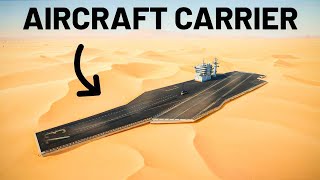
Satellite images of China's Taklamakan Desert reveal something extraordinary: full-scale mock-ups of US Navy aircraft carriers and destroyers sitting in the middle of one of the most remote, arid landscapes on Earth. China built these fake aircraft carriers in the desert as target practice for missile systems specifically engineered to destroy American warships. This isn't a bluff or a propaganda stunt — it's an active military testing program, and satellite imagery shows the targets are actually being hit.
 00:42
Satellite image zooming into the Taklamakan Desert reveals what appears to be a full-scale aircraft carrier mock-up in the middle of arid, flat terrain
Watch at 00:42 →
00:42
Satellite image zooming into the Taklamakan Desert reveals what appears to be a full-scale aircraft carrier mock-up in the middle of arid, flat terrain
Watch at 00:42 →
The structures were first spotted in the Taklamakan Desert in Northwestern China, the second largest sand desert in the world. At first glance, the shapes look alien against the flat, empty terrain. But zoom in, and the outlines are unmistakable: one closely resembles a Gerald R. Ford-class carrier, the crown jewel of the US Navy's fleet, while another mirrors the silhouette of an Arleigh Burke-class destroyer, complete with a bridge outline, funnels, and even the positioning of its vertical launch system.
These are not China's own carrier designs. They are deliberate replicas of American ships — and that distinction matters enormously.
02:15
Side-by-side comparison of the desert mock-up outline against a real Gerald R. Ford-class US Navy aircraft carrier — the resemblance is precise
Watch at 02:15 →
What Is Really Happening Between the US and China at Sea?
To understand why China is doing this, you need to understand what's unfolding in the waters just beyond its coastline. Two major flashpoints are driving Chinese military planning right now: the South China Sea and Taiwan.
In the South China Sea, China claims sovereignty over almost the entire body of water, treating it as its own national territory rather than international waters. To reinforce that claim, China has physically built military outposts on top of reefs and submerged islands, dredging up sand to create artificial land. The US has repeatedly pushed back with so-called freedom of navigation operations, sending warships directly through these disputed waters to challenge China's territorial assertions.
Then there's Taiwan. Beijing considers the self-governing island a breakaway province that will eventually be reunified with mainland China — by force if necessary. The US opposes any military takeover, which is why American carrier strike groups maintain a consistent presence in the Taiwan Strait. These two conflicts, layered on top of each other, have created a situation where US and Chinese military assets are regularly within striking range of one another. China is preparing for the worst-case scenario of that confrontation.
Is China Actually Preparing to Invade Taiwan?
All available evidence suggests China is not just posturing. The desert testing site is one piece of a much larger strategic picture. Taiwan itself is taking the threat seriously: the island recently conducted large-scale military drills simulating a full Chinese invasion, with over 22,000 reservists participating. Meanwhile, China continues expanding its navy, its missile arsenal, and — as these satellite images reveal — its capacity to neutralize the single greatest obstacle to a successful military campaign in the region: the US aircraft carrier.
An American carrier strike group is the most powerful conventional military force on the planet. Neutralizing that threat, or even just pushing carriers far enough from the conflict zone, would dramatically shift the strategic calculus in China's favor. The desert mock-ups are central to that goal.
06:30
Historical satellite image progression showing the site evolving from a grid of poles in 2020 to a detailed ship mock-up with defined outlines
Watch at 06:30 →
How Many Aircraft Carriers Does China Have?
Just fifteen years ago, China had no aircraft carriers at all. Today it operates three, including its first domestically built carrier which entered service in recent years. China has clearly invested heavily in building the shipyards, training, and industrial capacity to produce these vessels. But here's the strategic irony: while China is building its own carriers, it is simultaneously developing the weapons to make carriers obsolete — at least for its adversaries. The fake US carriers in the desert are proof that China is thinking far beyond its own fleet expansion.
What Is China's Carrier-Killer Missile and Why Is It So Dangerous?
The weapon being tested against these desert targets is believed to be a variant of the Dongfeng 21D, a ballistic missile China has developed specifically to destroy aircraft carriers at sea. Understanding how it works helps explain why military analysts are paying such close attention to these satellite images.
Unlike a conventional missile, the Dongfeng 21D follows a ballistic arc — launching high into the atmosphere before plummeting back down at extreme velocity. But what makes it uniquely threatening is what happens during the descent: a maneuverable reentry vehicle separates from the missile body and can adjust its course mid-flight. It can track and hit moving targets. In theory, it can even execute evasive maneuvers to dodge interception attempts.
09:10
Animation illustrating the Dongfeng 21D ballistic trajectory and maneuverable reentry vehicle separating during descent to track a moving ship
Watch at 09:10 →
To support this system, China has also expanded its satellite surveillance network, improving its ability to track US carrier movements in real time. The combination of persistent tracking and a fast, maneuverable warhead is a serious problem for US naval defense planners.
10:45
Satellite view of the winding rail tracks designed to simulate a US carrier executing evasive maneuvers, with the 3D mock-up visible at the far end
Watch at 10:45 →
How Could China Actually Destroy a US Aircraft Carrier?
The challenge with the Dongfeng 21D isn't just the technology itself — it's the timeline. Conventional US surface-to-air defense systems are designed to intercept threats during mid-flight. But a ballistic missile traveling at hypersonic speeds through the upper atmosphere may not give defense systems enough reaction time during that phase. And in the terminal phase, the maneuverable reentry vehicle's unpredictable flight path makes interception dramatically harder.
This is exactly what the desert test site is designed to refine. The unusual, winding train tracks that run through the facility aren't there by accident. Experts believe the curves are engineered to simulate a US aircraft carrier executing evasive maneuvers — sharp turns at speed designed to throw off an incoming missile's targeting. By running a mock carrier along these tracks at varying speeds and trajectories, China can test whether its guidance systems can maintain a lock on a target that's actively trying to escape.
Historical satellite imagery from the site shows an evolution: early layouts featured grids of cubes and upright poles arranged in ship shapes. Later, the outlines became more defined and more precise. Newer images appear to show successful strikes on the stationary targets. The moving target tests, conducted via the rail system, represent the next level of that program.
Some analysts believe the vertical metal poles scattered across the mock-ups serve as either sensors measuring impact data or radar reflectors designed to mimic the complex electromagnetic signature of a real steel warship, making radar-guided weapons tests more realistic.
Does Any Other Country Build Fake Warship Targets?
China isn't alone in this practice, though the scale and specificity of the Taklamakan facility is unusual. In 2014, Iran constructed a seaworthy replica of a US aircraft carrier and proceeded to attack it with missiles until it sank — a display that attracted significant international media coverage, though analysts debated how much was genuine military training versus theater.
The US military does the same thing in reverse. A replica of China's Chengdu J-20 stealth fighter jet was spotted at a US Air Force base in Georgia, and the US has operated fully functional Russian Su-27 and MiG-29 fighter jets on American soil for adversary training programs. Realistic target practice is a cornerstone of modern military preparation.
What distinguishes China's desert program is the strategic signal it sends. These structures are clearly visible to commercial satellites, which means China knows the world is watching. Experts suggest this visibility is intentional: if the US believes China has a reliable, tested system for sinking carriers, American commanders will be forced to operate those carriers farther from Chinese shores — outside the effective range of carrier-based aircraft. The weapon doesn't have to be used to change the strategic equation. Its existence alone shifts the balance of power.
What This All Means Going Forward
The satellite images from the Taklamakan Desert are more than a curiosity. They are a window into how China is preparing for potential conflict with the United States — methodically, at scale, and with increasing technical sophistication. Whether the Dongfeng 21D performs as advertised in a real combat scenario remains an open question. But the testing program reveals a Chinese military that is thinking seriously about how to neutralize America's greatest conventional advantage at sea.
As tensions over Taiwan and the South China Sea continue to escalate, the empty desert of Northwestern China has quietly become one of the most strategically significant places on Earth.