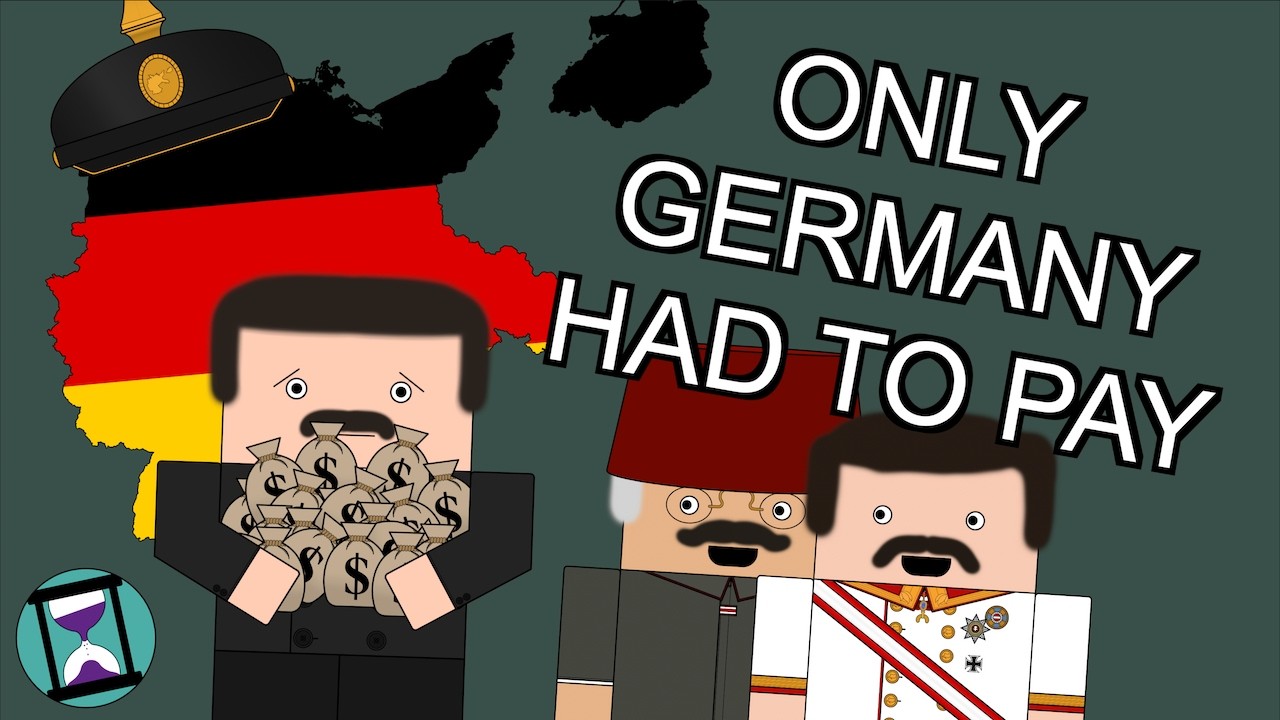

Germany's WWI reparations are one of the most debated topics in modern history — but here's what often gets lost: Germany wasn't the only country that lost the war. Austria-Hungary, Bulgaria, and the Ottoman Empire all fought alongside Germany as the Central Powers, and all of them lost too. So why did only Germany have to pay reparations after World War 1? The short answer is brutal and surprisingly simple: the others either fell apart, went completely broke, or — in Turkey's case — fought their way out of it entirely.
Who Were the Central Powers in World War 1?
Before diving into the reparations question, it helps to know who was actually on Germany's side. The Central Powers consisted of four states: Germany, Austria-Hungary, Bulgaria, and the Ottoman Empire. Austria-Hungary was technically two kingdoms sharing a monarch and a handful of joint ministries, which would later become a massive headache for anyone trying to assign blame — and a bill — after the war.
 00:45
Map showing the territorial losses imposed on Germany under the Treaty of Versailles
Watch at 00:45 →
00:45
Map showing the territorial losses imposed on Germany under the Treaty of Versailles
Watch at 00:45 →
When the war ended in 1918, the victorious Allied powers — primarily Britain, France, Italy, and the United States — gathered in Paris to decide what surrender actually looked like for each of these defeated nations. Rather than one sweeping agreement, they hammered out five separate treaties, one for each of the Central Powers (with Austria and Hungary counted separately given the dissolution of their empire). The most famous of these was the Treaty of Versailles, aimed squarely at Germany.
What Did the Treaty of Versailles Actually Demand?
The Treaty of Versailles stripped Germany of significant territory, dismantled the bulk of its military capability, and — most infamously — forced it to accept financial reparations for the damage caused during the war. Crucially, the exact amount wasn't specified in the treaty itself. That figure would be decided later, which became something of a running theme across all five peace settlements.
Germany was in a uniquely enforceable position compared to its former allies. Its government and state institutions, while changed from imperial to republican, remained intact. The country was still recognizably Germany — same borders, same bureaucracy, same infrastructure to tax and squeeze. That made it a viable target for repayment in a way the others simply were not.
03:10
The fragmented successor states that emerged from the collapse of Austria-Hungary
Watch at 03:10 →
Why Did Only Germany Pay WWI Reparations?
The answer lies in what happened to each of the other Central Powers after the war ended. One by one, each nation either collapsed, lost so much territory it became economically useless, or managed to escape the peace process entirely through armed resistance. Germany, standing largely intact as a functioning state, became the one party the Allies could realistically hold accountable.
Austria and Hungary: Broke, Broken, and Barely Surviving
The Austro-Hungarian Empire didn't just lose the war — it ceased to exist. By the time the dust settled, the empire had fragmented into a collection of successor states: a shrunken Austria, a devastated Hungary, and newly independent nations like Czechoslovakia, Poland, and Yugoslavia claiming chunks of the old imperial territory.
Under the Treaty of Saint-Germain-en-Laye, Austria was designated the successor state to the western half of the empire and told it would have to pay reparations. The Allies even made a point of forbidding Austria from calling itself "German Austria" and explicitly banned any future union with Germany — a proposal that had genuinely alarmed the victorious powers. But on the matter of actual payment? The Allies knew they were never getting a cent. One in three Austrians lived in Vienna, and there weren't enough agricultural workers to feed the population. The country was staring down mass impoverishment. Pressing Vienna for cash would have simply accelerated a collapse, so the Allies quietly agreed to forget about it.
Hungary's situation was even grimmer. Its war with Romania and Czechoslovakia continued even after the Habsburg surrender, with Romanian forces advancing deep into Hungarian territory and overthrowing the government. Once the great powers intervened, installed a negotiable government, and got a treaty signed, the result was catastrophic for Hungary: it lost 70% of its land and 65% of its population under the Treaty of Trianon. Like Austria, Hungary was told reparations were owed — and like Austria, everyone involved understood that Hungary was in no position to pay them. Its neighbors would simply have to settle for the massive territorial gains instead.
06:20
Ottoman territory before and after the Treaty of Sèvres compared to the final Treaty of Lausanne borders
Watch at 06:20 →
Did Bulgaria Actually Pay WWI Reparations?
Bulgaria is the one partial exception in this story. Unlike the Austro-Hungarian successor states, Bulgaria remained a functioning state after the war and was in a position where the Allies could actually enforce terms against it. Under the Treaty of Neuilly-sur-Seine, Bulgaria was forced to cede territory to Serbia and Greece, dramatically limiting its access to key ports, and its military was sharply curtailed.
Bulgaria was also made to pay reparations — but the sum was a tiny fraction of what Germany faced. More distinctively, Bulgaria had to hand over physical goods: a set amount of coal, cattle, and other commodities delivered directly to its neighbors as restitution in kind. Combined with the loss of its ports and the economic strain of absorbing hundreds of thousands of demobilized soldiers, Bulgaria's economy took a severe hit and the country became increasingly impoverished and politically radicalized. The Allies eventually reduced and then cancelled Bulgaria's financial obligations through the 1920s, following a pattern similar to the gradual unwinding of Germany's own reparations schedule.
What Happened to Austria-Hungary After WWI?
Beyond the reparations question, the dissolution of Austria-Hungary created a thorny problem of assigning blame in the first place. When Czechoslovakia declared independence, it took a substantial chunk of the old empire's industrial base with it. Telling the Czechs they could have their freedom but also owed reparations to Italy and Romania for their factories' role in the Habsburg war effort would have been a genuinely impossible sell. The fragmentation of the empire made collective punishment logistically incoherent, so the Allies focused blame on Austria as the designated successor state and largely moved on.
What Happened to the Ottoman Empire After WWI?
The Ottoman Empire's post-war story is perhaps the most dramatic of all the Central Powers. The initial peace terms — the Treaty of Sèvres — were crushing. Ottoman territory was reduced to a rump state in Anatolia, the military was gutted, and the Allies carved out zones of economic influence, while the strategically vital Dardanelles were placed under international control. As for reparations, the Allies quickly realized they were holding most of the Ottoman Empire's former revenue-generating territory themselves. Britain and France effectively paying reparations to themselves made no sense, and they calculated that Istanbul would need loans just to stay afloat, not payments going the other way.
But the real twist came from Ankara. A rival nationalist government under Mustafa Kemal refused to accept Sèvres or any of its terms. The Allies, exhausted from four years of war, had no appetite for another major military campaign in Anatolia. Britain's dominions — with the sole exception of New Zealand — refused outright to send troops, triggering a political crisis that brought down the British government. The Turkish nationalists, meanwhile, successfully drove out French, Armenian, and Greek forces over several years of fierce fighting.
The result was the Treaty of Lausanne in 1923, which replaced Sèvres entirely. Turkey received far more favorable borders, the punishing economic clauses were dropped, and — most remarkably — the Allies formally agreed that Turkey bore no blame for World War 1. With that declaration, any possibility of Ottoman or Turkish reparations vanished permanently.
The Bottom Line: Why Germany Paid Alone
When the Allies finally sat down to calculate what they were actually owed, the math was bleak. Bulgaria had handed over a modest amount of goods and a small financial sum before payments were cancelled. Hungary and Austria had transferred some raw materials briefly before the Allies accepted the obvious: there was nothing left to extract. Turkey had fought its way to a clean slate. That left Germany — intact, governable, and holding the bag for the entire Central Powers coalition.
- Bulgaria paid a small fraction of Germany's burden, mostly in goods, before payments ended in the 1920s.
- Austria was declared too broke to pay and the obligation was quietly dropped.
- Hungary lost so much territory that reparations were effectively replaced by land transfers to its neighbors.
- The Ottoman Empire / Turkey fought its way out and was officially declared blameless by the Allies.
- Germany remained a functioning, enforceable state and bore virtually the entire financial burden as a result.
It's one of the more ironic footnotes of the post-war settlement: Germany's strength as a surviving state — the very thing that made it a formidable enemy — was also what made it the only Central Power the victors could realistically squeeze for decades to come.