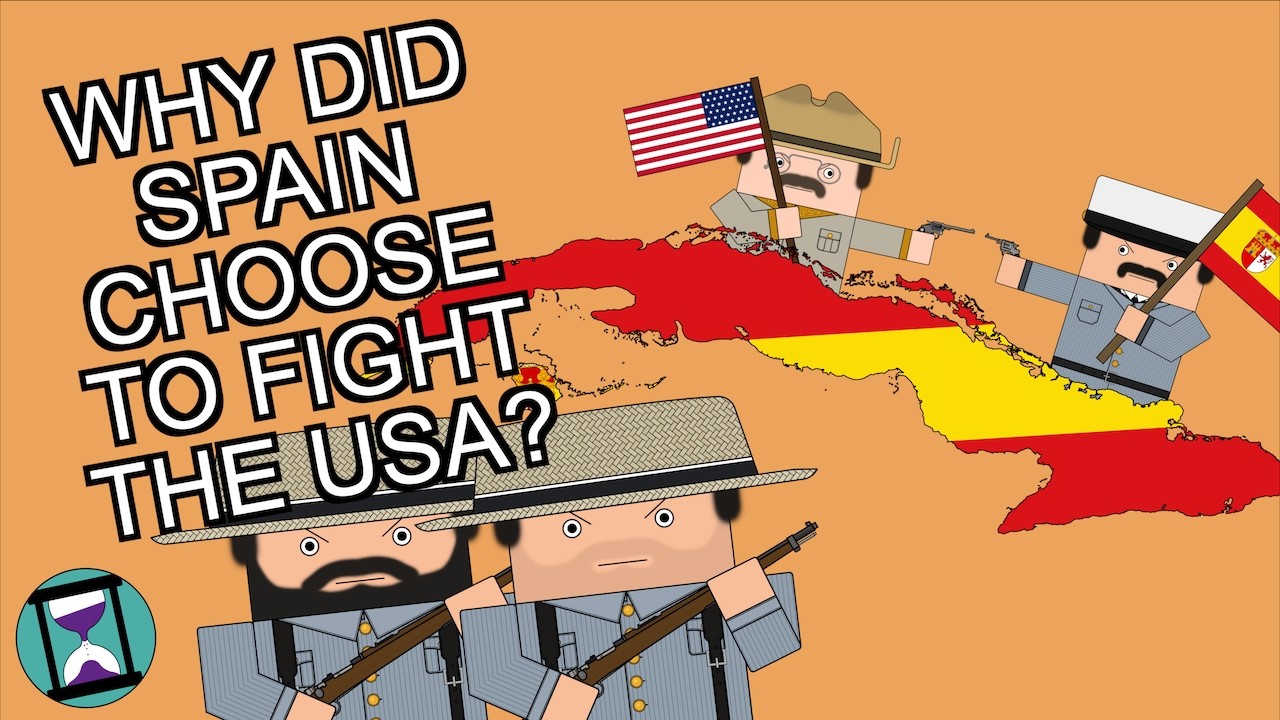
Why did Spain declare war on the United States in 1898, knowing full well it was almost certainly going to lose? At first glance, it seems like one of history's strangest decisions. Spain was a declining empire, its military was stretched thin across two colonial rebellions, and the United States was by nearly every measure a far more powerful nation. And yet, when the US implemented a naval blockade of Spanish Cuba — itself an act of war — Spain formally declared war rather than back down. The reasons behind that decision are a fascinating mix of military pressure, political survival, national pride, and a series of diplomatic miscalculations that would cost Spain everything.
What Were the Main Causes of the Spanish-American War?
By the 1890s, what remained of Spain's once-vast empire was under serious strain. Cuba — long considered the crown jewel of Spanish imperial holdings — was in open revolt, as was the Philippines. Spain had sent enormous numbers of troops to both regions, and the brutal wars of independence were draining its treasury and military manpower. Disease and malnutrition were taking a devastating toll on Spanish soldiers stationed in the tropics.
Back in the United States, public opinion was shifting rapidly in favor of intervention. Newspaper coverage — much of it sensationalized — painted a vivid picture of Spanish cruelty toward Cuban civilians. A riot in Havana, the explosive sinking of the USS Maine in Havana harbor, and a leaked letter from Spain's ambassador insulting President McKinley all poured fuel on the fire. Congress began setting aside large sums for a potential war, and US senators were openly condemning Spain in public speeches.
Meanwhile, President McKinley — who was at least partially opposed to war — was trying to negotiate a diplomatic resolution. He pushed for a ceasefire between Spain and the Cuban rebels, which Spain technically agreed to in early April 1898. But the agreement fell apart almost immediately when it became clear that Spain interpreted the ceasefire as the end of the rebellion, while the United States interpreted it as the beginning of Cuban independence. Those are very different things, and there was no bridging that gap.
Why Did Spain Choose to Fight the US in 1898?
So why did Spain declare war rather than simply handing Cuba over and walking away with its other colonies intact? The answer comes down to several overlapping pressures that left Spanish politicians feeling like war was actually the least bad option available to them.
The Military Demanded It
Prime Minister Mateo Sagasta was personally open to granting Cuba greater autonomy within the Spanish Empire as a compromise. But high-ranking military officers in Madrid made it crystal clear that any negotiated settlement — any deal that looked like backing down — would be seen as a direct affront to Spain's national honor. The army would not tolerate it. That kind of implicit threat from the officer class was a powerful motivator for civilian politicians who needed the military's loyalty to stay in power.
The Political Survival Calculation
Spanish political leaders weren't naive. They understood that abandoning Cuba — the birthplace of the Spanish Empire and a cornerstone of national identity — without a fight would cause a public outrage that could destabilize the government and potentially spark a revolution. And as tensions escalated, this pressure only grew. Just as in America, the Spanish public was becoming increasingly pro-war, partly because military and political figures were publicly promoting the idea that Spain could actually win — or at least fight honorably.
Behind closed doors, many Spanish politicians and naval officers privately knew that victory was extremely unlikely. But admitting that publicly was politically impossible.
The Hope for a Face-Saving Defeat
Some in Madrid calculated that even if Spain lost, going down fighting would be far less damaging to national honor than surrendering without firing a shot. There was also a hope — which turned out to be completely wrong — that a fierce enough Spanish resistance would inflict enough casualties on the Americans to turn US public opinion against the war, forcing Washington into a compromise peace that might let Spain keep the Philippines and perhaps even some dignity.
How Did Spanish and US Military Power Compare in 1898?
The military balance of power in 1898 was not as one-sided as it might seem on paper — at least not in every category. The United States had a far larger population, a significantly more modern and productive economy, and access to resources Spain couldn't dream of. But its standing army was only around 30,000 soldiers, compared to roughly a quarter of a million in the Spanish military.
Of course, the vast majority of Spain's army was already deployed in Cuba and the Philippines, exhausted, diseased, and far from home. The Spanish navy was similarly divided across three theaters — Cuba, the Philippines, and Spain itself — making it nearly impossible to concentrate forces effectively. The US Navy, meanwhile, had more modern ships and could focus its strength where it mattered most.
One factor that gave some European observers pause was the belief that because the US lacked a long naval tradition and had no experience with major fleet battles, it would be at a disadvantage against Spain at sea. As history would quickly prove, this was a catastrophic miscalculation.
Did Europe Try to Help Spain Against the United States?
One of the biggest miscalculations Spain made was betting that the European great powers would step in to prevent the United States from swallowing a major chunk of the world's remaining colonial territory. That hope was largely a fantasy.
Britain: Firmly in America's Corner
Britain was bluntly uninterested in helping Spain. The British largely viewed Spain as a backwards, declining power whose day had long passed. More importantly, Britain was actively improving its relationship with Washington and was enthusiastic about seeing another English-speaking power rise to global prominence. If embarrassing Spain was part of that process, the British were perfectly fine with it.
France: Worried but Helpless
France watched the approaching war with genuine alarm. A victorious United States gaining Cuba, Puerto Rico, and especially the Philippines would create a new imperial naval power with a foothold in Asia and an even tighter grip on the Americas — dangerously close to France's own growing imperial interests. The French were also worried the US would develop an appetite for further expansion into Africa.
But France couldn't do anything about it. Going to war with the United States would risk weakening France and giving its European rivals an opening, and the US was a major trading partner France couldn't afford to alienate. France's best move was quiet diplomacy — trying to broker an early peace or push the Americans to settle for less. The US flatly rejected any European interference.
Germany: Playing a Longer Game
Germany's approach was the most calculating of all. Berlin worried that a Spanish defeat might topple the Spanish monarchy, which could weaken monarchism across Europe more broadly. Germany pushed Austria, Russia, Italy, and Britain to collectively back Spain's continued colonial presence — and all of them refused.
Knowing Spain was probably doomed, Germany then pivoted to positioning itself to pick up the pieces, particularly eyeing the Philippines. Its fleet shadowed the American one in the Pacific, hoping to convince the US that taking the islands would upset the European balance of power enough to force a German-Russian-French-Austrian alliance against American and British interests. The US ignored this entirely, and Britain's indifference to Germany's concerns meant the whole gambit went nowhere.
What Did Spain Lose After the War Ended?
The Spanish-American War was short and utterly devastating for Spain. After a string of American military victories on land and sea, the Spanish government openly pleaded for peace. The United States — winning decisively and with no reason to settle early — agreed only when it was ready.
The Treaty of Paris, signed in December 1898, forced Spain to give up Cuba, Puerto Rico, the Philippines, and Guam. In one brief conflict, Spain lost the last significant remnants of an empire it had built over four centuries.
What Was the Long-Term Impact on Spain After 1898?
The political hope in Madrid — that fighting honorably would at least preserve some national dignity — proved completely hollow. Spain's international prestige was permanently and severely damaged. The loss became known in Spain simply as El Desastre — The Disaster — and it sparked a cultural and intellectual crisis that would shape Spanish society for decades.
Ironically, the revolution that Spanish politicians feared would happen if they backed down without fighting never materialized anyway. The monarchy survived. But Spain's place as a world power was over — definitively, undeniably, and permanently. The decision to fight, rather than negotiate, had taken everything Spain was hoping to protect and destroyed it anyway.