
A small YouTube channel called Conduit — with fewer than 3,000 subscribers — spent one dedicated week watching Hassan Piker's streams and caught something that has left many viewers stunned: Piker, who presents himself as a leading voice on Middle Eastern politics and the Israel-Palestine conflict, openly admitted on stream that he knows nothing about the Western Wall. Not the politics surrounding it. Not even what it is.
What Hassan Actually Said
During a stream, Piker stated that the Western Wall is the one thing about Judaism he simply does not know. He called it "just a wall" and told his audience to "calm down" about it, while in the same breath listing Sukkot traditions as evidence of his "deep lore" on Judaism.
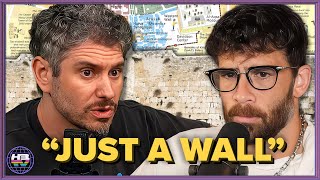 01:15
Hassan on stream saying he doesn't know what the Western Wall is and dismissing it as 'just a wall'
Watch at 01:15 →
01:15
Hassan on stream saying he doesn't know what the Western Wall is and dismissing it as 'just a wall'
Watch at 01:15 →
To be clear about what Piker was dismissing: the Western Wall is the last remaining structure of the Second Temple, built roughly 2,000 years ago. It is the closest accessible point to the inner sanctum where, according to Jewish tradition, God himself dwelt. It is the holiest site in Judaism. People travel from every corner of the world to pray there. Children fold handwritten wishes and press them into its ancient stones. It is not a footnote — it is the literal center of the conflict Piker claims to analyze every single day.
Why This Matters for the Conflict He Claims to Understand
The Western Wall sits inside the Old City of Jerusalem, which is divided into four historic quarters: Jewish, Muslim, Christian, and Armenian. Immediately above the Wall is the Temple Mount — the third holiest site in Islam, where Muhammad is said to have ascended to heaven. Steps away is the Christian Quarter, home to the Church of the Holy Sepulchre, where Jesus is said to have been both crucified and resurrected.
03:20
Map or visual of the Old City of Jerusalem showing the Jewish, Muslim, Christian, and Armenian quarters
Watch at 03:20 →
This single patch of ancient city is the most religiously contested ground on Earth. Every serious negotiation over Israeli-Palestinian peace has stumbled, at least in part, over what to do with Jerusalem — specifically who controls these holy sites. The Western Wall and Temple Mount are not background detail. They are the central sticking point. If you do not understand why these walls matter, you do not understand the conflict.
Piker also wondered aloud why Christians visit the Wall and cry, speculating that it is political virtue signaling in support of Israel. The actual answer is straightforward: Jesus taught inside the Temple walls. The Old Testament is foundational to Christianity. These are sacred sites to Christians for entirely religious reasons that predate modern Israeli statehood by two millennia.
A Pattern of Confident Ignorance
This was not an isolated stumble. An older clip resurfaced alongside the Conduit video showing Piker attempting to locate Yemen on a map — a country whose Houthi movement he had loudly championed, describing himself as "ten toes down" in support. He clicked through Israel, Iran, Iraq, Jordan, Syria, and Saudi Arabia before eventually landing near the correct region only after exhausting nearly every other option.
09:45
Hassan attempting to locate Yemen on a map, clicking multiple wrong countries including Israel
Watch at 09:45 →
Piker has claimed to have been passionate about and engaged with Middle Eastern politics for over a decade. That timeline makes the Yemen geography clip difficult to excuse as a youthful lapse — and it makes the Western Wall admission worse, not better. He has had years to fill these gaps. He has not.
The Double Standard
What compounds the problem is not just the ignorance — it is the tone. Piker dismissed the holiest site in Judaism as "just a wall" and told people to calm down about it. It is worth asking whether he would apply that same casual dismissiveness to an Islamic landmark. The Al-Aqsa Mosque sits on the same Temple Mount. Would Piker shrug and say "it's just a dome, calm down"? The answer is obviously no — and that asymmetry is itself the story.
Proudly stated ignorance about Jewish religious sites, paired with fluent outrage about perceived disrespect toward Islam, is not a neutral position. It is a bias expressed through what a person chooses to learn and what they feel comfortable not knowing.
The Credibility Problem
None of this means every opinion Piker holds on the conflict is wrong. But credibility on a topic this sensitive and this complex requires actual knowledge of the terrain — literally and figuratively. A commentator who does not know where Yemen is, does not know what the Western Wall is, and responds to that ignorance with a shrug rather than curiosity has not earned the platform of authority he occupies.
The Conduit video, made by a creator with under 3,000 subscribers who simply sat down and watched for a week, did more rigorous accountability journalism on this than most outlets bother to attempt. That, too, says something.