
Twitch's leadership team found itself in a self-inflicted crisis after its director of partnerships sent a recruitment-style email to a Kick streamer named Cuffam — a creator whose entire public profile consists of openly antisemitic, racist, and genocidal statements — just one week before Twitch CEO Dan Clancy was scheduled to testify before a congressional oversight committee on platform extremism.
Who Is Cuffam?
Cuffam is a Kick streamer whose content went viral multiple times in the months leading up to the Twitch outreach. The clips tell a consistent story. In one, recorded approximately three months before the Twitch email, he said on stream: "Kill all Jews. All I want to see is 1,000 nukes bombing Israel." He prefaced this by explicitly stating he didn't care who was right or wrong in any geopolitical context — ruling out any charitable interpretation.
In a separate clip from July, he directed a racial slur at another streamer repeatedly and on camera. Most recently — and most visibly — he went viral for waving a Nazi flag on stream and stating, unprompted, "Hitler was right."
 02:10
Clip of Cuffam waving a Nazi flag and saying 'Hitler was right' on stream
Watch at 02:10 →
02:10
Clip of Cuffam waving a Nazi flag and saying 'Hitler was right' on stream
Watch at 02:10 →
These clips were not obscure. They circulated widely across streaming and social media communities. The Nazi flag clip alone generated enough attention to bring Cuffam to mainstream awareness within days.
The Email
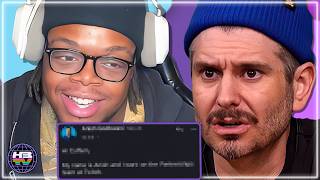
Shortly after the Nazi flag clip went viral, Cuffam shared a screenshot on stream of an email he had received from Twitch. The sender was Anish Godwani, identified as Twitch's director of partnerships — a senior executive who reports directly to the CEO.
05:45
Screenshot of the Twitch partnership email from Anish Godwani to Cuffam
Watch at 05:45 →
The email read: "Hi Cuffam, my name is Anish and I work on the partnership team at Twitch. If you're open to it, I'd like to have a 10–15 minute call to introduce myself. I know a few members of our partnership team have reached out in the past, but my understanding is that they never heard back. Let me know if Discord is the best way to connect."
Several details make the email difficult to explain away. First, it came from the director of the department — not a junior recruiter. Second, the email explicitly acknowledges that Twitch had made multiple prior attempts to contact Cuffam, framing the director's personal outreach as an escalation. Third, Cuffam does not stream on Twitch at all — he has no presence on the platform and has publicly stated he has no interest in joining it.
Twitch's Response Made Things Worse
After the email became public, Twitch's VP of partnerships, Pontus Eskilsson, posted a statement on social media attempting to reframe the situation.
09:20
Tweet from Twitch VP of Partnerships Pontus Eskilsson clarifying the email's intent
Watch at 09:20 →
His statement read: "To be clear, this was not a recruitment email. We were setting up a call to discuss Twitch policies. We need to revisit the wording we use for these emails."
The statement backfired in two ways. First, it confirmed the email was real — eliminating any possibility that Cuffam had fabricated the screenshot. Second, the alternative explanation it offered was arguably more damaging: if the call was truly about policy, why was Twitch's director of partnerships personally cold-calling a creator who doesn't stream on their platform, referencing multiple failed outreach attempts, and asking which messaging app is most convenient for him? The email's subject line was "Call with Partnerships." The email opened by identifying the sender as working in partnerships. Claiming it had nothing to do with recruitment while simultaneously saying the wording needed to be revised amounts to a public acknowledgment that the framing was misleading.
There is also a structural awkwardness in the response: a VP publicly criticizing the email written by the director, who holds a nominally higher or equivalent position depending on Twitch's internal hierarchy.
The Timing and the Pattern
The outreach occurred approximately one week before Dan Clancy was scheduled to appear before a congressional committee to address concerns about extremism on Twitch. That context transforms an embarrassing story into a potentially consequential one. Platform leadership actively attempting to recruit a creator who had called for the nuclear annihilation of an ethnic group — on the eve of testimony about platform safety — is not a minor PR stumble.
The situation is compounded by a separate controversy involving Twitch's former head of diversity marketing, Bridget Chermak, who had previously posted an antisemitic joke to her public account. That incident, combined with the Cuffam recruitment attempt, suggests that Twitch's problems with antisemitic content are not limited to what appears on streams.
Cuffam himself, for his part, rejected the outreach. He has said publicly he has no intention of moving to Twitch and appears content remaining on Kick, where his content faces no apparent consequences.
What This Actually Reveals
Setting aside the antisemitism entirely — which cannot and should not be set aside, but for the sake of argument — the episode illustrates a fundamental competency failure at the executive level of one of the world's largest streaming platforms. The director of partnerships personally escalating outreach to a creator with a documented, publicly viral history of hate speech, on the eve of a congressional hearing specifically about hate speech on the platform, represents a collapse in basic institutional awareness.
Whether the intent was recruitment or policy discussion, the outcome is the same: Twitch's most senior partnership executive handed a documented antisemite what amounts to a public endorsement, told the world that Twitch had been chasing him for some time, and gave congressional critics fresh material days before testimony was due. The VP's attempt to walk it back confirmed the email's authenticity while offering an explanation that satisfied no one.
The streaming industry has long debated where platform responsibility ends and creator autonomy begins. This case doesn't really touch that debate. It's something simpler: a leadership team that apparently did not know — or did not care — what its own director was doing in their name.